

Key Takeaways
Why Multi-Climate Packing Requires a Different Mindset
Single-destination trips let you pack for one climate and stop thinking. A multi-region US itinerary — the kind that might take you from the Sonoran Desert to the Colorado Rockies to the Oregon Coast — demands a more deliberate approach. The challenge isn't just temperature range; it's the unpredictable microclimates that exist even within a single region. San Francisco's famous fog means summer highs can sit in the low 60s°F while cities 50 miles inland hit 95°F on the same afternoon.
The travelers who struggle most are those who try to pack complete outfits for each climate zone. That approach fills a bag fast. The travelers who manage best think in systems and components — pieces that combine and recombine to meet whatever conditions they encounter. If you're still deciding which type of trip suits you, the city break vs. nature escape guide can help clarify what activities to plan around before building your packing list.
Use Weather Apps by Specific City
National or regional forecasts can miss the sharp differences between, say, San Francisco's foggy coast and the hot Central Valley just 90 miles inland. Before finalizing your packing list, check a 10-day forecast for every individual city on your itinerary. A short detour in elevation or geography can shift the required wardrobe by 20–30°F.
For a fuller view of pre-departure preparation, the pre-trip planning checklist covers everything from documents to contingency planning alongside packing decisions.
What to Pack and How to Pack It
The steps below walk through a proven approach for assembling a multi-climate kit that stays carry-on viable for trips up to 10 days. The foundation is a capsule wardrobe built on the layering principle, supported by smart accessory choices and mid-trip laundry planning.
What you will need
Packing cubes
Organize clothing by category or destination leg, making items easy to find and re-pack quickly.
Compression bags
Compress bulky items like fleece jackets or sweaters to reclaim usable bag space.
A lightweight daypack
Carries daily essentials during excursions without checking a larger bag in and out of accommodation.
Laundry sheets or travel detergent pods
Allows mid-trip hand-washing, reducing how many clothing items you need to carry overall.
Map Your Climate Zones First
Before touching your suitcase, write down each destination and its climate type: desert, alpine, humid coastal, arid plateau, subtropical. A trip that moves from Phoenix to Denver to Seattle in one week crosses three meaningfully different climate zones. Identify the temperature ranges and precipitation patterns for each leg, then note overlaps — a lightweight merino base layer, for instance, works from desert nights to Pacific Northwest mornings.
Build a Capsule Wardrobe Around Neutrals
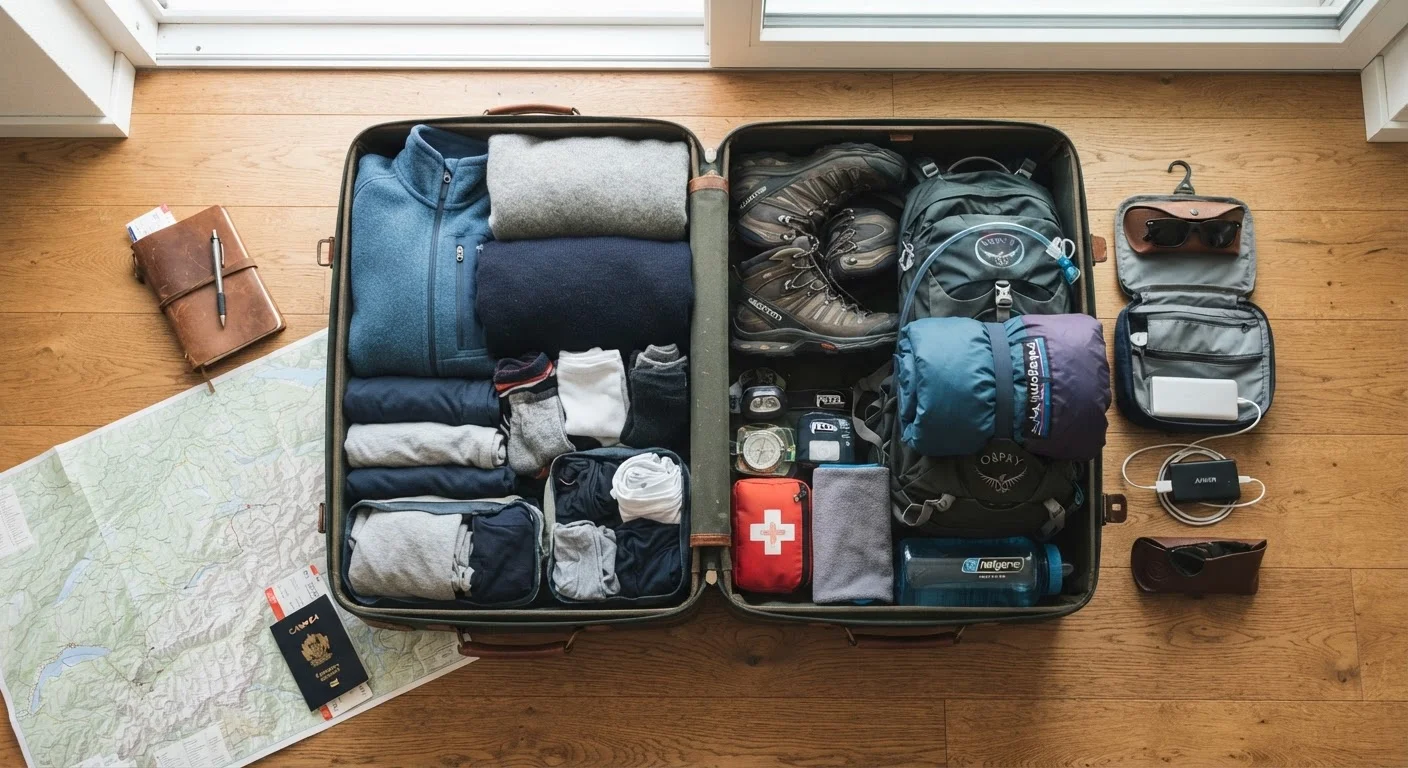
Choose clothing in two or three neutral colors that mix and match freely. A typical multi-climate capsule might include: three to four tops (moisture-wicking or merino), two pairs of pants (one lightweight hiking, one versatile casual), one mid-layer fleece, one packable outer shell, and one set of smart-casual clothes for city evenings. Every item should be wearable in at least two of your climate zones.
Apply the Three-Layer System
The layering system used by outdoor travelers translates directly to multi-climate packing. Base layer: a moisture-wicking shirt or thermal that sits against your skin. Mid layer: a fleece or light down jacket that traps warmth. Outer layer: a packable, weather-resistant shell. You'll rarely need all three in a hot desert, but in the Rockies or the Pacific Northwest, this stack can handle wide swings in a single day. These three pieces together weigh and pack lighter than a single heavy coat.
Limit Footwear to Three Pairs with Overlapping Use
Shoes consume more space and weight than almost any other category. A workable three-pair framework for multi-climate US travel: a trail or light hiking shoe that handles uneven terrain and city walking, a casual sneaker or slip-on for urban settings and warmer legs, and waterproof sandals that serve beaches, hostel showers, and warm-weather cities. Resist the temptation to add a fourth pair for a single dinner or a single beach afternoon.
Pack Accessories That Double as Climate Tools
A lightweight buff or neck gaiter can substitute for a hat, scarf, or dust mask across desert, mountain, and cold-coast environments. A packable wide-brim hat protects in high-altitude sun and subtropical humidity. A compact umbrella handles coastal drizzle without the weight of a full rain jacket. These small accessories bridge the gaps between climate zones at minimal bulk cost.
Use Packing Cubes and Plan a Mid-Trip Laundry Stop
Divide your bag into climate-specific cubes: one for warm-weather items, one for cold-weather layers. As you move between destinations, you access only the relevant cube rather than unpacking everything. If your trip exceeds seven days, plan one laundry stop — either at a coin laundry or by hand-washing a few items overnight. This single step can cut the total clothing you carry by one-third.
Don't Pack for Worst-Case Every Leg
Packing every contingency item for every climate — heavy rain gear for the desert, thick down for coastal Florida — leads to an unmanageable bag. Focus on the most probable conditions for your trip dates and plan for layering to bridge the gaps. Overpacking is one of the most common and avoidable travel mistakes.
Verify Airline Baggage Rules Before You Pack
Carry-on size and weight restrictions vary between airlines and fare classes. A bag that clears one carrier's overhead bin may be gate-checked on another. Confirm the specific rules for every flight segment on your itinerary — especially if you're mixing full-service carriers with regional or budget operators — before you finalize how much you're bringing.
If your itinerary is still taking shape, the anatomy of a well-built itinerary explains how to structure your days in a way that also informs practical decisions like what gear you'll actually use. Timing your trip around shoulder seasons — when crowds thin and conditions moderate — can also simplify the climate range you need to pack for. See the regional shoulder season overview for a destination-by-destination breakdown.