

Key Takeaways
Start here
What Actually Defines a Muscle Car
Next
The Golden Era: 1960s and 1970s
Then
Muscle Cars vs. Sports Cars: A Common Confusion
When you're ready
What to Consider Before Owning One
What Actually Defines a Muscle Car
The term muscle car gets applied loosely in everyday conversation, but automotive historians generally agree on a fairly specific definition: a mid-size, two-door American coupe powered by a large-displacement V8 engine and sold at a mainstream price. The formula is about accessible performance - serious power without requiring a luxury budget.
Displacement
The total volume swept by all the pistons inside an engine's cylinders, usually measured in liters or cubic inches. Larger displacement generally means more potential power and torque.
V8 engine
An engine with eight cylinders arranged in a V-shape. V8s are associated with high power output and a distinctive exhaust sound, and have been the traditional heart of American muscle cars.
Torque
A measure of rotational force - essentially how hard the engine twists the drivetrain. High torque at low rpm produces the strong, immediate acceleration associated with muscle cars.
Pony car
A subcategory of American performance car - smaller and lighter than a true muscle car, and typically more affordable. The Ford Mustang is the original pony car, introduced in 1964.
Rear-wheel drive (RWD)
A drivetrain layout where engine power is sent to the rear wheels only. Most traditional muscle cars use RWD, which contributes to their characteristic hard-launch feel.
Horsepower (hp)
A unit measuring how much work an engine can do over time. In practical terms, it determines a car's top speed potential and sustained high-speed performance.
Three elements need to be present for most definitions to apply: the V8 (or equivalent high-displacement) engine, the affordable price positioning, and the American-made identity. Remove any one of those and the vehicle typically falls into a different category - supercar, sports car, or simply a performance trim of a standard sedan.
This definition matters when you're reading a spec sheet or comparing models. Understanding the genre also helps when exploring how different vehicles are designed for different purposes - something covered in depth in our guide to how body style shapes your daily drive.
The Golden Era: 1960s and 1970s
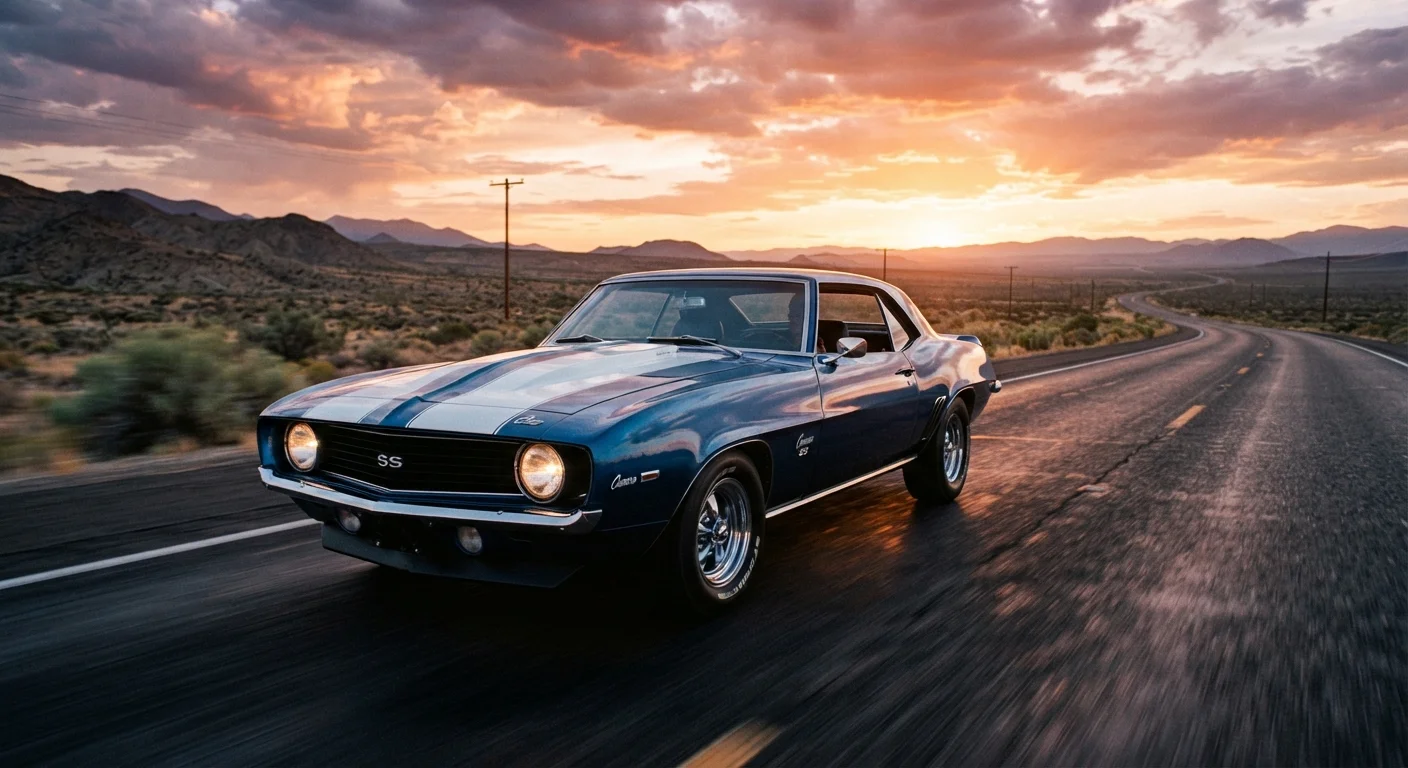
The muscle car genre is generally traced to 1964, when Pontiac installed a large-displacement V8 into its mid-size Tempest platform to create the GTO - widely credited as the first true production muscle car. The move triggered a horsepower arms race among American manufacturers that lasted nearly a decade.
Throughout the late 1960s, models such as the Chevrolet Chevelle SS, Dodge Charger, Plymouth Road Runner, and Buick GS all competed on horsepower figures, quarter-mile times, and striking styling. Engines in this era commonly displaced 396, 426, or 440 cubic inches - roughly 6.5 to 7.2 liters by modern measurement - producing outputs that were impressive even by contemporary standards.
The era came to an abrupt halt. The 1973 OPEC oil embargo made large-engine vehicles expensive to operate. Simultaneously, new federal emissions standards and skyrocketing insurance premiums for high-performance cars pressured manufacturers to detune engines or discontinue models entirely. By the mid-1970s, the golden era was effectively over.
The Modern Muscle Car
A genuine revival began in the mid-2000s. Ford relaunched a retro-styled Mustang in 2005, Chevrolet brought back the Camaro in 2010 after a hiatus, and Dodge committed to keeping the Challenger in production with increasingly powerful Hellcat and Redeye variants pushing well beyond 700 horsepower in some configurations.
Check the Trim Level for Real Specs
Muscle car nameplates often span a wide range of engine options - a base V6 Mustang and a Shelby GT500 carry the same badge but deliver very different performance. Always look at the specific trim and engine code when comparing models, not just the model name.
Modern muscle cars are substantially more sophisticated than their predecessors. Electronic stability control, multi-mode traction management, launch control systems, and significantly improved braking technology make them safer and more manageable than raw horsepower figures might suggest. Fuel economy, while still modest, improved considerably through direct injection and cylinder deactivation technology.
The category is also beginning to absorb electric powertrains. Dodge's Charger Daytona concept introduced an EV platform explicitly positioned within muscle car identity - acknowledging that instant electric torque can serve the genre's core acceleration-first philosophy. How this evolution unfolds will be shaped in part by broader model year changes across the industry; our article on what changes between vehicle model years explains how to track those shifts.
Muscle Cars vs. Sports Cars: A Common Confusion
The two categories are frequently conflated, but they represent distinct engineering philosophies. A sports car is typically lighter, smaller, and engineered for handling precision - think balanced cornering, responsive steering, and a driver-focused cockpit. Performance comes from agility as much as outright power.
A muscle car, by contrast, is engineered for straight-line dominance. The platform tends to be heavier, the engine larger and torquier, and the rear-wheel-drive layout optimized for hard launches rather than tight cornering. The buyer profile traditionally valued the visceral experience of raw acceleration over track-day precision.
Both categories contrast sharply with everyday utility-focused vehicles. For a sense of how those broader tradeoffs play out across vehicle types, it's useful to compare muscle cars against the priorities outlined when looking at Toyota's full lineup from sedans to trucks.
What to Consider Before Owning One
Muscle cars carry real ownership implications that are worth understanding before purchase. Fuel consumption is the most immediate: a V8-powered rear-wheel-drive coupe will consume significantly more fuel than a comparable four-cylinder sedan, especially in city driving where the engine rarely reaches an efficient operating range.
High-Power Vehicles Require Careful Operation
Vehicles producing 400-plus horsepower respond far more abruptly to throttle inputs than typical commuter cars, particularly in wet or cold conditions. If you are new to high-performance vehicles, allow time to acclimate in low-traffic environments before driving in demanding situations. Always observe posted speed limits and traffic laws.
Insurance costs on high-performance vehicles are generally higher than on standard models, and vary considerably by driver age, location, and driving history. Tire wear can also be accelerated on higher-powered rear-wheel-drive vehicles depending on driving habits. Maintenance, while manageable on modern examples, should be factored into the total cost of ownership.
For buyers new to the car ownership process entirely, these practical considerations sit alongside the basics covered in our guide to everything you need to know before driving off the lot. The auto ownership hub also offers ongoing guidance once you've made a purchase decision.
None of this is meant to discourage interest in the genre - it's about making an informed choice. Muscle cars occupy a genuinely unique place in American automotive history, and modern versions offer a level of daily usability that their predecessors never could.