

Key Takeaways
Option A
Hawaii
The vast, immersive Pacific archipelago with volcanic drama.
Best for: Travelers seeking diverse landscapes, outdoor adventure, and a deep cultural experience across multiple islands.
Option B
US Virgin Islands (USVI)
The compact, Caribbean-flavored US territory with effortless access.
Best for: Travelers wanting a laid-back Caribbean beach getaway without the need for a passport or currency exchange.
If you want maximum landscape diversity in one trip
Hawaii
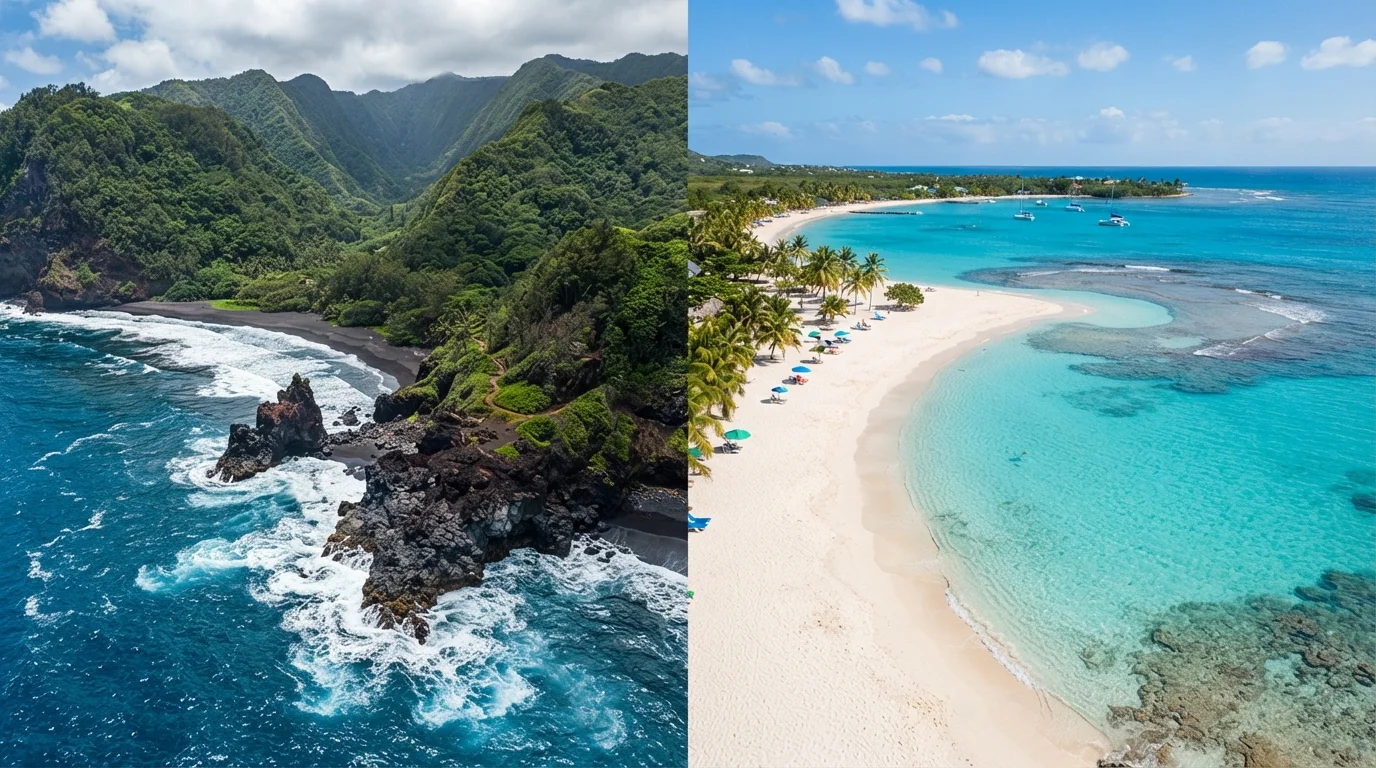
Hawaii's islands offer everything from black sand beaches and active volcanoes to lush valleys and alpine hiking, all within a single destination.
If you want a classic Caribbean beach experience without a passport
US Virgin Islands (USVI)
The USVI delivers turquoise water, sailing culture, and a relaxed island pace — with the convenience of US currency and no passport requirement.
If you're traveling from the US East Coast on a shorter window
US Virgin Islands (USVI)
A 3–4 hour flight from major East Coast hubs makes the USVI a practical choice when time is limited.
If cultural depth and indigenous heritage matter to your trip
Hawaii
Hawaiian culture — language, hula, traditional navigation, and land practices — is a living, prominently present part of everyday island life.
If you're considering a cruise as part of your itinerary
US Virgin Islands (USVI)
St. Thomas is one of the Caribbean's busiest cruise ports, and the USVI integrates naturally into broader Caribbean itineraries — see our Caribbean cruise guide for context.
Getting There: Distance, Flights, and Logistics
One of the most practical differences between these two destinations is how you get there. Hawaii sits roughly 2,400 miles from the US West Coast, meaning nonstop flights from California run about five to six hours — and considerably longer from the East Coast, often requiring connections. It's a genuine long-haul journey by domestic standards.
The US Virgin Islands, by contrast, sit in the northeastern Caribbean, about 1,600 miles southeast of Miami. Nonstop flights from East Coast cities like New York or Miami typically clock in at three to four hours. For travelers based east of the Mississippi, the USVI is significantly more accessible by time and often by cost.
Importantly, neither destination requires a US passport for American citizens, since both are US territories. You'll need a valid government-issued photo ID for Hawaii and a passport or equivalent for the USVI — though US citizens can technically enter the USVI on a government-issued ID alone. Always verify current entry requirements before booking, as rules can change.
If you're still weighing how to structure your travel logistics, our guide to road trips vs. flying covers broader decision factors worth reviewing first.
Landscape and Activities: Volcanic Drama vs. Caribbean Calm
Hawaii's geography is simply unlike anything else in the US. The archipelago stretches across six main visitor islands, each with a distinct character. The Big Island hosts one of the world's most active volcanoes; Maui offers the massive Haleakalā crater alongside lush road-to-Hāna jungle; Kauaʻi is defined by dramatic sea cliffs and rainforest valleys. Visitors can snorkel, surf, hike alpine terrain, or explore lava fields — often within the same trip.
The US Virgin Islands — primarily St. Thomas, St. John, and St. Croix — are smaller in scale but rich in their own way. St. John is notable for having roughly 60 percent of its land protected as Virgin Islands National Park, preserving some of the Caribbean's most pristine coral reef and forested hiking trails. St. Thomas is more developed and commerce-oriented, while St. Croix offers a quieter, historically layered experience.
| Criterion | Hawaii | US Virgin Islands |
|---|---|---|
| Flight time from East Coast | ~10–11 hrs (with connection) | ~3–4 hrs nonstop |
| Geographic scale | 6 major islands, 137 total | 3 main islands |
| Landscape variety | Volcanic, alpine, rainforest, beach | Tropical beach and reef |
| Cultural character | Native Hawaiian / Pacific Islander | Afro-Caribbean / Danish colonial |
| Hurricane risk | Low (outside main belt) | Moderate to high (Jun–Nov) |
| Currency | US Dollar | US Dollar |
| Passport required (US citizens) | No | No (verify current rules) |
| Cruise port access | Limited major cruise routes | Major Caribbean cruise hub |
Where Hawaii leans toward adventure and immersion, the USVI leans toward relaxation, sailing, and reef-focused snorkeling. Neither is objectively better — they serve different travel moods. If you're undecided between an outdoors-driven trip and something more relaxed, our city break vs. nature escape guide may help frame the choice.
Culture, History, and Character
Culture is where these two destinations diverge most sharply. Hawaii has a deeply rooted indigenous culture — the Native Hawaiian tradition of language, navigation, land stewardship, music, and dance is actively preserved and publicly present. Visitors will encounter the hula, hear ʻŌlelo Hawaiʻi (the Hawaiian language) on signs and in schools, and find cultural sites woven into everyday life. It's worth approaching this with genuine curiosity and respect.
The US Virgin Islands carry a markedly different history. The islands were a Danish colony until the US purchased them in 1917, and that layered past — Danish colonial architecture, Afro-Caribbean culture, and American governance — gives the USVI a distinctive character found nowhere else in the US system. The local Crucian and Viginislander cultures are warm and distinct, shaped by generations of Caribbean tradition.
A Note on Cultural Sensitivity in Hawaii
Hawaii has seen growing public conversation about the impacts of mass tourism on Native Hawaiian land, culture, and resources. Some sacred sites and natural areas have restricted or managed access as a result. Visitors are encouraged to research cultural protocols before traveling, respect posted boundaries, and seek out community-led or culturally informed experiences where possible.
Both destinations have a relationship with tourism that locals navigate thoughtfully. Respectful, curious engagement is welcomed in both places — and both benefit when visitors move beyond resort boundaries.
Cost and Practical Considerations
Neither Hawaii nor the USVI is a budget destination. Both carry elevated costs for accommodation, dining, and activities compared to a mainland US trip. Hawaii's multi-island scope can push costs up further if travelers want to visit more than one island, since inter-island flights add to the expense.
~10M
Annual visitors to Hawaii
Hawaii Tourism Authority data indicates visitor arrivals typically range between 9 and 10 million annually in recent pre-pandemic years.
~60%
St. John land area protected
Approximately 60 percent of St. John is preserved as Virgin Islands National Park, one of the Caribbean's most significant protected areas.
1917
Year the US purchased the Virgin Islands
The US acquired the Virgin Islands from Denmark in 1917 for $25 million, primarily for strategic military positioning.
In the USVI, the smaller geographic scale keeps logistics simpler — you can reach St. John from St. Thomas by a short ferry ride. St. Thomas in particular has abundant duty-free shopping, which can offset some costs for certain purchases. US dollars are the currency throughout, which simplifies budgeting for American travelers.
Seasonality is worth factoring in. The USVI falls within the Atlantic hurricane belt, with the most active risk running from roughly June through November. Hawaii is largely outside the main hurricane track, though tropical storms are not unheard of. For the USVI, traveling outside peak hurricane months — or securing comprehensive travel insurance — is a sensible precaution. Before committing to any Caribbean destination, review our pre-booking Caribbean checklist for a fuller set of planning questions.
Both destinations also offer beach experiences quite different from a typical domestic coastal trip — if you're comparing those options, our look at Florida's Gulf vs. Atlantic Coast provides useful contrast for planning purposes.