

Key Takeaways
Option A
Fixed-Rate Mortgage
The predictable, long-term stability choice.
Best for: Buyers who plan to stay in their home long term and want consistent monthly principal and interest payments throughout the loan.
Option B
Adjustable-Rate Mortgage (ARM)
The lower initial rate, variable long-term option.
Best for: Buyers who expect to sell or refinance within a defined timeframe and can tolerate potential payment fluctuations after the initial fixed period ends.
If you plan to own the home for more than seven years
Fixed-Rate Mortgage
Payment certainty over a long horizon protects you from rate increases and makes budgeting more straightforward across decades.
If you expect to sell or refinance within five to seven years
Adjustable-Rate Mortgage (ARM)
You can benefit from the lower initial rate during the fixed period and exit before adjustments expose you to higher costs.
If your budget has little room to absorb a higher monthly payment
Fixed-Rate Mortgage
A fixed payment eliminates the risk that a rate adjustment stretches your budget beyond comfortable limits.
If you expect your income to grow significantly in coming years
Adjustable-Rate Mortgage (ARM)
Starting with a lower ARM payment may be manageable now, with the expectation that future income growth offsets any rate adjustments.
How Each Loan Structure Works
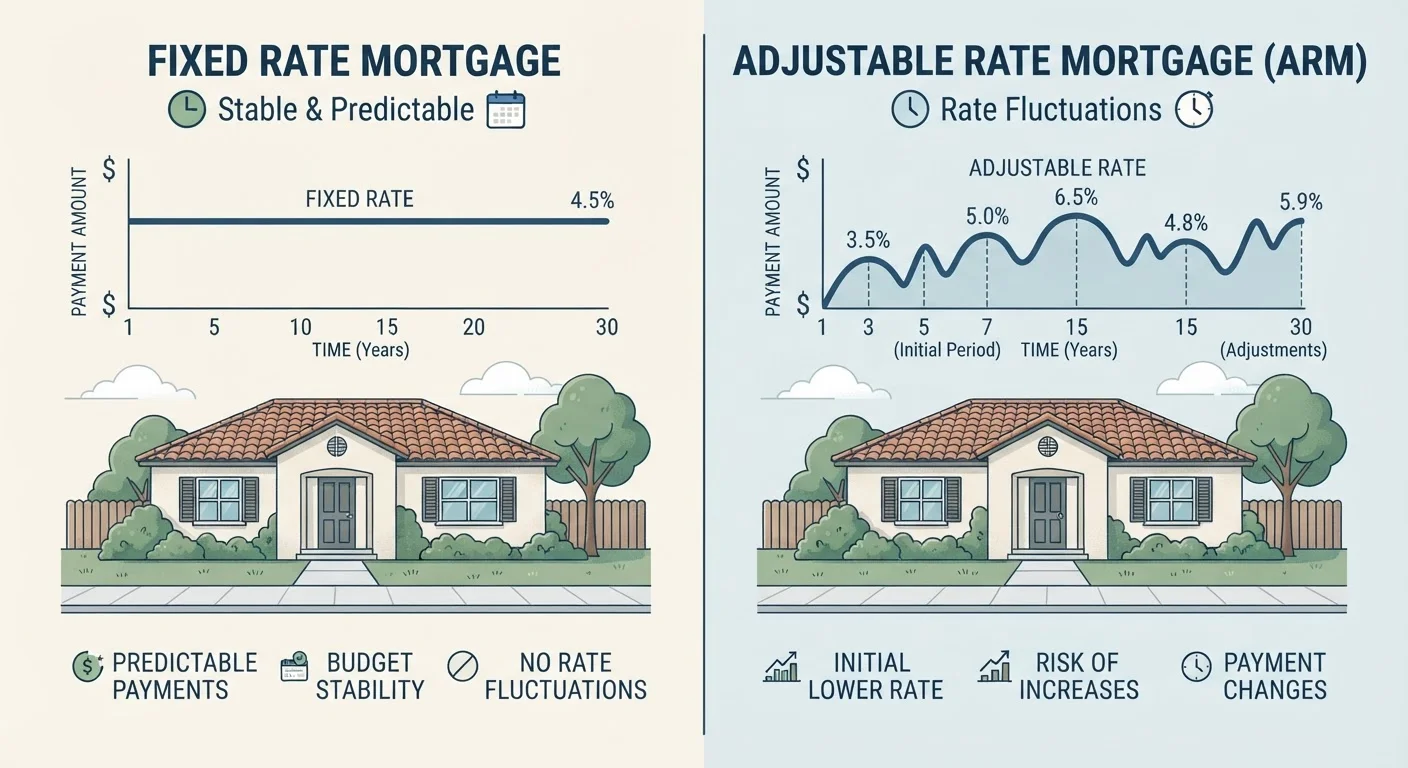
A fixed-rate mortgage sets your interest rate at closing and keeps it unchanged for the entire loan term — typically 15 or 30 years. Every monthly principal and interest payment is identical, making long-range budgeting straightforward. To understand why payment predictability matters within a broader personal finance plan, see our article on fixed vs. variable expenses.
An adjustable-rate mortgage (ARM) has two distinct phases. During the initial fixed period — commonly expressed as 5/1, 7/1, or 10/1 — your rate is locked. The first number indicates how many years that fixed period lasts; the second indicates how often the rate adjusts afterward (usually annually). Once adjustments begin, the lender recalculates your rate by adding a set margin to a benchmark index, such as the Secured Overnight Financing Rate (SOFR). The result can rise or fall depending on market conditions.
Rate caps are a critical safeguard built into every ARM. A typical cap structure such as 2/2/5 means the rate cannot rise more than 2 percentage points at the first adjustment, more than 2 points at any subsequent adjustment, and more than 5 points above the initial rate over the life of the loan. Caps do not eliminate rate risk — they define its limits.
| Criterion | Fixed-Rate Mortgage | Adjustable-Rate Mortgage (ARM) |
|---|---|---|
| Interest rate over time | Locked for full loan term | Fixed initially, then adjusts periodically |
| Initial rate level | Generally slightly higher | Generally lower at outset |
| Payment predictability | Principal & interest never change | Payment can rise or fall after fixed period |
| Rate risk | None — lender absorbs it | Borrower absorbs post-adjustment risk |
| Rate caps | Not applicable | Per-adjustment and lifetime caps apply |
| Typical best-fit horizon | Long-term ownership (7+ years) | Shorter horizon or planned refinance |
| Common loan terms | 15 or 30 years | Often 30 years with 5/1, 7/1, or 10/1 structure |
Cost Differences and Break-Even Logic
Fixed-rate mortgages generally carry a slightly higher initial rate than comparable ARMs because the lender is absorbing the risk that market rates could rise. That premium buys the borrower certainty. ARMs price that certainty out and pass the rate-change risk back to the borrower after the fixed window closes.
Whether a fixed or adjustable loan costs less over time depends heavily on how long you hold the mortgage and which direction rates move — neither of which is knowable in advance. A useful mental exercise is to calculate the break-even point: roughly, how many years of lower ARM payments would it take to offset the savings from a fixed rate if rates later rise significantly? Your loan officer can run these scenarios with specific numbers.
~90%
Share of mortgages that are fixed-rate
Historically, fixed-rate mortgages have dominated US originations; Freddie Mac data consistently shows they account for the large majority of new loans.
5/1
Most common ARM structure
The 5/1 ARM — five years fixed, then annual adjustments — is among the most widely used adjustable structures in the US residential market.
Your credit profile also influences the rate spread between the two options. Borrowers with stronger credit scores and lower debt-to-income ratios typically access narrower gaps between ARM and fixed offerings, which can shift the calculus. For context on how credit factors into mortgage eligibility more broadly, our credit hub covers the fundamentals.
Situations Where Each Option Tends to Make Sense
Fixed-rate loans are often the default choice for buyers who have found a long-term home and want predictability in their housing costs. When benchmark interest rates are relatively low, locking in those rates for 15 or 30 years is broadly considered prudent by housing finance professionals. First-time buyers in particular may benefit from the stability while they build equity and adjust to homeownership costs.
ARMs tend to attract buyers with a defined shorter-term horizon — professionals relocating every few years, buyers who plan to trade up before the fixed period ends, or those who intend to refinance when rates shift favorably. The lower initial payment can also allow a buyer to qualify for a larger loan amount, though borrowers should be careful not to stretch affordability based solely on an introductory rate.
Before reaching the rate-type decision, most buyers will benefit from understanding their loan program options as well. Our overview of conventional, FHA, VA, and USDA loans explains how the main mortgage types differ in eligibility and terms — decisions that interact with whether a fixed or adjustable rate is available to you.
Pre-Approval Can Clarify Your Options
Before deciding between a fixed or adjustable rate, getting pre-approved gives you concrete rate quotes for both products based on your actual credit and financial profile. That comparison is more useful than general estimates. See our guide on mortgage pre-qualification vs. pre-approval to understand what the process involves.
This article is for general informational and educational purposes only and does not constitute personalized financial or mortgage advice. Consult a licensed mortgage professional or financial adviser for guidance based on your individual circumstances.