

Key Takeaways
Our Verdict
No single mortgage type is universally superior — the right choice depends on your military status, income, location, credit profile, and available savings. Understanding each loan's eligibility rules and cost structure is the essential first step before applying.
| Best for | Recommended |
|---|---|
| Buyers with solid credit and 5–20% saved for a down payment | Conventional Loan |
| First-time buyers with limited savings or lower credit scores | FHA Loan |
| Eligible veterans, active-duty military, and surviving spouses | VA Loan |
| Low-to-moderate income buyers purchasing in qualifying rural or suburban areas | USDA Loan |
What Sets These Four Loan Types Apart
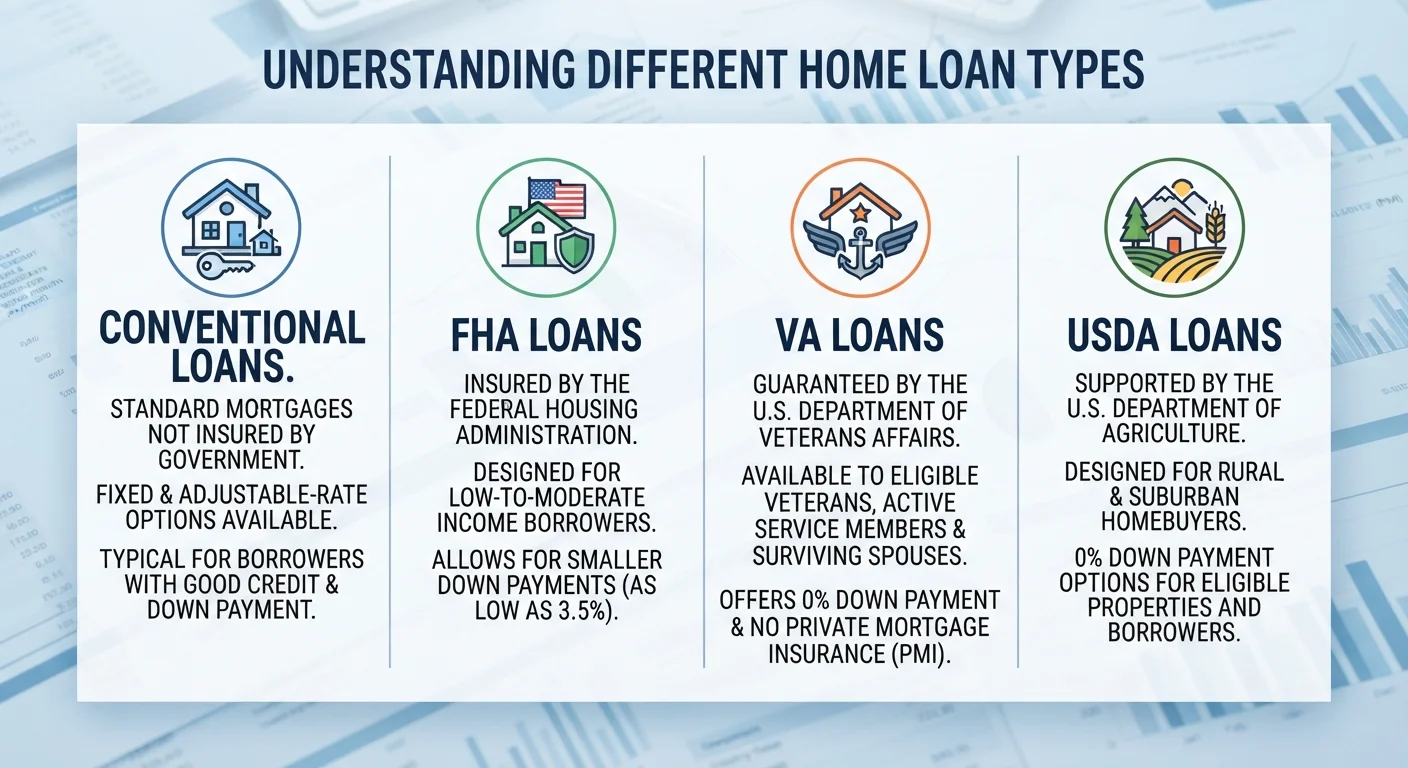
When shopping for a mortgage, buyers encounter four primary loan categories: conventional, FHA, VA, and USDA. Three of the four — FHA, VA, and USDA — are government-backed, meaning a federal agency insures the lender against borrower default. Conventional loans carry no such guarantee and are instead governed by standards set by Fannie Mae and Freddie Mac, the government-sponsored enterprises that purchase most conventional mortgages on the secondary market.
That structural difference shapes everything downstream: who qualifies, how much of a down payment is required, what mortgage insurance costs, and which properties are eligible. Before diving into individual loan types, it helps to understand a few foundational terms. See our plain-language homebuyer glossary for definitions of terms like escrow, debt-to-income ratio, and mortgage insurance premium that appear throughout this comparison.
| Conventional | FHA | VA | USDA | |
|---|---|---|---|---|
| Government backing | None | FHA (HUD) | Dept. of Veterans Affairs | Dept. of Agriculture |
| Minimum down payment | 3% (typically) | 3.5% (580+ credit) | 0% | 0% |
| Minimum credit score (typical) | 620 | 580 (500 with 10% down) | No set minimum (lender-set) | 640 recommended |
| Mortgage insurance | PMI (cancellable at 80% LTV) | UFMIP + annual MIP (often lifetime) | None (funding fee applies) | Guarantee fee + annual fee |
| Income limits | None | None | None | 115% of area median income |
| Property location limits | None | None | None | USDA-eligible areas only |
| Who is eligible | Most borrowers | Most borrowers | Veterans, military, some spouses | Low-to-moderate income buyers |
Conventional Loans: The Standard Market Option
Conventional loans are not insured or guaranteed by the federal government. Because lenders assume more risk, they typically require stronger borrower credentials — generally a credit score of at least 620 and a debt-to-income (DTI) ratio below 45%. Down payments can be as low as 3% through certain programs, but borrowers who put down less than 20% must pay private mortgage insurance (PMI) until they build sufficient equity.
PMI is typically cancellable once the loan balance reaches 80% of the home's original value — an advantage over FHA's lifetime mortgage insurance in some scenarios. Conventional loans also come with no income limits or geographic restrictions, making them broadly available. For buyers who are uncertain about the distinction between initial lender contacts, our guide on pre-qualification vs. pre-approval explains what each step involves.
PMI Is Not Permanent on Conventional Loans
Borrowers who put down less than 20% on a conventional loan can request PMI cancellation once the loan balance drops to 80% of the home's original appraised value. Under the Homeowners Protection Act, lenders are required to automatically cancel PMI at 78% LTV for borrowers in good standing. This makes conventional loans worth revisiting even for buyers with modest down payments who expect to build equity relatively quickly.
FHA Loans: Accessible Entry for Many Buyers
Insured by the Federal Housing Administration (FHA), these loans are designed to expand homeownership access. The key advantages are a lower credit score floor — as low as 580 for the 3.5% down payment option, or 500–579 with a 10% down payment — and more flexible DTI allowances. FHA loans are popular with first-time buyers, though they are not restricted to them.
The trade-off is mortgage insurance. FHA loans require both an upfront mortgage insurance premium (UFMIP), currently 1.75% of the loan amount, and an annual premium paid monthly. For most borrowers with less than 10% down, this annual premium lasts the life of the loan — meaning refinancing to a conventional loan later is often the only way to eliminate it. FHA loans also have loan limits set by county, which the U.S. Department of Housing and Urban Development (HUD) updates annually.
Many buyers overestimate how much they need to bring to the table. Our article on common down payment myths addresses several misconceptions that can discourage otherwise-qualified applicants.
VA Loans: A Significant Benefit for Those Who Qualify
Guaranteed by the U.S. Department of Veterans Affairs, VA loans are available to eligible veterans, active-duty service members, National Guard and Reserve members meeting service requirements, and certain surviving spouses. Eligible borrowers can typically finance 100% of a home's purchase price — no down payment required — and are not subject to PMI, which substantially lowers monthly costs compared to other zero-down scenarios.
VA loans do carry a funding fee — a one-time charge (ranging from roughly 1.25% to 3.3% of the loan amount as of recent guidance, depending on down payment and first-time vs. subsequent use) that can be financed into the loan. Some borrowers, including those receiving VA disability compensation, may be exempt. Credit and income requirements are set by individual lenders within VA guidelines, so standards vary. There is no maximum loan amount under current VA rules, though lenders apply their own limits.
~12%
Share of 2023 home purchase loans backed by VA
According to the Consumer Financial Protection Bureau's annual mortgage market data, VA loans represented a meaningful share of purchase originations.
580
Minimum FHA credit score for 3.5% down
HUD guidelines set 580 as the threshold for the lowest FHA down payment tier; scores between 500–579 require 10% down.
USDA Loans: Rural and Suburban Opportunity
Backed by the U.S. Department of Agriculture, USDA loans target low-to-moderate income buyers purchasing in USDA-designated eligible areas — which include many suburban communities, not just rural farmland. Like VA loans, USDA loans offer 100% financing with no down payment. They also carry relatively low interest rates and reduced mortgage insurance costs compared to FHA.
Eligibility is means-tested: household income generally cannot exceed 115% of the area median income, a threshold that varies by location and household size. The property itself must be in a USDA-eligible area, which buyers can verify through the USDA's online eligibility map. USDA loans come in two forms: the Guaranteed Loan Program (processed by approved private lenders) and the Direct Loan Program (funded directly by USDA, aimed at very low income households).
Once you've identified the right loan type, the next decision involves your rate structure. Our comparison of fixed-rate vs. adjustable-rate mortgages helps buyers think through that second major variable.
This article is for general informational and educational purposes only and does not constitute personalized financial, mortgage, or legal advice. Loan program terms, limits, and eligibility requirements change periodically. Consult a licensed mortgage professional and verify current guidelines with the relevant federal agency before making borrowing decisions.