

Key Takeaways
Option A
Fixed Expenses
The predictable, unchanging obligations in your budget.
Best for: Households that want a stable baseline to build their budget around, making planning straightforward.
Option B
Variable Expenses
The flexible, fluctuating costs that shift month to month.
Best for: Identifying where spending can be adjusted when income changes or financial goals need prioritizing.
If you want to establish a baseline spending floor
Fixed Expenses
Totaling your fixed expenses first reveals the non-negotiable monthly minimum your income must cover before any other spending decisions are made.
If you need to reduce spending quickly
Variable Expenses
Variable costs like dining out, subscriptions, and entertainment can be reduced or eliminated in the short term without breaking a contract or long-term commitment.
If you have an irregular or fluctuating income
Variable Expenses
When monthly income varies, adjusting variable spending is the most practical way to keep your budget balanced without defaulting on fixed obligations.
If you are building a long-term financial plan
Fixed Expenses
Fixed expenses form the structural backbone of any multi-month financial plan, providing predictability that makes saving and debt repayment goals easier to schedule.
Defining the Two Categories
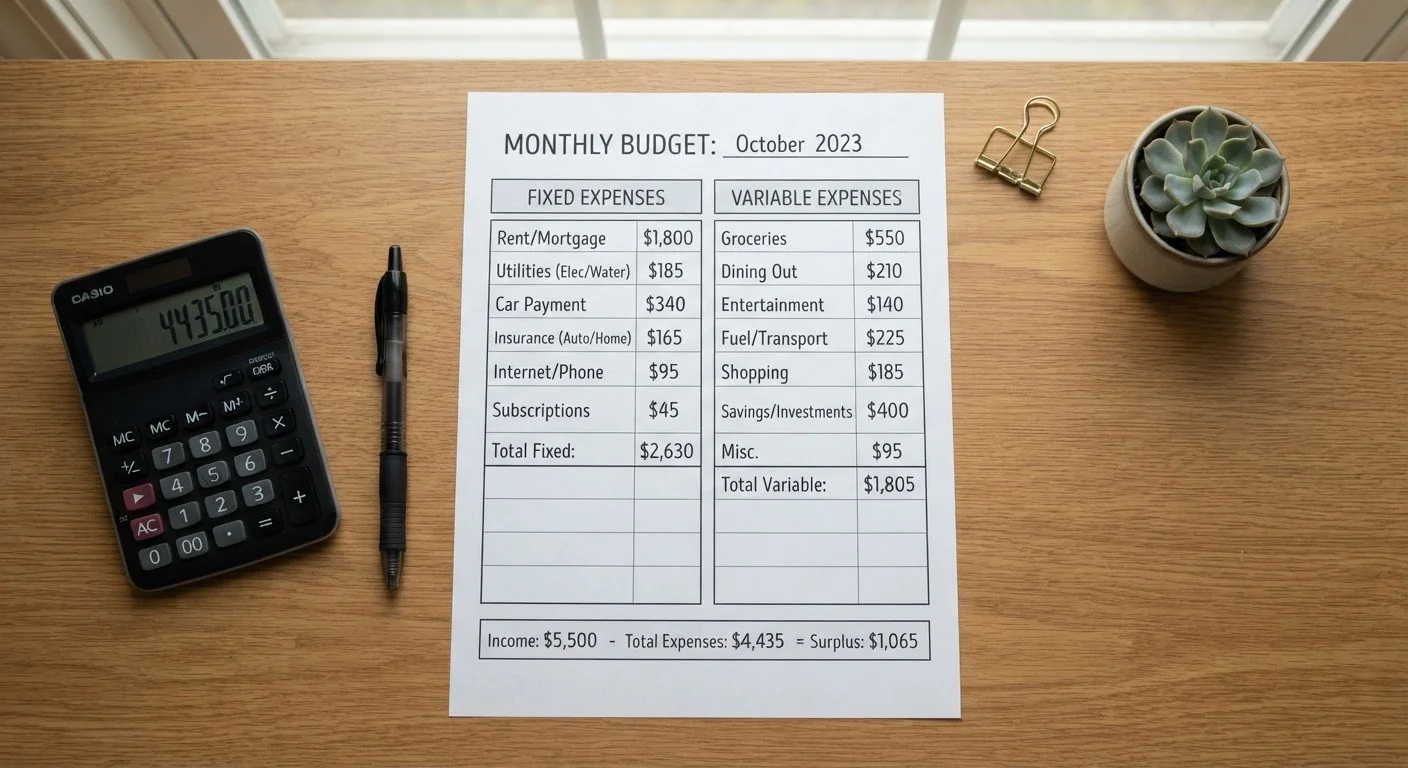
Every dollar that leaves your household falls into one of two buckets: fixed expenses or variable expenses. Understanding which is which is one of the most practical skills in personal budgeting - and one of the most underused.
Fixed expenses are costs that remain the same amount each billing cycle. Your mortgage or rent payment, car loan installment, student loan payment, and most insurance premiums are classic examples. You agreed to a set figure when you signed a contract, and that figure does not change until the contract does.
Variable expenses are costs that fluctuate based on usage, behavior, or circumstances. Groceries, gasoline, utility bills, dining out, clothing, and entertainment all vary from month to month depending on how much you consume or how often you engage in an activity.
A third category worth knowing - sometimes called periodic or irregular fixed expenses - covers bills that are fixed in amount but don't recur monthly. Annual car registration fees or semi-annual insurance premiums are examples. These are technically fixed but require deliberate planning because they don't appear on every monthly statement. For more on terminology like this, see common budgeting vocabulary every household should know.
| Criterion | Fixed Expenses | Variable Expenses |
|---|---|---|
| Amount each month | Stays the same | Changes based on usage or behavior |
| Examples | Rent, car loan, insurance premium | Groceries, gas, dining, utilities |
| Ease of planning | High - predictable and recurring | Moderate - requires tracking and estimates |
| Short-term flexibility | Low - contract or obligation binds you | High - can be reduced or paused |
| Role in budget | Sets spending floor | Primary lever for cost adjustment |
| Risk of overspending | Low - amount is known in advance | Higher - easy to underestimate |
Why the Distinction Matters in Practice
The real value of separating fixed from variable expenses is strategic clarity. Once you know your total fixed obligations each month, you immediately know your spending floor - the minimum your income must cover before you have any room to maneuver. If your fixed expenses total $2,400 per month and your take-home pay is $3,500, you know that $1,100 remains for variable spending, saving, and unexpected costs.
~67%
Of average US household spending is fixed or near-fixed
Bureau of Labor Statistics Consumer Expenditure data consistently shows housing, transportation, and insurance together account for the majority of household budgets.
$1,000+
Typical monthly variable spending gap vs. estimates
Financial planning research suggests many households underestimate discretionary and variable spending by a meaningful margin when budgeting without detailed tracking.
Variable expenses, by contrast, are where most day-to-day budgeting decisions happen. Cutting back on restaurants, pausing a streaming service, or reducing how often you drive can all trim spending without requiring you to break a lease or renegotiate a loan. This flexibility is particularly important for people whose income changes from month to month - a topic covered in depth in our guide on budgeting strategies for freelancers and gig workers.
Fixed expenses, while harder to reduce in the short term, are not entirely immovable. Refinancing a mortgage, shopping for a lower insurance premium at renewal, or renegotiating a service contract are all ways households can lower fixed costs - but these changes generally require planning, time, and sometimes a financial trade-off.
Building a Budget That Accounts for Both
A practical monthly budget should list fixed expenses first and total them. This gives you a clear picture of committed spending before any discretionary choices are made. From there, allocate amounts to variable spending categories based on what remains after fixed costs and saving contributions are accounted for.
One common challenge is underestimating variable expenses. Many households budget for average months but don't account for higher-cost periods - back-to-school shopping, holiday travel, or an unusually high utility bill in winter. Building a small buffer into variable categories, or maintaining a dedicated budget buffer, helps absorb these fluctuations without derailing your plan. For a closer look at how a budget buffer differs from an emergency fund, see emergency fund vs. budget buffer.
If you are deciding how to structure your overall approach, percentage-based vs. fixed-amount budgeting methods explores how different frameworks handle fixed and variable costs differently. And if you are weighing how much structure is helpful versus constraining, the case for and against a strict monthly budget offers a balanced perspective.
This article is for general informational and educational purposes only and does not constitute personalized financial advice. Consult a qualified financial professional for guidance tailored to your individual circumstances.