

Key Takeaways
Our Verdict
Percentage-based budgeting adapts well to fluctuating incomes and long-term goal-setting, while fixed-amount budgeting rewards consistency and simplicity for steady earners. Most households benefit from understanding both approaches and selecting - or blending - based on their specific income pattern and financial priorities.
| Best for | Recommended |
|---|---|
| Variable or irregular income earners | Percentage-Based Budgeting |
| Salaried households with predictable monthly expenses | Fixed-Amount Budgeting |
| Households managing joint finances with multiple income streams | Percentage-Based Budgeting |
| Beginners who want a simple, easy-to-track system | Fixed-Amount Budgeting |
How Each Method Works
At their core, both approaches solve the same problem - deciding where your money goes - but they use different logic to get there. Before diving in, it helps to review common budgeting terms so that concepts like net income, discretionary spending, and cash flow are clear.
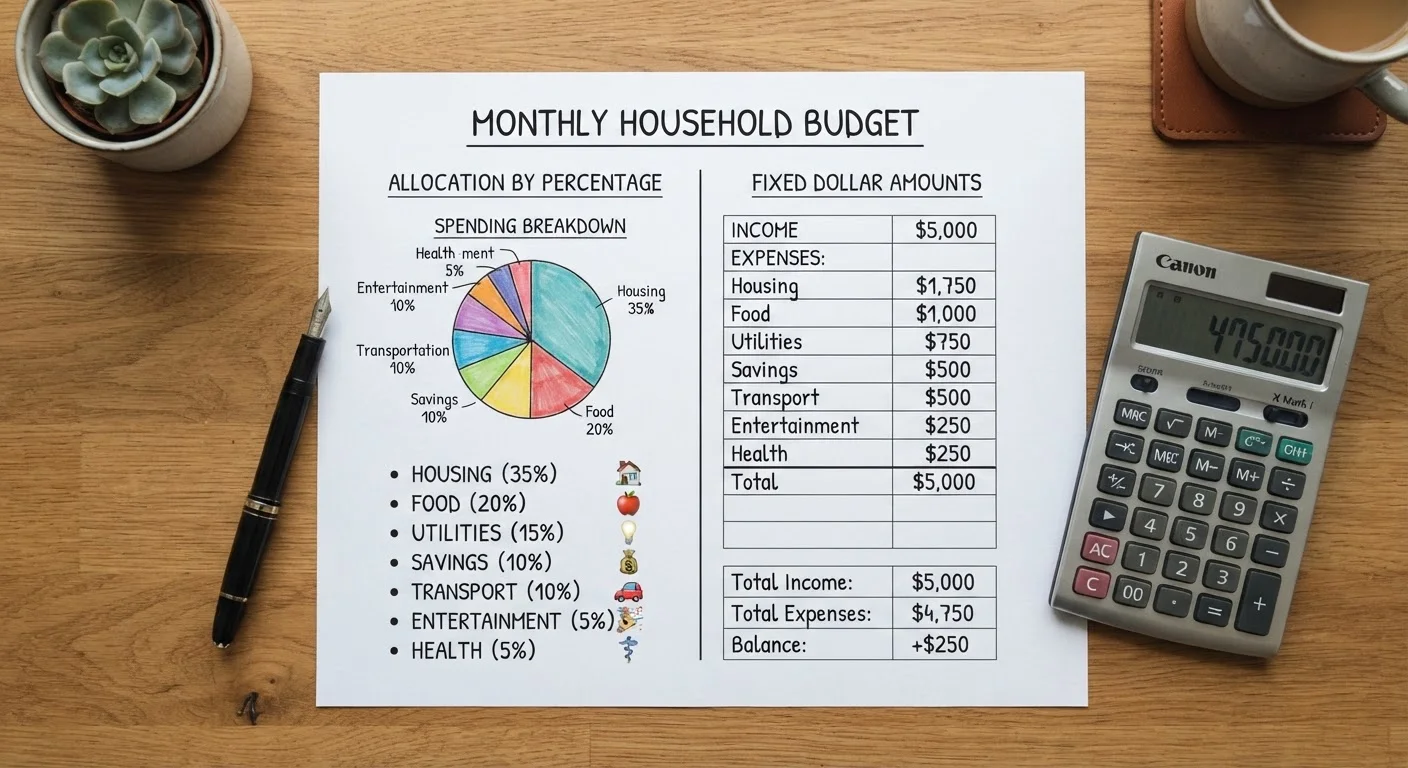
Percentage-based budgeting allocates your after-tax income by proportions. The most widely cited framework is the 50/30/20 rule: roughly 50% toward needs (housing, utilities, groceries), 30% toward wants (dining out, entertainment), and 20% toward savings and debt repayment. Because the allocations are expressed as ratios, the dollar amounts shift automatically whenever income rises or falls.
Fixed-amount budgeting assigns a specific dollar figure to each spending category each month - for example, $1,400 for rent, $300 for groceries, $200 for transportation. Those numbers stay constant regardless of what you earn in any given period, making overspending in a category immediately visible.
| Criterion | Percentage-Based | Fixed-Amount | |
|---|---|---|---|
| Best income type | Variable or irregular income | Stable, salaried income | |
| Flexibility when income changes | Automatically adjusts | Requires manual revision | |
| Ease of daily tracking | Requires calculation or app | Straightforward dollar limits | |
| Savings growth over time | Scales with income increases | Flat unless manually updated | |
| Setup complexity | Moderate - ratios need deciding | Low - set dollar amounts once | |
| Suited for beginners | Moderate - abstract concept | High - intuitive and concrete | |
| Accountability for overspending | Softer - proportional limits | Clear - hard dollar ceilings |
Strengths and Limitations of Each Approach
Percentage-based budgeting shines for households with variable income - freelancers, commission-based workers, or anyone whose paycheck fluctuates month to month. When income dips, spending targets automatically shrink; when income grows, savings contributions scale up without requiring a manual revision. This built-in flexibility also aligns naturally with long-term wealth-building, since a fixed savings rate compounds more effectively over time than a fixed dollar amount. For couples managing shared money, percentage contributions can also feel fairer - each partner contributes in proportion to what they earn. See budgeting as a household for more on proportional contribution models.
The limitation: percentage budgets can feel abstract. If you earn $4,200 one month, mentally calculating 50% of that every time you buy groceries is impractical without a spreadsheet or app.
Fixed-amount budgeting trades flexibility for clarity and accountability. Knowing you have exactly $300 for groceries this month creates a concrete boundary that's easy to track, even without financial software. It works best when income is predictable and fixed costs dominate your spending. The drawback is rigidity - a windfall month won't automatically boost your savings, and a lean month may push you over category limits unless you actively adjust. Those interested in how strict monthly structures affect behavior can explore the case for and against a strict monthly budget.
Try a Hybrid Approach First
Rather than committing entirely to one method, consider applying percentage logic to savings and investment contributions while using fixed dollar amounts for predictable recurring expenses like rent, subscriptions, and utilities. This gives you built-in savings discipline without sacrificing the clarity that fixed caps provide for everyday spending categories.
Choosing the Right Method - or Combining Both
The decision largely hinges on two factors: income consistency and how much administrative effort you're willing to invest each month. Consider these practical guidelines:
- If your take-home pay varies by more than 15-20% month to month, percentage-based budgeting typically requires fewer painful mid-month adjustments.
- If your income is salaried and consistent, fixed amounts are simpler to track and less prone to category creep.
- A hybrid approach - using percentages for savings and investments, fixed amounts for known recurring costs - captures the benefits of both. For instance, automate a 15% savings transfer on payday (percentage logic), then manage groceries and utilities with firm dollar caps (fixed logic).
Once your budgeting method is stable, the natural next step is putting saved funds to work. Exploring investing basics can help you understand how to deploy the surplus your budget creates. You might also find it useful to compare specific savings strategies, such as dollar-cost averaging vs. lump-sum investing, once you have consistent surplus to allocate.
For households that want even more granular control over day-to-day spending, it's worth comparing envelope budgeting vs. digital spending trackers - either can layer on top of the framework you choose here. Alternatively, zero-based budgeting offers a method that assigns every dollar a purpose before the month begins, which pairs well with fixed-amount logic.
This article is for general informational purposes only and does not constitute personalized financial advice. Consult a qualified financial professional regarding decisions specific to your situation.