

Key Takeaways
Option A
Envelope Budgeting
The tactile, cash-based system built on physical limits.
Best for: People who overspend on discretionary categories and benefit from a physical, visible spending boundary.
Option B
Digital Spending Trackers
The data-driven, app-based approach to real-time financial visibility.
Best for: People who pay primarily by card, want automated tracking, and prefer analyzing spending trends over time.
If you regularly overspend on dining, entertainment, or impulse purchases
Envelope Budgeting
Physical cash creates a hard stop - when the envelope is empty, spending in that category stops. This tactile feedback is difficult to replicate digitally.
If most of your transactions are digital and you travel or shop online frequently
Digital Spending Trackers
Using cash becomes impractical when most purchases happen via card or online. A tracker works within the digital payment system rather than against it.
If you want detailed spending reports and trend analysis over time
Digital Spending Trackers
Most apps generate monthly summaries and category breakdowns automatically, giving you data-backed insight that envelopes simply can't provide.
If you're new to budgeting and find abstract numbers easy to ignore
Envelope Budgeting
Holding cash makes the budget real and concrete. Research on behavioral economics suggests physical money triggers more deliberate spending decisions than card payments.
If you manage finances jointly with a partner across multiple accounts
Digital Spending Trackers
Shared app access allows both partners to see real-time spending without coordinating physical envelopes. See our guide to household budgeting for more on shared finances.
How Each System Works
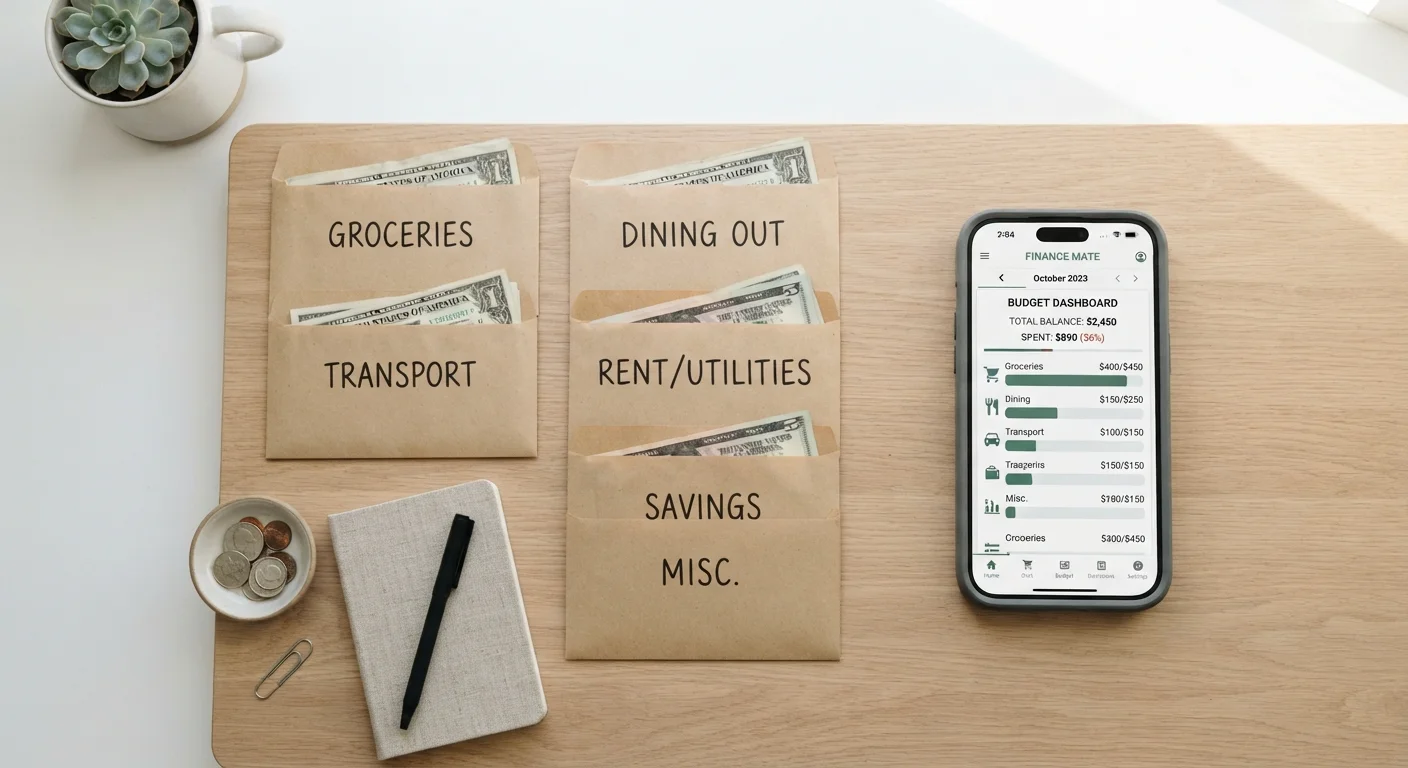
The envelope budgeting system - popularized decades ago and still widely used - divides your take-home pay into labeled envelopes, each representing a spending category: groceries, gas, dining out, and so on. You withdraw cash at the start of the month and physically place the allocated amount into each envelope. When an envelope is empty, spending in that category stops until the next funding cycle. There is no credit card buffer, no overdraft cushion - just the bills in the envelope.
A digital spending tracker works differently. These apps - whether standalone budgeting tools or features built into banking platforms - connect to your checking accounts, credit cards, and debit cards. They automatically import and categorize transactions, show running totals against your set limits, and send alerts when you approach a boundary. Instead of physical cash, the constraint exists as a notification or a color-coded dashboard.
Understanding these mechanics clearly helps avoid a common misconception: that one method is inherently more disciplined than the other. Both require intentional setup and regular check-ins. For a quick reference on budgeting vocabulary used throughout this comparison, see common budgeting terms every household should know.
| Criterion | Envelope Budgeting | Digital Spending Trackers |
|---|---|---|
| Payment method | Cash only | Cards and digital payments |
| Setup effort | Manual - withdraw and divide cash | Account linking, initial categorization |
| Spending enforcement | Hard stop when envelope is empty | Alerts and dashboards (soft limits) |
| Tracking accuracy | Manual; requires counting envelopes | Automated and near real-time |
| Trend analysis | Not available without manual logging | Built-in monthly and category reports |
| Works for online purchases | No | Yes |
| Security considerations | Risk of lost or stolen cash | Data privacy and app security |
| Behavior feedback | Immediate (empty envelope) | Delayed (requires checking app) |
The Real Trade-Offs: Friction, Flexibility, and Follow-Through
The central trade-off between these two systems comes down to friction - and whether that friction helps or hinders you.
With envelope budgeting, friction is the feature. Paying with cash is slower and more deliberate than tapping a card. Studies in behavioral economics suggest that people tend to spend less when paying with physical money compared to digital payment methods, because the physical exchange of bills makes the cost feel more real. The downside: cash is inconvenient for online purchases, subscription services, and contactless payment environments, which are increasingly the norm for US households.
Digital trackers reduce friction at the point of purchase - your card works everywhere - but they push the discipline to a later moment: reviewing the dashboard, responding to alerts, and consciously adjusting behavior when you see overspending. That delayed feedback loop can make it easier to rationalize overruns in the moment. However, the analytical depth of digital tools is significant. Month-over-month comparisons, spending trend graphs, and category breakdowns are simply not available with paper envelopes.
~32%
US adults with a formal written budget
According to Gallup polling, fewer than one in three American adults reports keeping a detailed household budget, suggesting significant room for either system to add value.
18%
More spent with cards vs. cash in studies
Multiple behavioral economics studies, including research published in the Journal of Consumer Research, have found consumers tend to spend more when using credit or debit cards compared to cash.
60%+
US adults using mobile banking apps regularly
The Federal Reserve's consumer finance surveys consistently show a majority of US adults access their finances via smartphone, making digital trackers a natural fit for many households.
It's also worth acknowledging what neither system fully solves: irregular income. If your pay varies month to month - freelancers, contractors, and gig workers face this regularly - both systems require adaptation. Envelope users must re-allocate each cycle; digital tracker users must manually adjust budget limits. This challenge is separate from the tool itself. For households weighing other structural budgeting frameworks, percentage-based vs. fixed-amount budgeting explores two foundational approaches that pair well with either method.
This article is for general informational purposes only and does not constitute personalized financial advice. Consult a qualified financial professional for guidance specific to your situation.
Can You Combine Both Methods?
Many households find success using a hybrid approach: a digital tracker for the overall budget picture and envelopes (or virtual envelope-style app categories) for high-risk spending areas like dining and entertainment. Some budgeting apps now include virtual envelope features, letting you allocate funds by category within a digital interface. If you're curious about how dedicated apps compare in practice, apps that help you manage money day to day offers additional context.