

Key Takeaways
Option A
Dollar-Cost Averaging (DCA)
The steady, disciplined approach to building a position over time.
Best for: Investors who receive income periodically, want to reduce timing risk, or are new to investing.
Option B
Lump-Sum Investing (LSI)
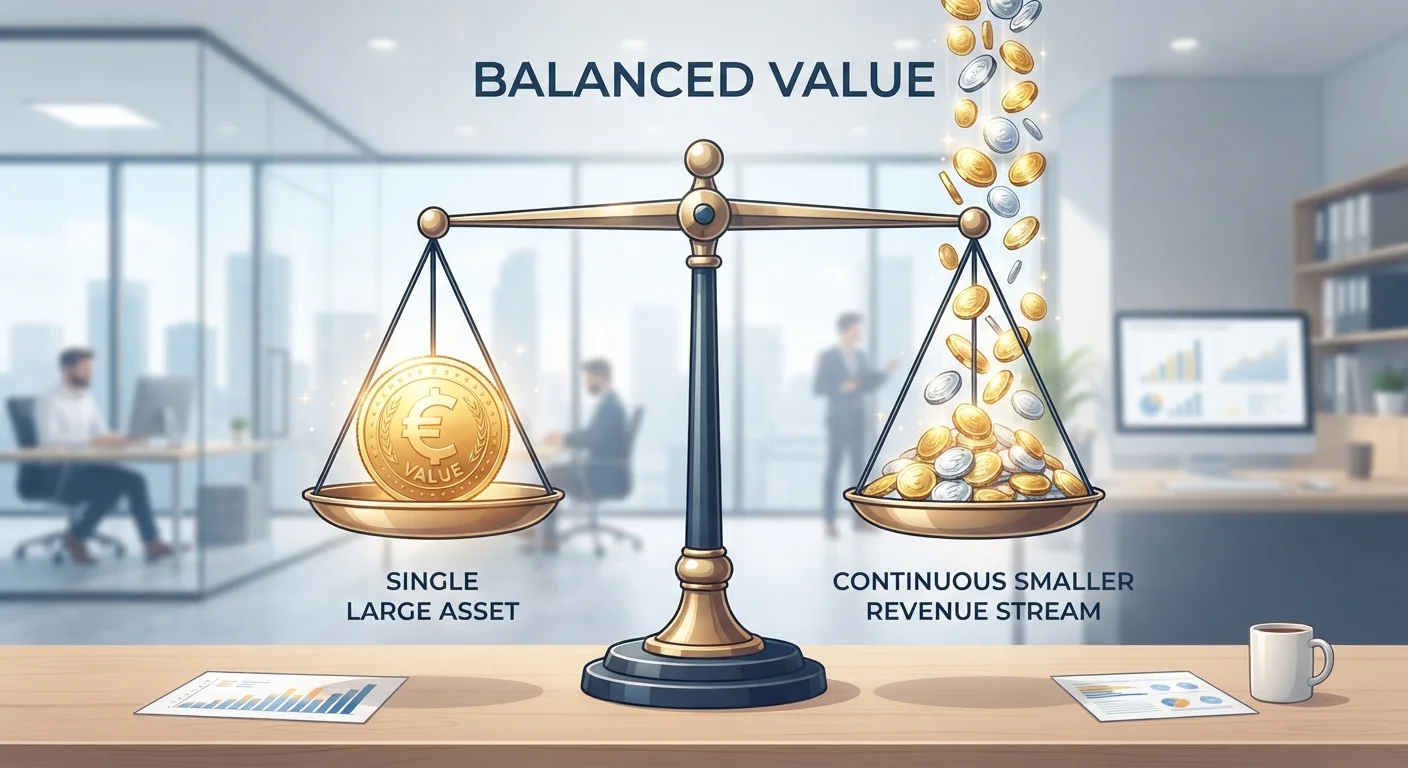
The all-in approach that maximizes time in the market from day one.
Best for: Investors who receive a windfall and can tolerate short-term volatility in pursuit of long-run growth.
If you receive a large windfall and have a long time horizon
Lump-Sum Investing (LSI)
Historical data favors putting money to work immediately. The longer your timeline, the more time in the market matters relative to timing the market.
If you are investing from a regular paycheck with no large sum on hand
Dollar-Cost Averaging (DCA)
DCA aligns naturally with how most Americans receive income, making it the realistic and practical default for ongoing contributions.
If market volatility causes you significant anxiety
Dollar-Cost Averaging (DCA)
Spreading purchases over time smooths out entry points and can make it psychologically easier to stay invested during downturns.
If you want to deploy an inheritance or bonus with lower emotional risk
Dollar-Cost Averaging (DCA)
Dividing a lump sum into scheduled installments over three to twelve months can reduce regret if markets dip shortly after investing.
What Each Strategy Actually Means
Dollar-cost averaging (DCA) means investing a fixed dollar amount at regular intervals — say, $300 every month — regardless of whether prices are rising or falling. Because you buy at various price points, you automatically acquire more shares when prices are low and fewer when prices are high. The result is an average cost per share that is smoothed over time.
Lump-sum investing (LSI) means deploying an available sum of money into the market all at once. The investor accepts whatever the current price is and allows the full amount to begin compounding from day one. There is no staged entry — the capital is fully invested immediately.
It is worth noting that for most working Americans, DCA is already happening through paycheck-linked 401(k) contributions. The practical debate usually arises when someone receives a bonus, inheritance, or other one-time windfall and must decide how to deploy it. For guidance on starting small, see starting your investment journey with less than $500.
| Criterion | Dollar-Cost Averaging | Lump-Sum Investing |
|---|---|---|
| Core mechanism | Fixed amount invested at regular intervals | Full sum invested immediately |
| Historical performance edge | Wins ~1 in 3 scenarios | Wins ~2 in 3 scenarios |
| Timing risk | Lower — spread across multiple entry points | Higher — entire sum exposed at one price |
| Compounding start | Delayed — capital enters gradually | Immediate — full capital compounds from day one |
| Behavioral ease | Easier to maintain psychologically | Can trigger anxiety after a sudden drop |
| Best market condition | Sideways or declining then recovering markets | Steadily rising markets |
| Suitability for windfalls | Good if emotional comfort is a priority | Mathematically favored for long-term investors |
What the Research Generally Shows
Studies examining historical US and global market data — including analysis from major investment institutions — have consistently found that lump-sum investing outperforms dollar-cost averaging roughly two-thirds of the time over multi-year holding periods. The core reason is straightforward: markets have historically trended upward over long horizons. Every month you delay full investment is, on average, a month of potential gains foregone.
~2 in 3
Times lump-sum investing outperforms DCA historically
Analyses of rolling historical periods in US and global equity markets generally show LSI ahead roughly two-thirds of the time over 10-year horizons.
~1 in 3
Times DCA produces better outcomes than LSI
DCA tends to win in periods where markets decline significantly shortly after a lump-sum entry point would have occurred.
12 months
Common DCA deployment window for lump sums
Spreading a windfall over 6–12 monthly installments is a frequently discussed middle-ground approach that balances timing risk and market exposure.
However, those findings come with important context. They reflect average outcomes across many historical periods — including both favorable and unfavorable entry points. In the roughly one-third of scenarios where LSI underperforms, the investor put their full sum to work just before a significant market decline. The loss in those cases can be substantial and emotionally difficult to sustain.
DCA does not eliminate market risk — all equity investing carries the possibility of loss. What it does is reduce the probability of investing your entire sum at a market peak. This trade-off — accepting a somewhat lower expected return in exchange for reduced timing risk — is the heart of the DCA value proposition. To understand how these strategies pair with broader portfolio decisions, see asset allocation across life stages.
The Psychological Dimension
Finance research has long documented that investor behavior — not just market returns — determines real-world outcomes. Panic selling after a sudden drop, or avoiding the market entirely due to fear of bad timing, are among the investing mistakes that can cost years of progress.
DCA works partly as a behavioral guardrail. If an investor would otherwise procrastinate indefinitely waiting for the "right" moment, scheduled contributions ensure money actually enters the market. Similarly, an investor who deploys a lump sum and immediately watches it decline 15% may panic-sell at a loss — making LSI's theoretical advantage irrelevant in practice.
The strategy you can stick with through volatility is often more valuable than the one that looks better in a spreadsheet. Both approaches integrate naturally with passive index fund investing, which itself reduces the pressure of individual security selection.
A Middle Path: Scheduled Deployment
Some investors split the difference by dividing a lump sum into equal installments deployed over six to twelve months. This is technically a form of DCA. While it still trails full LSI in expected-return terms, it can meaningfully reduce the regret of investing everything just before a market downturn. There is no universally correct interval — the goal is to find a pace that keeps you committed to the plan.
This article is for general informational and educational purposes only and does not constitute personalized financial or investment advice. Past market performance does not guarantee future results. Consult a qualified financial adviser before making investment decisions based on your individual circumstances.