

Key Takeaways
Why Night Driving Is a Different Skill Set
Most American drivers accumulate the bulk of their experience during daylight hours, which means the habits formed during that time are calibrated to conditions that simply do not exist after dark. Visibility drops dramatically, peripheral vision narrows, and depth perception becomes less reliable - all without the driver necessarily feeling any different. The road may look familiar, but it behaves like a different environment.
The numbers reinforce this. Fatal crash rates per mile driven are substantially higher at night than during the day, even though traffic volume is lower. The combination of limited visibility, driver fatigue, and a higher concentration of impaired motorists creates compounding risks that daytime experience does not prepare you for.
~50%
Of fatal crashes occur at night
According to the National Safety Council, roughly half of all traffic fatalities occur after dark, despite significantly less traffic volume during those hours.
3x
Higher nighttime fatal crash rate
The NHTSA has reported that the fatal crash rate per mile driven is approximately three times higher at night than during daylight hours.
37%
Of fatal crashes involve alcohol at night
NHTSA data consistently shows that drunk driving fatalities are disproportionately concentrated in nighttime and early-morning hours.
Nighttime also changes the dynamics of other hazards. Adverse weather conditions - fog, rain, and wet roads - are all harder to detect and manage in darkness. Similarly, the differences between highway and city driving become sharper at night, since urban intersections grow more unpredictable and highway speeds amplify the sight-distance problem.
Common Night Driving Mistakes and How to Avoid Them
The errors drivers make at night are rarely reckless in intent - they are usually the product of applying daytime instincts to a fundamentally different situation. Recognizing these patterns is the first step toward correcting them.
Driving at the same speed at night as during the day on the same road.
Why it happens: Familiarity with a route creates a false sense of security, and posted speed limits apply to ideal conditions rather than darkness.
Maintaining the same following distance used during daytime driving.
Why it happens: Drivers apply the two-second rule they learned in daylight without accounting for reduced reaction time caused by fatigue or limited visibility.
Failing to use high beams on unlit roads out of habit or hesitation.
Why it happens: Many drivers are uncertain about when high beams are appropriate or forget to switch between low and high beams during rural driving.
Ignoring early signs of fatigue and continuing to drive.
Why it happens: Drivers often feel they are managing fine until fatigue becomes severe, and highway monotony suppresses the brain's alertness signals.
Not accounting for blind spots and pedestrians that are far harder to detect at night.
Why it happens: Pedestrians dressed in dark clothing and cyclists without adequate lighting are nearly invisible outside a vehicle's headlight beam.
Stopping Distance Can Exceed Your Sight Distance
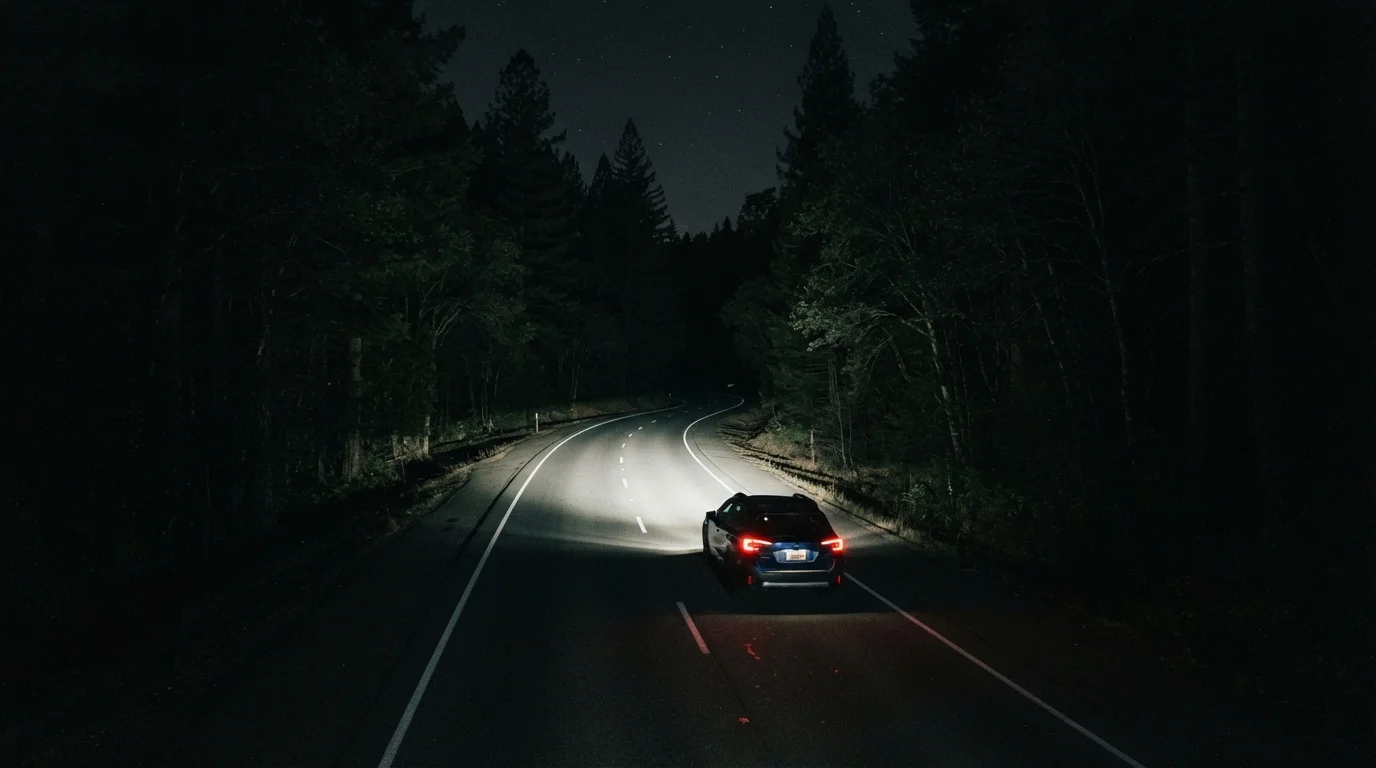
At 65 mph, a typical vehicle needs roughly 300 feet to stop - but standard low-beam headlights illuminate only about 160 feet ahead. This means you may be driving faster than your ability to react to obstacles in the dark. Slowing down at night is not overly cautious; it is physically necessary.
Adjusting your behavior does not require special equipment or training. It requires deliberate awareness that the rules governing safe daytime driving are a starting point - not a ceiling - for what nighttime conditions demand.
Fatigue Is Not Always Obvious to the Driver
Drowsy driving impairs reaction time and judgment in ways similar to alcohol intoxication, yet many drivers underestimate how tired they are. Microsleeps - brief unconscious episodes lasting just a few seconds - can occur without warning. If you are yawning frequently, struggling to keep your eyes focused, or cannot recall the last mile driven, pull over safely and rest before continuing.
Fatigue and impairment deserve particular attention because they affect judgment before drivers recognize the problem themselves. Planning long drives to avoid peak drowsiness hours (typically between midnight and 6 a.m.) and being alert to other erratic drivers are both practical strategies that reduce exposure to serious risk.