

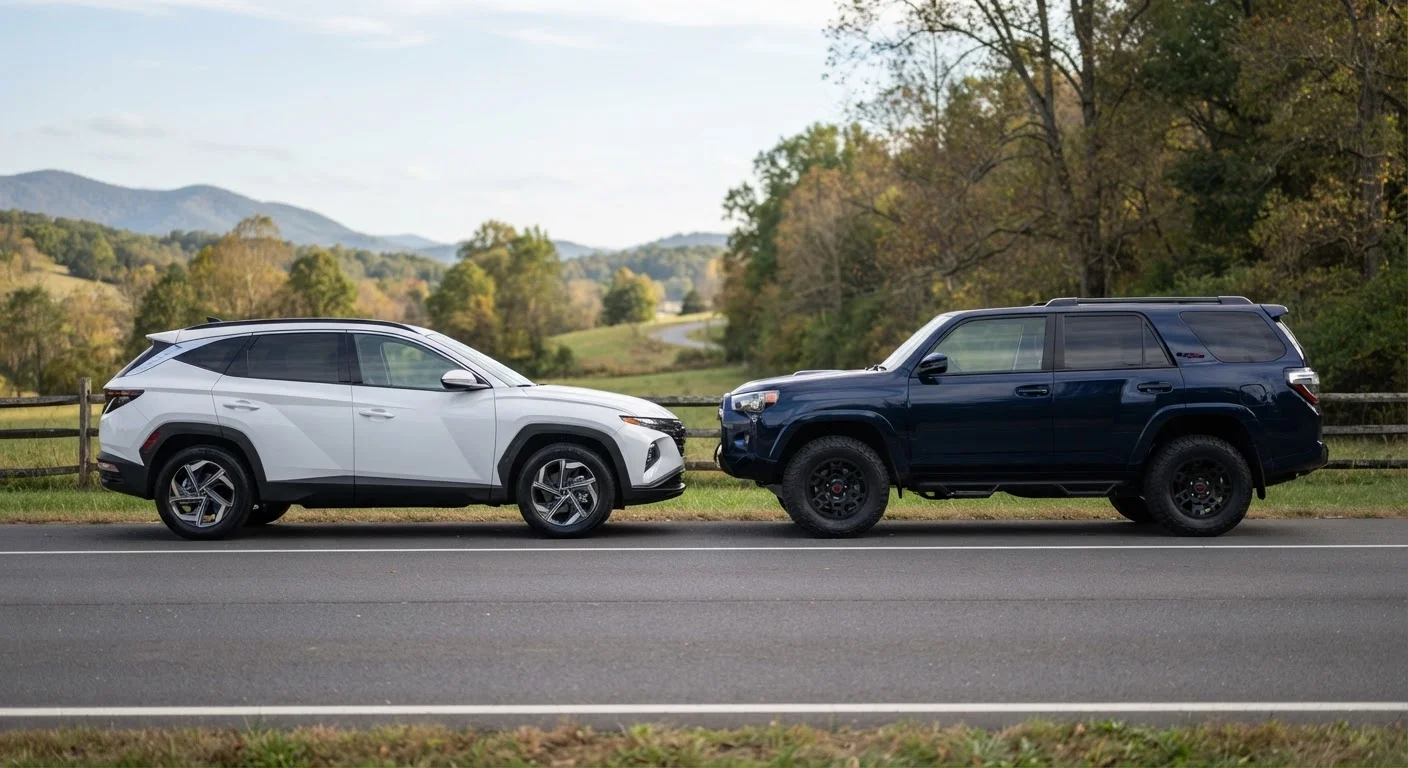
Key Takeaways
Option A
Crossover (CUV)
The car-based, everyday-versatility choice.
Best for: Drivers who want SUV-style space and ride height with carlike handling, fuel economy, and comfort.
Option B
Traditional SUV
The truck-derived, heavy-duty hauler.
Best for: Drivers who need serious towing capacity, genuine off-road capability, or three-row space in a rugged package.
If you want a practical daily driver with room for passengers and cargo
Crossover (CUV)
Unibody crossovers offer carlike fuel economy, comfortable ride quality, and ample interior space without the bulk of a truck-based platform.
If you regularly tow a trailer, boat, or camper
Traditional SUV
Body-on-frame SUVs are engineered for high tow ratings that most crossovers simply cannot match.
If you need genuine off-road capability on rough terrain
Traditional SUV
Truck-based frames handle stress, flex, and punishment from off-road use better than unibody structures.
If fuel costs and urban maneuverability are your priorities
Crossover (CUV)
Crossovers are lighter and more aerodynamic, returning meaningfully better fuel economy in most driving conditions.
The Core Structural Difference
When automakers and journalists use the word "SUV," they often mean two very different things. The distinction that matters most is not size, price, or badge - it is how the vehicle is built.
A crossover utility vehicle (CUV) uses a unibody construction, meaning the body and the frame are a single welded structure - the same fundamental architecture as a sedan or hatchback. A traditional SUV uses body-on-frame construction, where a separate steel frame carries the body on top of it, just like a full-size pickup truck.
That one engineering decision ripples through nearly every other characteristic: ride quality, towing capacity, fuel economy, handling, and off-road durability. Understanding it helps you cut through the marketing language that has made these two vehicle types almost indistinguishable by name.
| Criterion | Crossover (CUV) | Traditional SUV |
|---|---|---|
| Frame type | Unibody (integrated body/frame) | Body-on-frame (separate chassis) |
| Platform shared with | Passenger cars | Pickup trucks |
| Typical tow capacity | 1,500-5,000 lbs | 6,000-9,000+ lbs |
| Fuel economy | Generally higher | Generally lower |
| Ride comfort | Car-like, smoother | Firmer, truck-like |
| Off-road durability | Limited | High |
| Handling | More agile, lower center of gravity | Less nimble, higher center of gravity |
| Market prevalence | Dominant - most "SUVs" sold today | Narrower segment, fewer models |
For a broader look at how vehicle architecture shapes the everyday driving experience, see how each body style shapes your daily drive.
Why Crossovers Now Dominate the Market
Through the 1990s and early 2000s, the dominant family hauler was a truck-based SUV. Automakers then noticed that most buyers never took their SUVs off-road and rarely towed anything heavy. Meanwhile, fuel prices were rising and car-based wagons offered a smoother, more economical ride.
The industry response was the crossover: retain the tall ride height and roomy interior that buyers loved, but swap the truck frame for a passenger-car platform. The result was a vehicle that handled fuel economy regulations more easily, felt familiar to sedan drivers, and cost less to manufacture.
~50%
US new vehicle sales that are crossovers or SUVs
Industry analysts consistently report that crossovers and SUVs together account for roughly half of all new vehicle sales in the United States.
8,000+ lbs
Typical max tow rating for full-size body-on-frame SUVs
Manufacturer specifications for full-size truck-based SUVs such as the Chevrolet Suburban and Ford Expedition commonly list tow ratings in this range.
Today, crossovers represent the single largest vehicle segment in the US market. Many models that carry an "SUV" label in advertising - three-row family haulers included - are technically crossovers under the skin. Brands such as Toyota, Honda, Hyundai, and Ford sell far more unibody crossovers than they do truck-based SUVs. Even Tesla's Model X and Y, both marketed as SUVs, are unibody crossovers.
If you are comparing multiple models across a brand's lineup, Toyota's full US model lineup breakdown is a useful reference for seeing where each vehicle actually sits.
Where Traditional SUVs Still Hold a Clear Edge
The body-on-frame SUV is not obsolete - it simply serves a narrower set of needs more capably than any crossover can. Three areas stand out:
- Towing: A truck-derived frame is engineered to handle the twisting stress of a heavy trailer. Full-size body-on-frame SUVs commonly support tow ratings in the 8,000-9,000 lb range; most crossovers max out well below that.
- Off-road durability: Separating the body from the frame allows each component to flex independently on rough terrain without transferring stress to the passenger cabin. That structural flexibility is genuinely useful on rocky trails or deep ruts.
- Longevity under heavy use: Truck-based platforms have a long track record in commercial and fleet applications where vehicles accumulate high mileage under sustained load.
Off-Road Ratings Are Not Universal
Not every body-on-frame SUV comes with a locking differential or low-range transfer case from the factory. Buyers seeking genuine trail capability should verify specific off-road package options, not assume all truck-based models are equally equipped. Review the manufacturer's specifications for the trim level you are considering.
Households weighing whether one capable vehicle can cover all their needs - towing and daily commuting - will find the trade-off analysis in owning one car vs. two in a household directly relevant.
Making the Label Work for You
The practical takeaway is straightforward: do not let the word "SUV" on a window sticker tell you what a vehicle is capable of. Check whether it uses unibody or body-on-frame construction, and match that to how you actually plan to use the vehicle.
If your driving is mostly highway commuting, school runs, and the occasional road trip, a crossover will almost certainly serve you better - lighter, more fuel-efficient, and easier to maneuver. Highway and city driving demand different habits, and a crossover adapts to both without much compromise.
If you tow regularly, drive serious off-road terrain, or need the sustained load-bearing capability of a truck platform, a traditional body-on-frame SUV earns its added weight and fuel cost. The key is being honest about which use case actually describes your life - not the aspirational one from the commercial.