
National Parks, State Parks, and City Escapes: Matching Destinations to Your Travel Style

Key Takeaways
Our Verdict
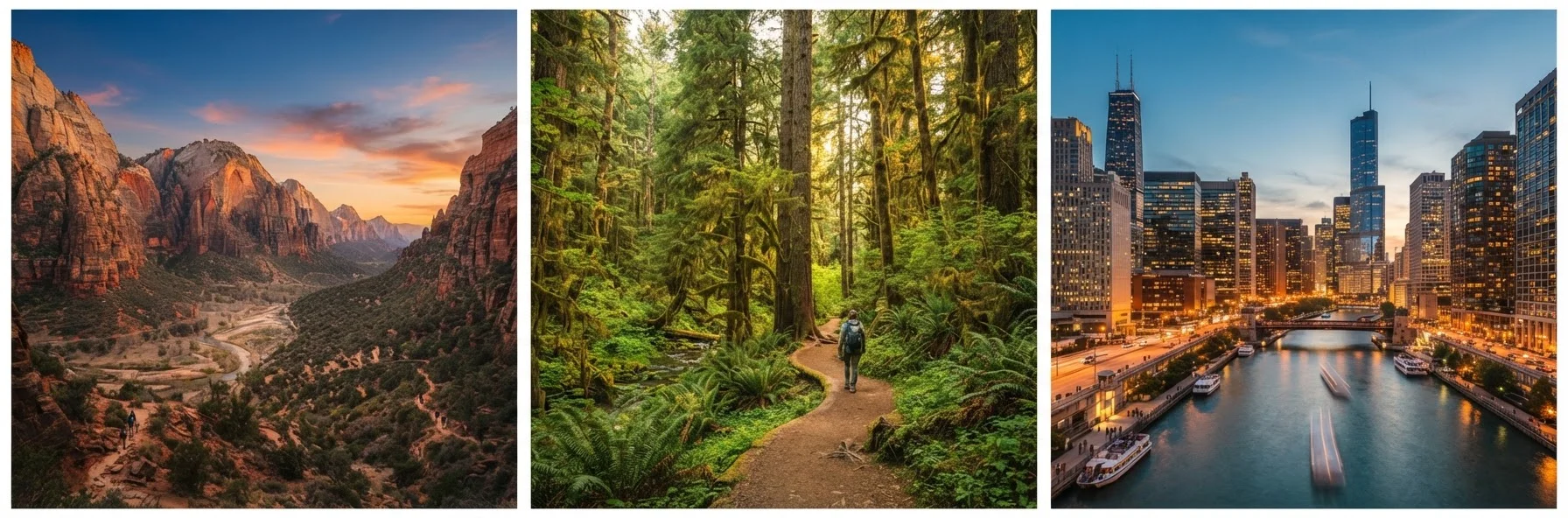
No single destination type outperforms the others — each serves a distinct traveler profile. National parks reward those willing to plan carefully for transcendent landscapes, state parks offer accessible nature without the logistical burden, and cities provide cultural depth on a flexible schedule. Matching the destination to your actual preferences, rather than what's trending, consistently produces the most satisfying trips.
| Best for | Recommended |
|---|---|
| Travelers seeking iconic, dramatic natural landscapes | National Parks |
| Outdoor lovers who prefer low-barrier, uncrowded access | State Parks |
| Those who prioritize culture, food, and convenience | City Escapes |
| Travelers wanting variety on a single trip | Mixed itinerary combining all three |
Why Destination Type Matters More Than Destination Name
Most trip-planning advice focuses on where to go — but the more useful question is what kind of experience you actually want. A traveler who dislikes crowds and long hikes will find Yellowstone frustrating regardless of its reputation. Someone energized by walkable neighborhoods and restaurant menus will feel restless in a remote campsite, however beautiful. Visit the destinations hub for inspiration, but start by honestly assessing your preferences before choosing a destination type.
The three broad categories most US travelers navigate are national parks, state parks, and urban city escapes. Each has a distinct access model, planning burden, cost profile, and experiential quality. Understanding those differences helps you build trips you'll actually enjoy — not trips that look impressive in retrospect.
National Parks: High Reward, High Commitment
The 63 national parks managed by the National Park Service represent some of the most spectacular protected land on Earth. The Grand Canyon's depth, Yosemite's granite walls, and Glacier's alpine meadows are genuinely difficult to overstate. But that reputation carries a real cost: overwhelming popularity.
Highly visited parks like Zion, Arches, and Acadia now require timed-entry permits during peak season. Campsite reservations often open months in advance and fill within minutes. Parking lots overflow by mid-morning in summer. As detailed in what first-time national park visitors often underestimate, newcomers frequently arrive underprepared for permit systems, elevation effects, and limited cell service.
National parks suit travelers who plan well ahead, don't mind logistical complexity, and are drawn to landscapes with a sense of geological or ecological significance. They're a poor match for last-minute travelers or those who find crowds draining.
| National Parks | State Parks | City Escapes | |
|---|---|---|---|
| Planning lead time | Months in advance (permits) | Days to weeks typically | Flexible, often last-minute |
| Typical cost | Moderate (entry fees + transport) | Lower overall cost | Higher lodging and dining costs |
| Crowd levels (peak season) | High to very high | Moderate | Varies by city and season |
| Physical demands | Often high (trails, altitude) | Varies widely | Low to moderate (walkable) |
| Best for spontaneous travel | Poor fit | Good fit | Excellent fit |
| Cultural and dining access | Limited | Limited | Extensive |
| Family-friendliness | Good with preparation | Very good | Good in most cities |
State Parks: The Underrated Alternative
The US has over 6,000 state parks, and many offer scenery and trail systems that rival their federal counterparts — without the planning burden. Reservations are typically easier to secure, day-use fees are lower, and crowds are considerably thinner. California's Pfeiffer Big Sur, New York's Watkins Glen, and Texas's Enchanted Rock are examples of state parks that would draw enormous national attention if branded differently.
State parks are especially well-suited to regional travelers who want a genuine outdoor experience without cross-country flights or advance permit applications. They're also more accommodating for spontaneous travel — a profile explored in building a flexible US travel itinerary. The tradeoff is that some state parks have fewer amenities, less interpretive programming, and more variable trail maintenance than national parks.
Try a State Park Before Dismissing It
If your only experience with state parks is a small, underdeveloped site, it's worth reconsidering. Many states have flagship parks with extensive trail systems, dramatic geology, and comfortable camping infrastructure that rival national park experiences. Checking your state's official parks website for 'premier' or 'signature' parks is a useful starting point before ruling out this category.
City Escapes: Structure-Free and Culturally Rich
Urban travel occupies a different register entirely. Cities don't require permits, trail maps, or weather contingencies — they offer museums, restaurants, neighborhoods, live music, and public transit on demand. A well-chosen city can sustain three to five days of exploration without a rigid itinerary.
Beyond the obvious draws of New York, Chicago, and San Francisco, a range of smaller American cities offer genuine depth. Lesser-known US cities worth treating as destinations covers several worth serious consideration. City travel suits those who prefer flexibility, are drawn to food and culture, or are traveling with mixed groups whose interests diverge significantly.
The limitations are real: urban trips tend to cost more per night, green space is limited, and the experience can feel familiar after a few visits. For travelers comparing these two modes directly, the city break vs. nature escape guide offers a structured framework. And if cost is a central concern, planning a US trip on a budget applies across all three destination types.
Combining Destination Types for a Richer Trip
Many experienced travelers find that pairing destination types within a single trip resolves the tension between different priorities. A week in the American Southwest might anchor three days in Zion National Park, a day in a lesser-visited state park, and two days in Salt Lake City or Las Vegas. A Pacific Northwest itinerary can layer Olympic National Park with time in Portland or Seattle.
This hybrid approach works especially well for groups with different travel personalities, or for solo travelers who want both solitude and stimulation. The key is sequencing thoughtfully: starting with a demanding national park segment while energy is high, then transitioning to a city segment for rest and cultural depth.
Those whose interests extend to water-based itineraries may find that cruise routes — particularly along the US coastline — offer another way to experience regional variety. The guide to US cruise itinerary types covers options from Alaska to New England for travelers considering that format.
325M+
Annual US national park visits
The National Park Service has recorded over 300 million visits annually in recent years, reflecting sustained and growing demand for national park access.
6,000+
State parks across the US
According to the National Association of State Park Directors, the US state park system collectively hosts hundreds of millions of visits per year across thousands of sites.