

Key Takeaways
Our Verdict
No single cabin category is universally superior — the right choice depends on how you plan to use your room, the itinerary you've selected, and how much you want to spend on accommodations versus onboard experiences. Inside cabins reward active, budget-conscious travelers; balconies suit those who want a private retreat with views; ocean view rooms occupy a practical middle ground.
| Best for | Recommended |
|---|---|
| Budget-focused travelers and port-intensive itineraries | Inside Cabin |
| Those who want natural light without spending on a balcony | Ocean View |
| Scenic routes, longer voyages, and travelers who value private outdoor space | Balcony |
| Families or groups who need extra square footage and amenities | Suite (above standard balcony) |
What Each Cabin Category Actually Means
Cruise lines organize staterooms into four broad tiers: inside (or interior) cabins, ocean view cabins, balcony cabins, and suites. Understanding what distinguishes each goes beyond the obvious window question — it also involves square footage, location on the ship, and the amenities included.
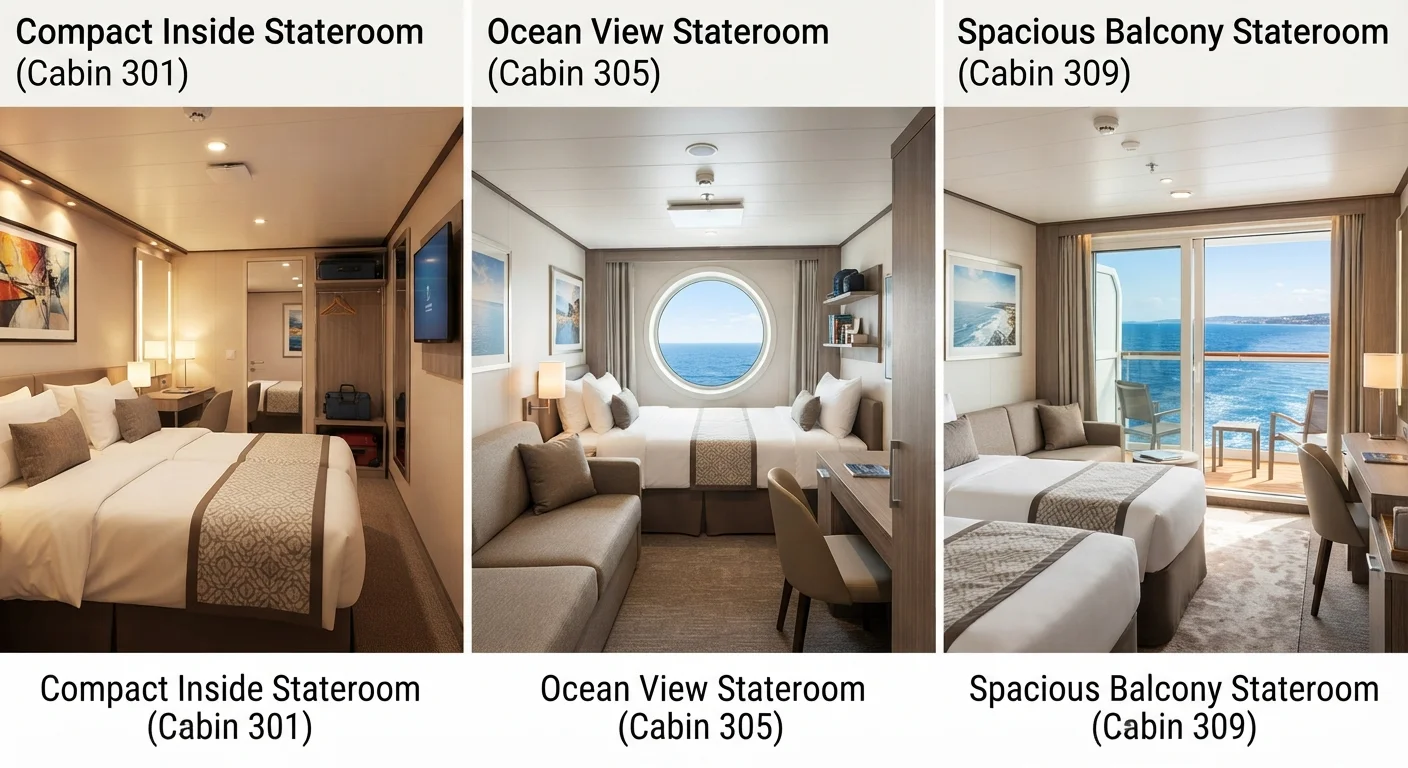
Inside cabins have no exterior window. They rely entirely on artificial lighting, which means they stay dark around the clock — appealing to some sleepers, disorienting for others. They are typically the smallest rooms on the ship, though newer vessels have expanded their dimensions considerably.
Ocean view cabins include a fixed porthole or a larger picture window, letting in daylight and a glimpse of the sea. The window does not open, so there is no fresh air or private outdoor space. These rooms sit on exterior-facing walls of the ship and tend to be slightly larger than inside cabins.
Balcony cabins — sometimes called verandah staterooms — feature a sliding glass door opening onto a private outdoor deck. You get natural light, open air, and direct views without leaving your room. They're typically priced noticeably higher than ocean view options. For context on how itinerary choice affects how much time you'll actually spend on that balcony, see our comparison of Caribbean vs. Mediterranean cruises.
| Inside Cabin | Ocean View | Balcony | |
|---|---|---|---|
| Natural light | None | Yes, fixed window | Yes, plus open-air access |
| Private outdoor space | No | No | Yes |
| Relative price | Lowest | Mid-range | Higher |
| Typical size | Smallest | Slightly larger | Largest of three |
| Best itinerary fit | Port-heavy, short trips | All-weather, moderate length | Scenic, longer voyages |
| Noise & motion exposure | Varies by deck | Exterior-facing, varies | Exterior-facing, varies |
| Sleep environment | Darkest, clock-free | Some daylight | Bright with outside sounds |
The Case for an Inside Cabin
Inside cabins carry a reputation as the economy option, but seasoned cruisers frequently choose them deliberately. On a seven-day Caribbean sailing where you're off the ship at nearly every port and spending evenings at shows, dining venues, and the pool deck, a cabin is essentially a place to sleep and shower. Paying a significant premium for a view you rarely sit down to enjoy is a calculation many experienced travelers decline to make.
The savings on cabin fare can be redirected toward shore excursions, specialty dining, or a drink package — categories that tend to have a more direct impact on the overall experience. Our guide on avoiding onboard overspending outlines exactly where those funds tend to go.
Check Square Footage Before Booking
Cabin dimensions vary significantly from ship to ship, even within the same category. A balcony stateroom on an older vessel may actually be smaller than an inside cabin on a newer mega-ship. Always review the specific square footage listed on the cruise line's deck plan rather than assuming category equals size.
One practical note: inside cabins are easier to keep dark during daytime naps, which some travelers — particularly those with young children or irregular sleep needs — find genuinely valuable.
When an Ocean View Is the Right Compromise
Ocean view cabins often get overlooked because they're positioned between two more clearly defined options. In practice, they solve a specific problem: the desire for natural light and a visual connection to the sea, without the cost jump of a balcony.
They work particularly well on cooler-weather itineraries — Alaska, Northern Europe, or transatlantic crossings — where you wouldn't spend much time on a balcony anyway due to wind and temperature. You still wake up to daylight and can watch the ship approach a port through your window, which adds meaningfully to the experience without the added expense.
Location within the ship matters for this category. Ocean view cabins near the bow or stern can be noisier or more subject to motion. Midship rooms on middle decks tend to offer the smoothest ride — worth considering if motion sensitivity is a concern. For more on managing sea sickness and onboard health, see our overview of staying healthy at sea.
Who Should Book a Balcony
A balcony cabin makes the strongest case for itself on longer voyages and itineraries built around scenic cruising — Alaska's Inside Passage, Norwegian fjords, or any route where the ship itself is part of the sightseeing. Watching glaciers calve or coastlines unfold from a private deck is a genuinely different experience from sharing a public observation area.
Balconies also suit travelers who value quiet downtime. Reading on a private deck, having morning coffee with an ocean view, or simply decompressing away from the ship's common areas adds real quality-of-life value on a 10- or 14-night voyage. On a short three- or four-night sailing, that value equation shifts considerably.
It's worth noting that balcony privacy isn't absolute. Cabins on curved ship sections may allow partial sightlines from neighboring balconies, and balconies on lower decks can sometimes be overlooked from public decks above. Checking a ship's deck plan before booking helps avoid surprises. For guidance on the full booking and planning process, our cruise planning timeline walks through each decision stage systematically.
Obstructed Views Are a Real Risk
Some balcony and ocean view cabins are listed as 'obstructed' — meaning a lifeboat, structural support, or overhang partially blocks the sightline. These rooms are typically discounted but may feel significantly less open than a standard balcony. Review the deck plan carefully and check if the line discloses obstruction levels in the cabin description before confirming your booking.