

Key Takeaways
Our Verdict
Neither renting nor buying is the objectively better financial move for everyone. Buying tends to reward those who stay in one place long enough to recoup transaction costs and build meaningful equity, while renting preserves flexibility and capital for those in transitional life stages or expensive markets. The strongest financial decisions are grounded in honest personal budgeting, realistic timelines, and local market data rather than cultural pressure in either direction.
| Best for | Recommended |
|---|---|
| Those planning to stay in one location for seven or more years | Buying |
| Those prioritizing mobility, lower upfront costs, or financial flexibility | Renting |
| Those with strong credit, stable income, and a sufficient down payment saved | Buying |
| Those in high-cost metros where price-to-rent ratios are especially elevated | Renting |
The Core Financial Difference: Equity vs. Flexibility
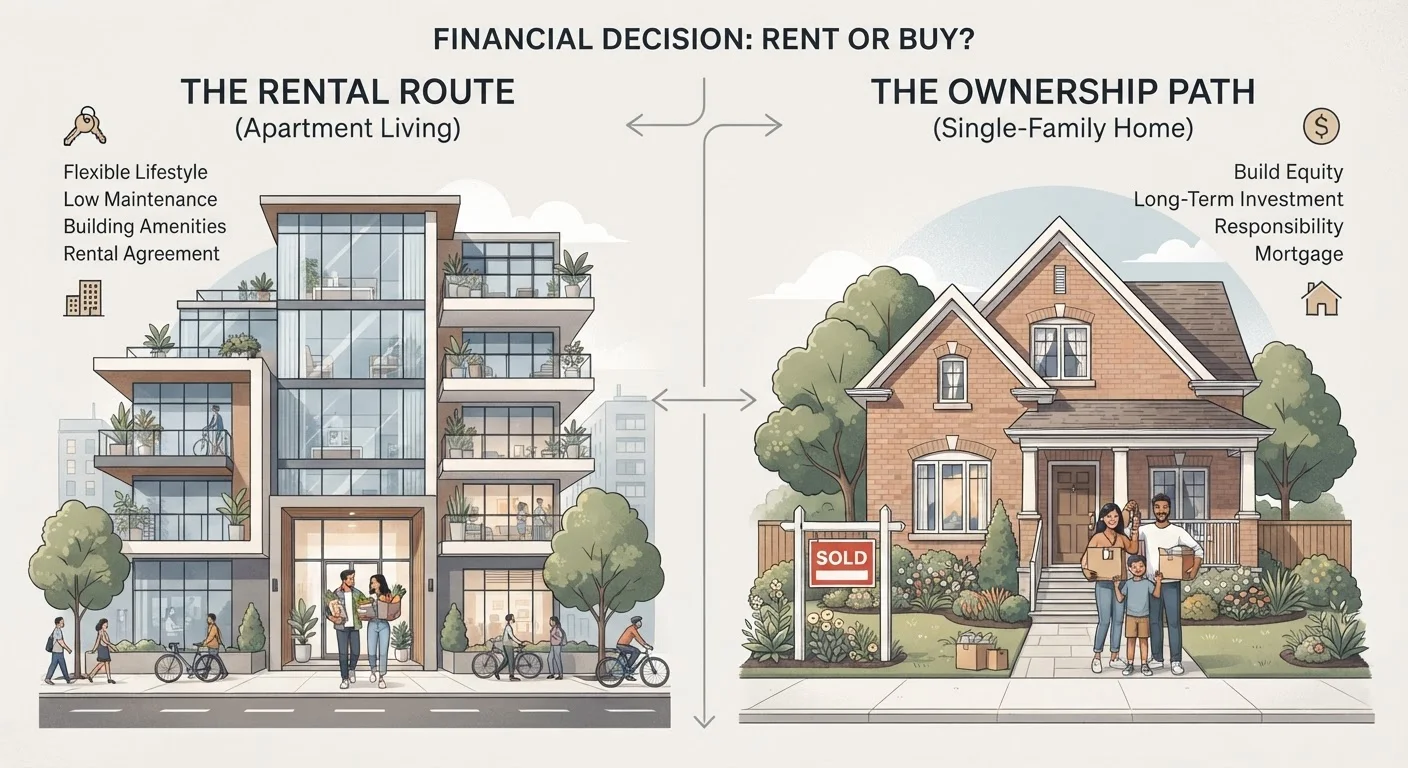
The fundamental distinction between renting and buying isn't simply about monthly payments — it's about what each arrangement does (or doesn't) do for your financial position over time.
When you buy, a portion of each mortgage payment reduces your loan principal, gradually building home equity — the share of the home's value you actually own outright. As values appreciate and the loan balance falls, that equity can become a meaningful financial asset. For a plain-language breakdown of how this process works, see how home equity builds and how it's used.
When you rent, monthly payments cover housing costs without accumulating ownership. That isn't inherently a loss — renters preserve capital that could be invested elsewhere, avoid large transaction costs, and retain the freedom to relocate. The question is whether those advantages outweigh the equity-building potential of ownership in a given situation.
| Renting | Buying | |
|---|---|---|
| Upfront costs | Security deposit, first/last month | Down payment + closing costs (5–25% of price) |
| Monthly payment predictability | Fixed term; rent may rise at renewal | Fixed-rate mortgage is stable; taxes/insurance can change |
| Equity building | None | Grows with payments and appreciation |
| Maintenance responsibility | Landlord handles structural repairs | Owner bears all costs |
| Flexibility to relocate | High — typically 30–60 days notice | Low — selling takes months and costs 8–10% |
| Tax considerations | No property tax or mortgage deduction | Potential mortgage interest and tax deductions (varies) |
| Financial risk exposure | Limited to deposit and lease terms | Market value fluctuations, large repair costs |
The True Costs on Both Sides
Monthly rent is straightforward: you pay a set amount and the landlord handles structural repairs, property taxes, and insurance. But the full cost picture for buyers is far more complex.
Purchasing a home typically requires a down payment of 3–20% of the purchase price, plus closing costs averaging 2–5% of the loan amount, according to the Consumer Financial Protection Bureau (CFPB). Once inside, owners shoulder property taxes, homeowner's insurance, HOA fees where applicable, and ongoing maintenance — commonly estimated at 1–2% of a home's value annually. What US homeowners should budget for beyond their monthly mortgage payment covers these costs in detail.
Renters aren't cost-free either. Security deposits, renters insurance, and annual rent increases must be factored in. However, renters face no repair bills, no property tax exposure, and no risk of a sudden large maintenance cost like a failed HVAC system or roof replacement.
Run the Numbers for Your Local Market
National averages rarely reflect local realities. Before deciding, research the price-to-rent ratio in your target area — your city or county assessor's website, Zillow's market data, or a HUD-approved housing counselor can help you interpret local figures. A counselor can also review your full financial picture at no or low cost and is a resource the federal government recommends for prospective homebuyers.
What the Research and Data Actually Show
Academic and industry research consistently finds that the financial advantage of buying over renting depends heavily on how long you stay and where you live. Transaction costs when buying and selling — agent commissions, transfer taxes, loan origination fees — can easily exceed 8–10% of a home's value. In markets where home prices are flat or rising slowly, buyers who move within three to five years may not recover those costs.
~5 years
Typical break-even horizon for buying
Many financial analyses suggest buyers generally need to remain in a home at least five years to recoup transaction costs, though this varies significantly by market.
35.9%
Share of US households that rent
According to the U.S. Census Bureau's American Community Survey, roughly one in three American households rents rather than owns their home.
2–5%
Typical closing cost range
The CFPB estimates closing costs for homebuyers generally fall between 2% and 5% of the total loan amount, paid upfront at settlement.
The price-to-rent ratio — a home's purchase price divided by annual rent for a comparable property — is a useful benchmark. When that ratio is high (above 20 in many coastal metros), renting often makes stronger mathematical sense in the short term. When it's lower, buying can reach break-even faster.
Critically, the opportunity cost of a down payment matters. Capital tied up in a home cannot simultaneously be invested in a diversified portfolio. Whether home appreciation outpaces alternative investments varies by location and time horizon, and is not guaranteed.
Lifestyle and Life-Stage Factors That Shape the Math
Financial calculations don't exist in a vacuum. Life circumstances play an equally important role in determining which path makes sense.
- Job stability and mobility: Frequent relocation needs — common in certain careers or early career stages — favor renting. Owning a home you may need to sell quickly introduces transaction cost risk.
- Family planning: The desire for school district certainty, outdoor space, or long-term neighborhood roots often tips households toward buying when finances allow.
- Local market conditions: In high-cost metros, a comparable home may cost three to four times what equivalent rent would. In more affordable regions, the monthly gap between owning and renting may be modest.
- Credit and financial readiness: Mortgage approval depends on credit score, debt-to-income ratio, and down payment. Those not yet in strong financial shape may find renting the more prudent path while they prepare.
For renters evaluating lease structures while making this longer-term decision, understanding how month-to-month and fixed-term leases differ can help match housing commitments to life stage. And if you're preparing to commit to renting, what every US renter should know before signing a lease is a practical next step.
For those leaning toward ownership, exploring how fixed and adjustable mortgage rates compare is an important part of understanding the full financing picture. The homebuying guidance hub offers a structured starting point for the purchase process.
This article is for general informational purposes only and does not constitute personalized financial, legal, or real estate advice. Consult a licensed financial adviser or a HUD-approved housing counselor for guidance specific to your circumstances.