

Key Takeaways
Option A
Whole Foods
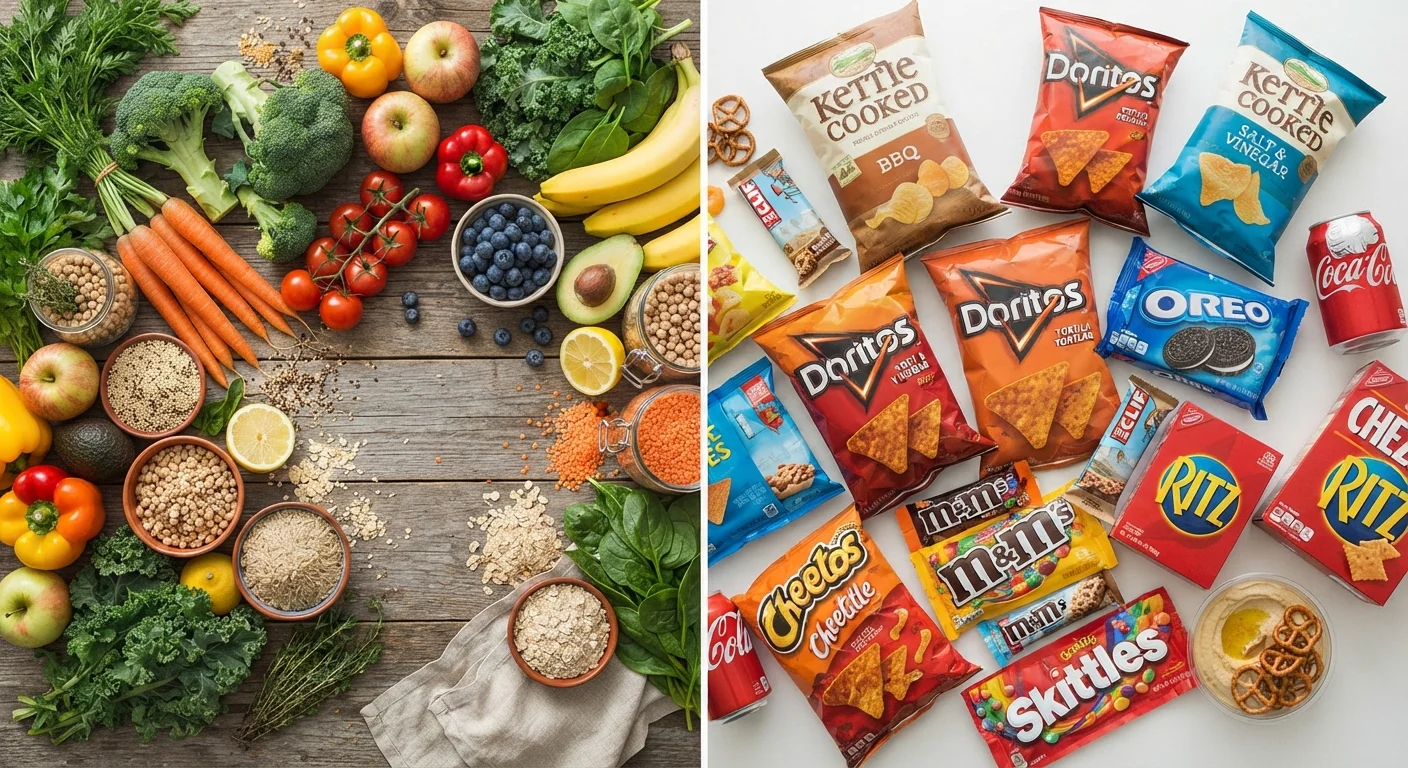
Foods in their natural or minimally altered state.
Best for: People seeking nutrient density, fiber, and long-term diet quality without relying on ingredient labels.
Option B
Ultra-Processed Foods
Industrially formulated products often engineered for palatability and shelf life.
Best for: Convenience and affordability in the short term, though regular heavy consumption is linked to poorer health outcomes.
If you want to maximize nutrient density in your daily diet
Whole Foods
Whole foods provide vitamins, minerals, fiber, and phytonutrients in naturally occurring combinations that are difficult to replicate in processed form.
If convenience and shelf life are primary practical concerns
Ultra-Processed Foods
Ultra-processed options offer speed and accessibility, though health professionals generally recommend limiting these to a small portion of overall intake.
If you are managing a chronic condition such as heart disease or type 2 diabetes
Whole Foods
Evidence links diets rich in whole foods to better cardiometabolic markers; always consult your healthcare provider for personalized dietary guidance.
If you are working within a tight grocery budget
Whole Foods
Staples like dried beans, oats, frozen vegetables, and whole grains are often among the most affordable options — see our guide on eating well on a budget.
How Food Processing Is Defined and Classified
Not all processing is harmful. Pasteurizing milk, freezing vegetables, or fermenting yogurt are all forms of food processing — and these methods can preserve nutritional value or even improve safety. The critical distinction lies in the degree of processing.
The most widely used scientific framework for this distinction is the NOVA classification system, developed by researchers at the University of São Paulo. NOVA divides foods into four groups:
- Group 1 — Unprocessed or minimally processed foods: Fruits, vegetables, eggs, plain meat, legumes, nuts, and milk. These are whole foods in their natural or near-natural state.
- Group 2 — Processed culinary ingredients: Oils, butter, flour, salt, and sugar — extracted from natural sources and used to prepare Group 1 foods at home.
- Group 3 — Processed foods: Items made by combining Group 1 and 2 foods, such as cheese, canned fish, or artisan bread.
- Group 4 — Ultra-processed foods (UPF): Industrial formulations containing ingredients rarely found in home kitchens — emulsifiers, artificial flavors, color additives, hydrogenated oils, and high-fructose corn syrup.
Understanding this spectrum helps clarify why a can of plain chickpeas and a bag of flavored crackers represent fundamentally different categories, even if both come in packaging.
| Criterion | Whole Foods | Ultra-Processed Foods |
|---|---|---|
| Definition | Unprocessed or minimally altered natural foods | Industrially formulated multi-ingredient products |
| Fiber content | Naturally high in dietary fiber | Typically low; fiber often removed during processing |
| Micronutrient density | Rich in vitamins and minerals | Often depleted; some nutrients added back artificially |
| Added sugars & sodium | Little to none (naturally occurring only) | Frequently high in both |
| Shelf life | Shorter; requires refrigeration or prompt use | Extended via preservatives and packaging |
| Satiety signaling | Promotes fullness through fiber and food matrix | May reduce satiety, potentially driving higher intake |
| Associated health outcomes | Linked to lower chronic disease risk in research | Higher consumption associated with cardiometabolic risk |
| Ingredient complexity | Single ingredient or simple whole combinations | Often contains additives, emulsifiers, artificial flavors |
Nutritional Differences and Health Evidence
Whole foods deliver nutrients in a matrix — fiber, antioxidants, vitamins, and minerals interact synergistically within the food's natural structure. This matrix affects how quickly nutrients are absorbed and how the body responds metabolically. Ultra-processed foods, by contrast, are typically lower in fiber and micronutrients while being higher in sodium, added sugars, and saturated fat.
57%
Share of US adult calories from ultra-processed foods
A 2016 analysis published in BMJ Open estimated that ultra-processed foods account for more than half of daily caloric intake among US adults.
500 kcal
Extra daily calories consumed on ultra-processed diet
A 2019 randomized controlled trial in Cell Metabolism (Hall et al.) found participants on an ultra-processed diet consumed roughly 500 more calories per day than on an unprocessed diet.
12%
Higher all-cause mortality risk associated with UPF
A large prospective cohort study (Rico-Campà et al., BMJ, 2019) found a 12% higher all-cause mortality risk for each 10-percentage-point increase in ultra-processed food consumption.
A landmark 2019 randomized controlled trial published in Cell Metabolism (Hall et al.) found that participants given an ultra-processed diet consumed, on average, 500 more calories per day and gained weight compared with those on an unprocessed diet — even when both diets were matched for presented nutrients. The researchers attributed the difference partly to the speed of eating and reduced satiety signaling from ultra-processed foods.
Epidemiological data reinforce these findings. Large cohort studies have associated higher UPF consumption with elevated risks of cardiovascular disease, type 2 diabetes, depression, and all-cause mortality. These are associations, not proof of direct causation, and researchers continue to investigate which specific aspects of ultra-processing drive the observed effects.
Understanding added sugars is part of this picture — our article on natural vs. added sugars explains the distinction and its health context. If you want to dig into how diet patterns that emphasize whole foods perform in clinical research, see our overview of Mediterranean, DASH, and plant-based diets.
Protein Sources Also Factor In
The whole foods vs. ultra-processed distinction applies to protein sources as well. Plain legumes, eggs, and fish are whole-food proteins, while many processed meat products fall into higher processing categories. For a broader look at protein quality across food types, see our comparison of plant and animal proteins.
Making Practical Shifts Without an All-or-Nothing Mindset
Dietary change rarely happens overnight, and rigid elimination of all processed foods is neither realistic nor necessary for most people. The evidence supports meaningful improvement at the margin — moving from a diet where ultra-processed foods dominate to one where whole foods make up the majority.
Practical starting points include:
- Replacing sweetened beverages with water, plain sparkling water, or unsweetened drinks.
- Choosing oats, whole grain bread, or brown rice over highly refined grain products.
- Snacking on fruit, nuts, or plain yogurt rather than packaged snack foods engineered for overconsumption.
- Cooking simple meals from whole ingredients — frozen vegetables and canned legumes count and are cost-effective.
When shopping, learning to read food labels is a practical tool. Our guide on reading a nutrition label walks through serving sizes, daily values, and how to spot added sugars and sodium quickly.
If you are managing a health condition or have specific dietary concerns, a registered dietitian can provide personalized guidance. This article is for general informational purposes only and is not a substitute for professional medical or nutritional advice.
This article is for informational and educational purposes only. It does not constitute medical or nutritional advice. Please consult a qualified healthcare professional before making significant changes to your diet, especially if you have an underlying health condition.