

Key Takeaways
Our Verdict
Mutual funds and ETFs are complementary tools, not competitors. ETFs tend to offer structural advantages in cost, tax efficiency, and flexibility for self-directed investors who trade through taxable brokerage accounts. Mutual funds remain valuable for automatic investment plans, certain actively managed strategies, and retirement accounts where intraday pricing is irrelevant. The best fit depends on your individual circumstances—consult a licensed financial adviser before making portfolio decisions.
| Best for | Recommended |
|---|---|
| Cost-conscious, self-directed investors in taxable accounts | ETFs |
| Investors who want automatic, scheduled contributions | Mutual Funds |
| Those seeking broad passive market exposure at low cost | ETFs |
| Retirement savers using employer-sponsored 401(k) plans | Mutual Funds |
What Are Mutual Funds and ETFs?
Both mutual funds and exchange-traded funds (ETFs) pool money from many investors to buy a diversified basket of securities—stocks, bonds, or other assets. That shared structure is where the similarity begins to break down. Understanding each vehicle's mechanics helps clarify which might suit a given investor's needs.
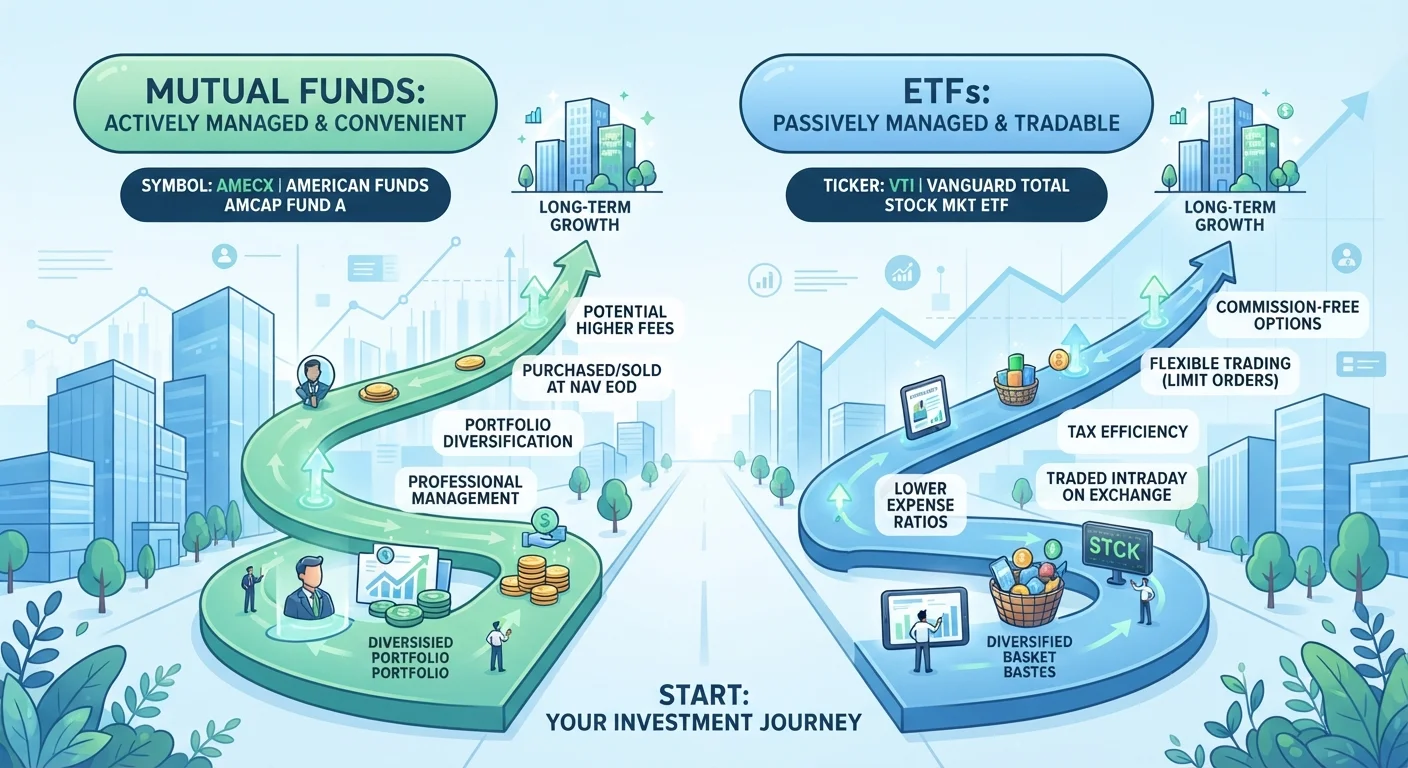
A mutual fund is purchased directly from the fund company (or through a broker) at a price calculated once per trading day, after markets close. That price is called the NAV—the total value of the fund's holdings divided by the number of outstanding shares.
An ETF, by contrast, is listed on a stock exchange and trades continuously throughout the day, just like an individual stock. Prices fluctuate in real time based on supply and demand, though they typically track closely to the underlying NAV. For a plain-language primer on how markets price securities, see how the stock market works.
| Feature | Mutual Funds | ETFs | |
|---|---|---|---|
| Pricing | Once daily, after market close (NAV) | Continuously throughout trading day | |
| Where Purchased | Fund company or broker | Stock exchange via brokerage account | |
| Minimum Investment | Often $500–$3,000+ | Cost of one share (or fractional) | |
| Typical Expense Ratio | Higher (active); lower (index) | Generally lower, especially for index funds | |
| Tax Efficiency (Taxable Accounts) | Lower — capital gain distributions common | Higher — in-kind redemptions limit distributions | |
| Automatic Contributions | Easily supports dollar-based scheduling | Requires fractional share support | |
| Intraday Trading | Not available | Available; bid-ask spread applies |
Key Structural Differences That Affect Everyday Investors
Trading mechanics: Because ETFs trade on exchanges, investors need a brokerage account and place buy or sell orders just as they would for a stock. This also means ETF buyers may pay a bid-ask spread—the small gap between the price a buyer pays and a seller receives. Mutual fund investors sidestep bid-ask spreads but have no control over the execution price during the trading day.
Minimum investments: Many mutual funds set minimum initial purchase amounts—sometimes $1,000 or more. ETFs typically require only enough to buy one share, and many brokers now offer fractional shares, reducing the barrier further.
Tax efficiency: When mutual fund managers sell securities to meet redemptions from departing investors, the resulting capital gains can be distributed to all remaining shareholders—creating a potential tax bill even for investors who didn't sell. ETFs use an in-kind creation and redemption mechanism that generally avoids this issue, making them more tax-efficient in taxable accounts. This distinction matters less inside tax-advantaged accounts like IRAs or 401(k)s.
Hold ETFs in Taxable Accounts When Possible
If you invest in both account types, many financial planners suggest placing tax-efficient ETFs in taxable brokerage accounts and keeping actively managed mutual funds—which may distribute taxable capital gains—inside tax-advantaged accounts like IRAs or 401(k)s. This approach, sometimes called asset location, can reduce your overall tax drag over time. Speak with a tax professional to evaluate what makes sense for your situation.
For investors building a long-term portfolio across different life stages, understanding how these vehicles fit within a broader allocation strategy is equally important. See asset allocation across life stages for context.
Costs: Expense Ratios and Hidden Fees
Both fund types charge an expense ratio—an annual fee expressed as a percentage of assets—to cover management, administration, and operational costs. Passively managed index ETFs have driven expense ratios to historic lows, with many broad-market ETFs charging under 0.10% annually. Actively managed mutual funds typically charge more, often between 0.50% and 1.00% or higher, to compensate portfolio managers making day-to-day security selections.
0.06%
Average ETF expense ratio (asset-weighted)
According to the Investment Company Institute's 2023 annual report on US-registered investment companies.
0.66%
Average actively managed mutual fund expense ratio
Investment Company Institute data reflects asset-weighted averages for actively managed equity mutual funds.
Some mutual funds also carry sales loads—commissions paid when buying (front-end load) or selling (back-end load) shares. No-load mutual funds eliminate these charges, and most ETFs have no sales load structure. However, frequent ETF trading can accumulate transaction costs through bid-ask spreads, so ETFs are not automatically "free" to trade actively.
Both mutual funds and ETFs can follow passive index strategies. For a deeper look at why index-based investing has grown popular, explore how index funds work and why many long-term investors favor them.
Choosing Between Them: Practical Considerations
No single vehicle is right for every investor. A few practical questions can guide the decision:
- Account type: In a 401(k), your plan's menu likely limits you to mutual funds. In a taxable brokerage account, the ETF's tax efficiency advantage becomes more meaningful.
- Contribution style: Mutual funds accept dollar-based automatic contributions on a schedule—useful for investors who want to invest a set dollar amount each paycheck. Most ETFs require purchasing whole shares (or fractional shares where supported), which can complicate precise dollar-amount investing.
- Active vs. passive strategy: Both wrappers offer passive index funds and actively managed options. The decision between active and passive management is separate from the mutual fund vs. ETF decision.
For a glossary of terms used throughout investing conversations—including NAV, expense ratio, and capital gains distributions—consult the investing reference glossary designed for US beginners.
This article is for general informational and educational purposes only and does not constitute personalized investment, tax, or legal advice. Consult a qualified, licensed financial adviser before making investment decisions based on your individual circumstances.