

Key Takeaways
Why Asset Allocation Matters at Every Age
Asset allocation refers to how an investment portfolio is divided among different asset classes — primarily stocks (equities), bonds (fixed income), and cash or cash equivalents. The mix you choose has a profound effect on both the growth potential and the volatility of your portfolio over time.
The fundamental idea is straightforward: stocks historically offer higher long-term growth but come with greater short-term price swings. Bonds tend to be more stable but typically generate lower returns. The challenge — and the discipline — of asset allocation is finding the right balance for your situation at each stage of life.
Understanding how risk tolerance works is the essential first step, since your capacity and willingness to absorb losses should anchor every allocation decision you make.
This Is General Education, Not Personal Advice
The information in this article describes broad, commonly discussed principles of asset allocation. It is not tailored financial, tax, or investment advice. Individual circumstances vary significantly. Always consult a licensed financial professional before making investment decisions.
Early Career: Prioritizing Growth Over Stability
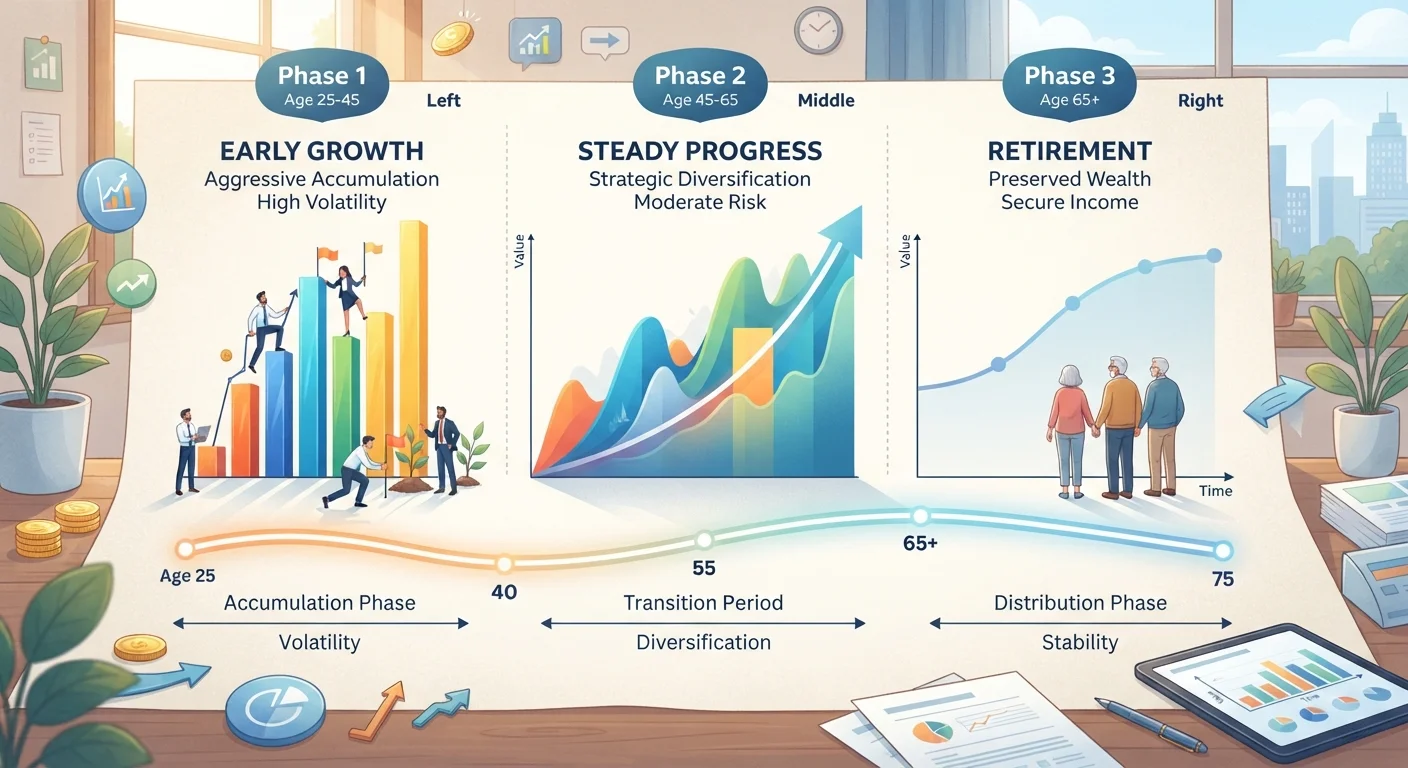
Investors in their 20s and early 30s have one major advantage: time. A long horizon means a portfolio can weather market downturns and still compound gains over decades. This is why conventional financial guidance typically favors a higher allocation to equities during this life stage.
The power of compounding rewards those who start early and stay invested. As explained in our overview of what compound interest actually does to savings, growth accelerates the longer money stays invested — making the early years especially valuable.
Lean heavily toward equities in your 20s and early 30s to maximize long-term growth potential.
Time is the most powerful variable in investing. A longer horizon allows a portfolio to absorb market downturns and recover before funds are needed. Equity markets have historically delivered stronger long-run returns than bonds, though past performance does not guarantee future results.
Gradually shift toward a more balanced mix in your 40s as competing financial priorities mount.
Mid-career often brings higher income but also greater financial obligations — mortgages, children's education costs, aging parents. A moderate allocation blend can maintain growth while reducing the impact of a severe market downturn on a now-larger portfolio.
Increase allocation to bonds and stable assets in your 50s and early 60s to preserve accumulated wealth.
With retirement drawing closer, the portfolio has less time to recover from sharp losses. Capital preservation becomes a priority alongside continued modest growth. A downturn right before or just after retirement can significantly affect retirement income.
In retirement, maintain some equity exposure to guard against inflation and longevity risk.
Longevity risk — the possibility of outliving your savings — is real. A portfolio too heavily weighted in bonds or cash may not keep pace with inflation over a 20- to 30-year retirement. A modest equity allocation can help sustain purchasing power over time.
Rebalance your portfolio at regular intervals to stay aligned with your target allocation.
Markets move unevenly. Over time, strong equity returns can push a portfolio well beyond its intended stock allocation, inadvertently increasing risk exposure. Periodic rebalancing — typically annually or after significant market shifts — restores the intended balance.
Broad diversification within equities is important at this stage. Index funds offer a low-cost way to access wide market exposure without the complexity of selecting individual securities.
Mid-Career and Pre-Retirement: Moderating Risk Gradually
As investors enter their 40s and 50s, the calculus shifts. Portfolios are typically larger, which means a significant market decline has greater dollar-denominated impact — even if the percentage loss is the same. At the same time, retirement is no longer an abstract future event.
This stage calls for a gradual, deliberate shift toward a more balanced allocation. The goal is not to abandon growth entirely but to reduce the downside risk of a poorly timed downturn. Avoid the common error of making dramatic, emotional allocation changes in response to short-term market movements — a pattern explored in our article on investing mistakes that cost years of progress.
Choosing the right account structure also matters during this phase. Understanding the differences between account types — such as those outlined in our guide to Roth IRA vs. Traditional IRA — can affect how tax-efficiently you hold different asset classes.
Retirement: Sustaining Income Without Running Out
Retirement does not mean investment decisions end. In fact, managing a portfolio to generate sustainable income over potentially 20–30 years is one of the most complex financial challenges many Americans face.
“The most important thing about an investment policy is that you have one — and that you stick to it. Asset allocation is not a formula; it is a discipline.”
— Burton Malkiel, Economist and author of 'A Random Walk Down Wall Street'
A common concern is being overly conservative. Holding too much in cash or short-term bonds exposes retirees to inflation risk — the gradual erosion of purchasing power. Maintaining a measured allocation to diversified equities can help a portfolio continue growing even as withdrawals are made.
Diversification across asset classes remains important in retirement, as no single type of investment performs well in every economic environment. Rebalancing annually or after major market movements helps maintain the intended allocation as conditions change.
This article is intended for general educational purposes only and does not constitute personalized financial, investment, or tax advice. Investment involves risk, including the possible loss of principal. Past performance does not guarantee future results. Please consult a qualified, licensed financial adviser for guidance suited to your individual circumstances.