

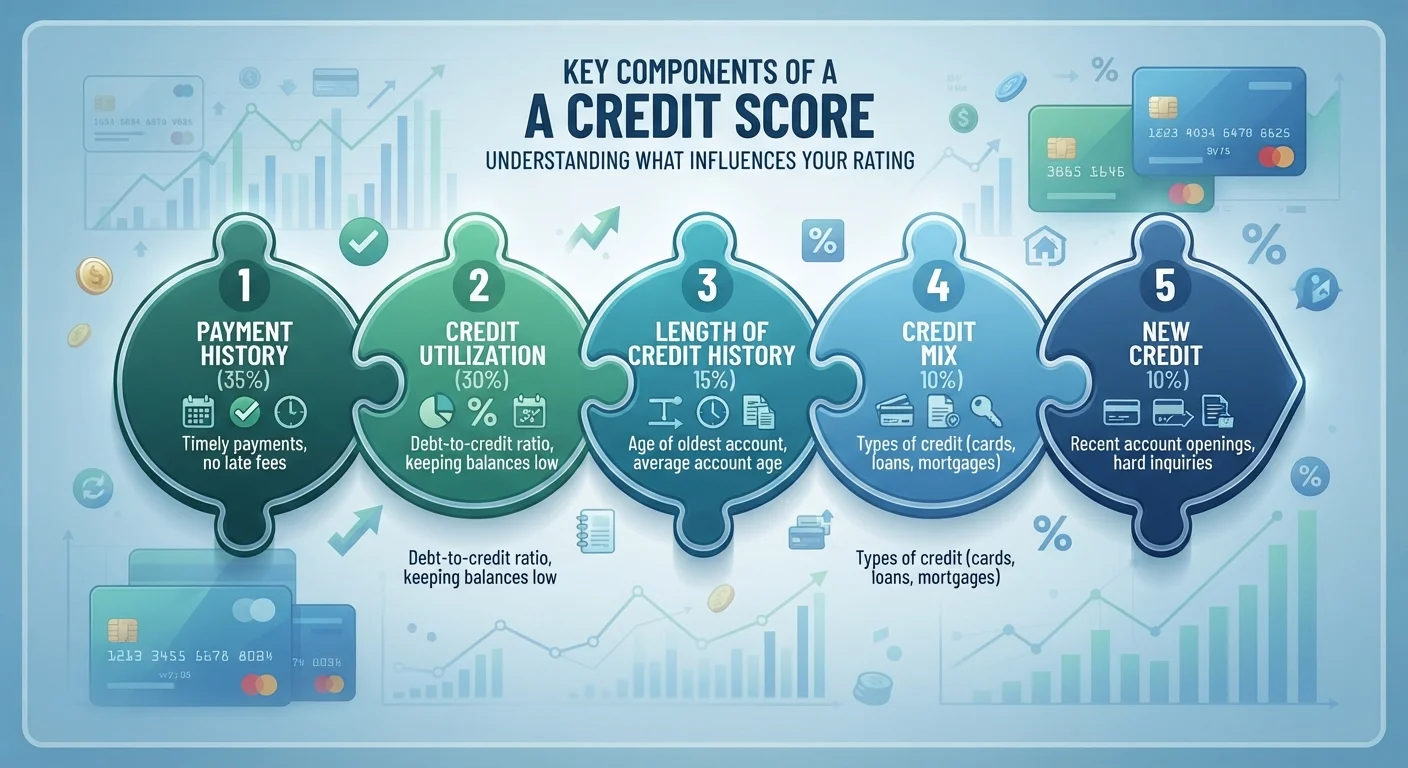
| Payment History Weight | 35% of FICO Score (FICO scoring model) |
| Credit Utilization Weight | 30% of FICO Score (FICO scoring model) |
| Length of Credit History Weight | 15% of FICO Score (FICO scoring model) |
| New Credit (Inquiries) Weight | 10% of FICO Score (FICO scoring model) |
| Credit Mix Weight | 10% of FICO Score (FICO scoring model) |
| Score Range | 300–850 (FICO and VantageScore models) |
What Your Credit Score Is Actually Measuring
Your credit score doesn't measure wealth or income—it measures how reliably you've managed borrowed money. Lenders, landlords, and even some employers use it as a proxy for financial responsibility. Under the FICO model, the most widely used framework in the US, your score is built from five distinct factors, each weighted by its predictive power.
| Payment History Weight | 35% of FICO Score (FICO scoring model) |
| Credit Utilization Weight | 30% of FICO Score (FICO scoring model) |
| Length of Credit History Weight | 15% of FICO Score (FICO scoring model) |
| New Credit (Inquiries) Weight | 10% of FICO Score (FICO scoring model) |
| Credit Mix Weight | 10% of FICO Score (FICO scoring model) |
| Score Range | 300–850 (FICO and VantageScore models) |
Understanding those weights lets you focus your energy where it actually matters. For a broader overview of how credit reporting fits into your financial life, see our comprehensive credit guide.
This article is for general informational purposes only and does not constitute personalized financial or legal advice. Consult a licensed financial professional for guidance specific to your situation.
The Five Factors, Ranked by Weight
1. Payment History (35%)
This is the single biggest factor in your score. Every on-time payment reinforces your profile; every missed or late payment works against it. A payment reported 30 or more days late can remain on your report for up to seven years under the Fair Credit Reporting Act. Consistent, on-time payments are the most reliable path to a strong score over time.
35%
Largest single factor: payment history
According to the FICO scoring model, on-time payments carry more weight than any other factor.
30%
Weight of credit utilization
FICO data indicates that keeping balances well below credit limits is the second most impactful scoring behavior.
7 years
How long most negative items remain on file
Under the Fair Credit Reporting Act, most derogatory marks—including late payments—can remain on a credit report for up to seven years.
2. Credit Utilization (30%)
This is the percentage of your revolving credit limits you're currently using. Keeping this ratio low—generally below 30%, and ideally lower—signals that you're not overextended. For a detailed breakdown of how this calculation works and what thresholds to target, see how credit utilization actually works.
3. Length of Credit History (15%)
Scoring models consider how long your oldest account has been open, the age of your newest account, and the average age of all accounts. Older accounts generally help your score, which is why closing long-standing cards—even unused ones—can sometimes be counterproductive.
4. New Credit and Hard Inquiries (10%)
Each time you apply for a new credit product, the lender performs a hard inquiry. A single inquiry has a minor, temporary effect on your score. But multiple applications in a short period can signal financial stress to lenders.
5. Credit Mix (10%)
Lenders like to see that you can handle different types of credit responsibly—revolving accounts (like credit cards) and installment loans (like auto or student loans). You don't need every type of account, but a reasonable mix can modestly benefit your score. Managing credit responsibly over the long term covers how to build this mix naturally over time.
FICO vs. VantageScore: Know the Difference
FICO and VantageScore are the two most widely used credit scoring models in the US. While they share similar factors and use the same 300–850 range, they weight those factors slightly differently. Most mortgage lenders rely on FICO scores specifically. The percentages cited in this article reflect the FICO model. Check which model a lender uses before applying.
Key Terms to Know
Credit Score
A three-digit number, typically ranging from 300 to 850, that summarizes your creditworthiness based on information in your credit report. Lenders use it to assess lending risk.
Credit Utilization Ratio
The percentage of your available revolving credit that you're currently using. It's calculated by dividing your total credit card balances by your total credit limits.
Hard Inquiry
A credit check triggered when you apply for new credit. Hard inquiries appear on your credit report and can modestly lower your score for up to two years.
Credit Mix
The variety of credit account types you carry, such as credit cards, auto loans, and mortgages. A diverse mix can positively influence your score.
Derogatory Mark
A negative item on your credit report—such as a late payment, collection, or bankruptcy—that signals elevated risk to lenders and lowers your score.
Some score-damaging habits aren't obvious until the damage has already accumulated. To learn which behaviors carry hidden risk, read about credit behaviors that quietly drag down your score over time.