

| Federal Highway Speed Authority | States set their own speed limits; federal law does not mandate a national maximum (FHWA, Highway Safety Overview) |
| Color of Posted Speed Limit Signs | White - indicates a legal, enforceable limit (MUTCD (Manual on Uniform Traffic Control Devices)) |
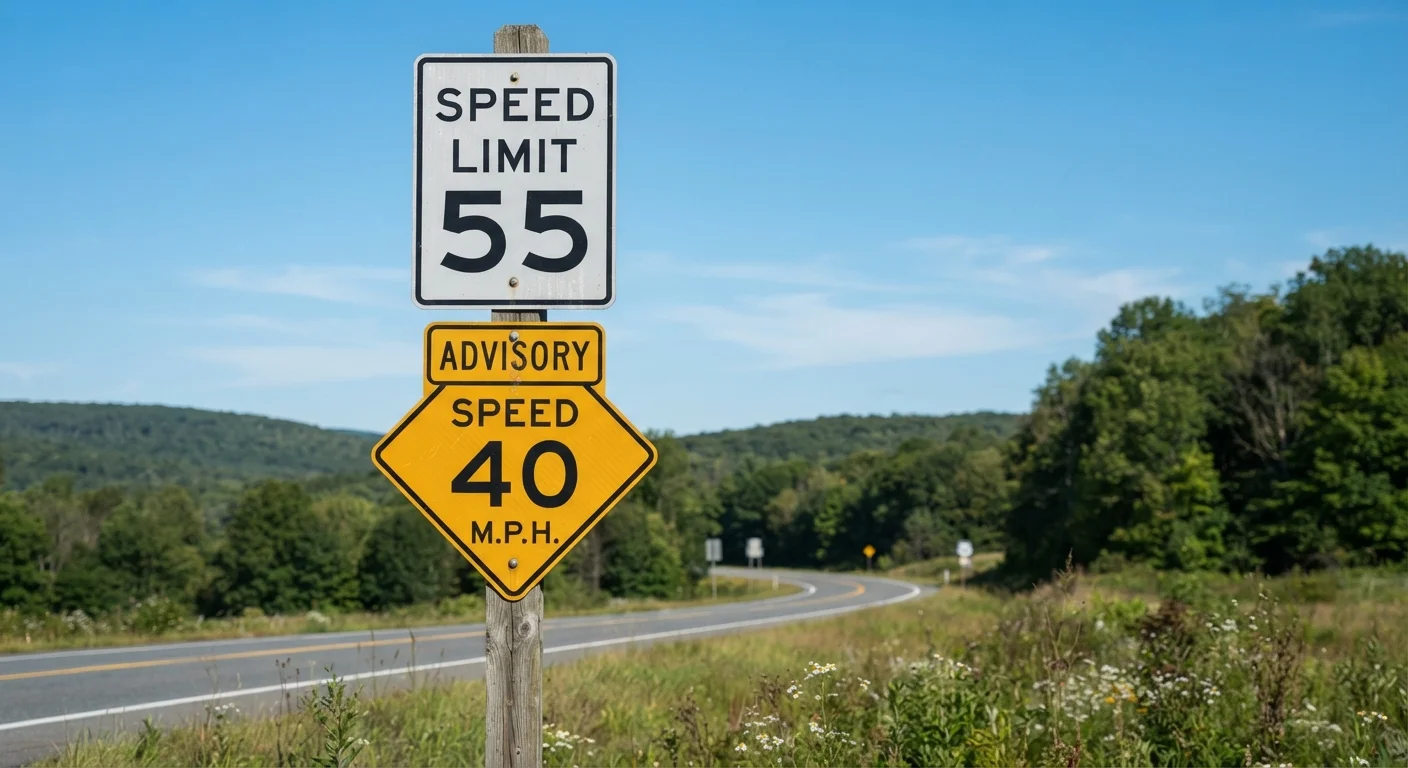
| Color of Advisory Speed Signs | Yellow - indicates a warning or recommendation, not a legal limit (MUTCD) |
| Most Common Statutory Urban Limit | 25 mph in most US states for urban/residential areas without posted signs (GHSA State Speed Laws Summary) |
| Highest Interstate Speed Limit (US) | 85 mph - State Highway 130, Texas (Texas DOT) |
| Basic Speed Law | Applies in all 50 states - drivers must travel at a safe speed for conditions regardless of posted limits (Governors Highway Safety Association) |
Why Speed Sign Types Matter
Not every speed-related sign on a US road carries the same legal weight - and treating them as identical can lead to confusion, traffic violations, or unsafe driving decisions. The federal MUTCD establishes a national standard for sign design, but individual states control the laws behind those signs. Understanding what each type of sign actually means helps drivers make better, safer decisions.
This reference guide explains the three main categories of speed regulation US drivers encounter: statutory speed limits, posted speed limits, and advisory speeds. It also covers how the basic speed law operates alongside all of them.
For a broader look at how speed affects safety outcomes, see the safety trade-offs of driving faster.
| Federal Highway Speed Authority | States set their own speed limits; federal law does not mandate a national maximum (FHWA, Highway Safety Overview) |
| Color of Posted Speed Limit Signs | White - indicates a legal, enforceable limit (MUTCD (Manual on Uniform Traffic Control Devices)) |
| Color of Advisory Speed Signs | Yellow - indicates a warning or recommendation, not a legal limit (MUTCD) |
| Most Common Statutory Urban Limit | 25 mph in most US states for urban/residential areas without posted signs (GHSA State Speed Laws Summary) |
| Highest Interstate Speed Limit (US) | 85 mph - State Highway 130, Texas (Texas DOT) |
| Basic Speed Law | Applies in all 50 states - drivers must travel at a safe speed for conditions regardless of posted limits (Governors Highway Safety Association) |
Statutory vs. Posted Speed Limits
Statutory speed limits are set by state law and apply to entire categories of road - residential streets, rural highways, interstate freeways - even where no sign is visible. A driver unfamiliar with local law is still legally responsible for observing them. Common examples include 25 mph in urban districts and 55 mph on two-lane rural roads, though exact figures vary by state.
Posted speed limits appear on white rectangular signs and represent the legally enforceable maximum for that specific stretch of road. Exceeding a posted limit is a violation in every US jurisdiction. Whether a state uses an absolute or prima facie speed law determines how much legal flexibility (if any) exists - but in practice, absolute laws are more common and leave no room for argument.
Statutory Speed Limit
A maximum speed set by state law that applies to a road type even when no sign is posted. Drivers are expected to know these limits without a posted sign.
Posted Speed Limit
A legally enforceable maximum speed displayed on a white rectangular sign. Exceeding it constitutes a traffic violation regardless of road or weather conditions.
Advisory Speed
A recommended, non-mandatory speed shown on a yellow sign, typically on curves or ramps. It is not a legal maximum but indicates the speed at which the road feature was designed to be safely navigated.
Prima Facie Speed Law
A legal standard used in some states where posted limits are presumptively safe speeds. A driver can theoretically argue that a higher speed was safe under the specific conditions, though this defense is difficult to sustain in court.
Absolute Speed Law
A legal standard used in many states where any speed above the posted limit is automatically a violation, with no allowance for arguing that the speed was otherwise safe.
Basic Speed Law
A principle present in virtually every US state requiring drivers to travel at a speed that is reasonable and prudent given current conditions - independent of any posted limit.
Speed limits may be raised or lowered from a state's statutory default to reflect local engineering studies, land use, or safety data. This is why a street that looks like a 35 mph road may be posted at 25 mph, or a rural highway may carry a 65 mph sign rather than the 55 mph default.
Advisory Speeds and Yellow Warning Signs
Yellow diamond or pennant-shaped signs with speed values are advisory, not mandatory. These appear most often before sharp curves, freeway on-ramps, or intersections with limited sight lines. The number reflects the speed at which the road feature was designed to be safely navigated under normal, dry conditions.
Yellow Signs Are Warnings, Not Limits
Drivers sometimes confuse yellow advisory speed signs with enforceable limits. Advisory speeds are engineering recommendations for navigating a curve, ramp, or intersection safely. You will not receive a speeding ticket for exceeding an advisory speed alone - but you could be cited for reckless or unsafe driving if conditions contribute to an incident.
School and Work Zones Have Special Rules
Speed limits in school zones and active construction zones are legally enforceable, often with enhanced penalties for violations. These limits may differ from the surrounding road's posted limit and can apply only during specific hours. Always watch for flashing beacons or flaggers that signal when reduced limits are active.
Because advisory speeds are engineering benchmarks rather than legal limits, exceeding them is not automatically a traffic violation. However, the basic speed law - present in all 50 states - requires every driver to travel at a speed that is reasonable and prudent given current road, weather, and traffic conditions. A driver who ignores a 20 mph curve advisory and loses control on a wet road may face a reckless driving charge even if they never crossed a posted limit.
This interaction between advisory speeds and the basic speed law is especially relevant in adverse weather. See how conditions change the rules for speed and control for practical guidance.
Special Zones, Variable Limits, and Practical Takeaways
Beyond standard highway and street signs, drivers encounter speed regulation in specific contexts:
- School zones: Reduced limits - commonly 15-25 mph - typically apply during arrival and dismissal hours. Many jurisdictions double fines for violations.
- Work zones: Active construction areas post temporary limits enforced with increased penalties in most states.
- Variable speed limit signs: Electronic signs on some interstates display speeds that change based on traffic, weather, or incidents. These are legally enforceable in the states that use them.
- Minimum speed limits: Some highways post a minimum as well as a maximum. Traveling significantly below the flow of traffic creates its own collision risk and may be a violation.
The safest approach is to treat posted limits as ceilings, not targets. Defensive driving principles call for adjusting speed continuously based on visibility, road surface, traffic density, and your vehicle's condition - not simply matching the number on the sign. For a comprehensive look at road safety practices, refer to this end-to-end road safety guide for US drivers.
29%
Of all US traffic fatalities involving speeding
According to NHTSA's Traffic Safety Facts report, speeding was a factor in approximately 29% of all motor vehicle crash deaths in a recent reporting year.
50+
Different state speed limit regimes in the US
Because each state independently sets speed laws, limits and enforcement standards vary considerably across the country.
85th percentile
Engineering basis for many posted speed limits
Traffic engineers commonly set speed limits at or near the speed at or below which 85% of vehicles naturally travel under free-flow conditions.