

Key Takeaways
Why Right-of-Way Confusion Causes Crashes
Misunderstood right-of-way rules are a consistent contributing factor in intersection and merge-zone crashes across the United States. The legal framework governing who goes first is established in each state's motor vehicle code, yet surveys of licensed drivers routinely show widespread uncertainty about basic scenarios - four-way stops, highway on-ramps, and roundabouts among them.
Part of the confusion stems from a fundamental misreading of what right-of-way actually means. It is not a guaranteed privilege one driver possesses; it is a framework of yielding. No driver can demand the right-of-way - other road users can only choose to give it up. Understanding that distinction shifts how you approach every intersection and merge point. See our guide to defensive driving for more on how anticipating others' mistakes fits into the broader safety picture.
Myth
When you're merging onto a highway, drivers in the through lane are supposed to move over and let you in.
Fact
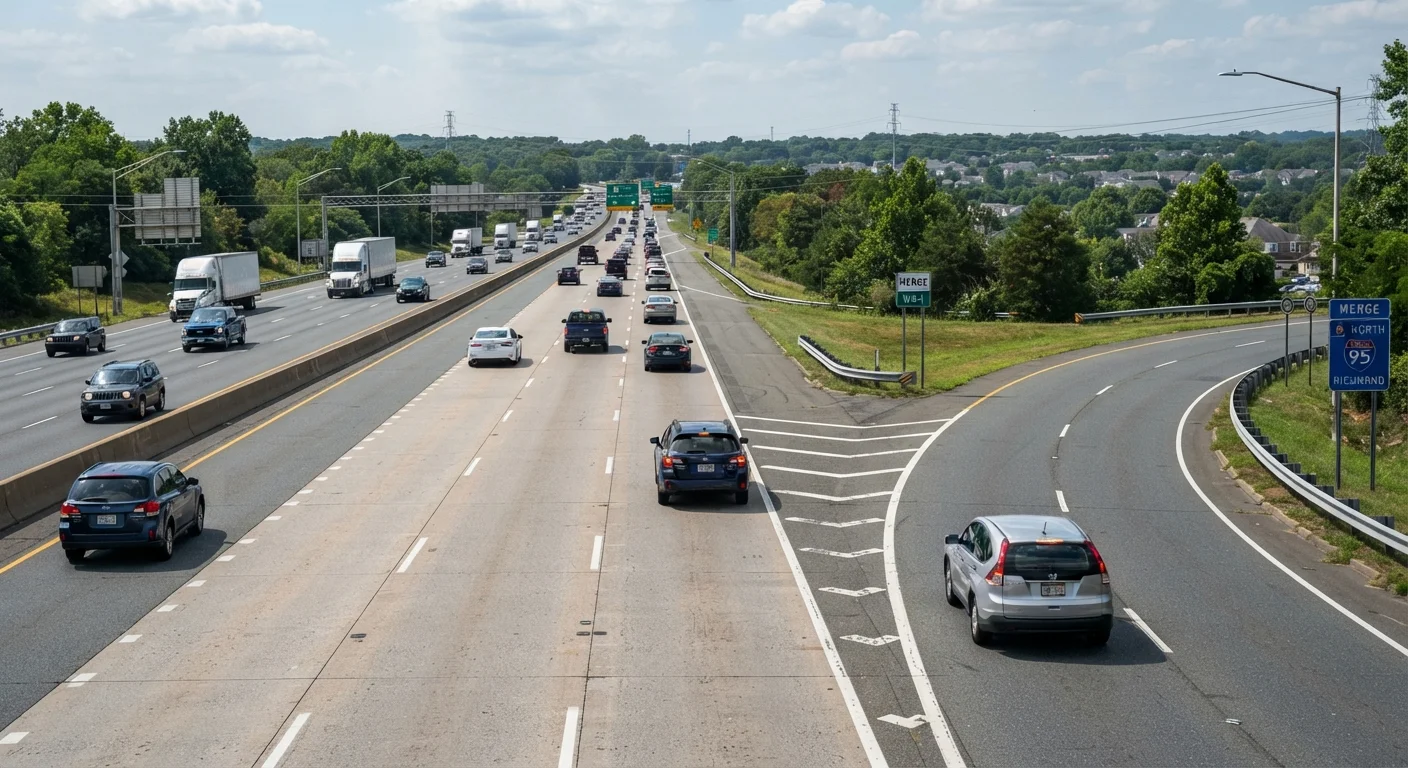
The merging driver holds the legal obligation to yield. Through-lane traffic is not required to change lanes or slow down.
This is one of the most dangerous misconceptions on US roads. On-ramp acceleration lanes exist specifically so merging drivers can match highway speed before entering traffic. The driver entering the highway must find a gap and time the merge - through-lane drivers have no legal duty to accommodate them, though many do so as a courtesy. Expecting the highway to part for you is a setup for a sideswipe collision. Use your full acceleration lane, match speed, signal early, and choose a gap - don't force one.
Myth
At a four-way stop, the driver turning right always goes first.
Fact
Arrival order governs four-way stops. The driver who stopped first proceeds first, regardless of intended direction.
Turn direction is irrelevant to four-way stop priority. The governing principle in virtually every state's traffic code is first to stop, first to go. When two vehicles arrive simultaneously, right-of-way goes to the driver on the right. When three or four vehicles arrive at the same time, drivers typically make eye contact and proceed with caution in a reasonable, cooperative sequence. Assuming a right-turn always has priority leads to hesitation and conflicting movements that cause low-speed collisions.
Myth
In a roundabout, you have the right-of-way once you've entered the circle.
Fact
Vehicles already circulating inside a roundabout have right-of-way. Entering drivers must yield until there is a safe gap.
Roundabouts follow a straightforward yield-on-entry rule: if you are waiting at a roundabout entry, you yield to all traffic already moving within the circle. Once you have entered and are traveling within the loop, other entering drivers yield to you. Many US drivers reverse this, either stopping unnecessarily once inside or pushing into the circle ahead of circulating traffic. Both errors create dangerous stopping behavior in a road design specifically engineered to keep traffic flowing smoothly.
Myth
Pedestrians always have the right-of-way, everywhere, at all times.
Fact
Pedestrians have right-of-way in marked crosswalks and at intersections in most states, but not at arbitrary mid-block locations.
The popular belief that pedestrians always win creates false confidence on both sides of the equation. Under the Uniform Vehicle Code - which most state codes mirror - drivers must yield to pedestrians lawfully within a crosswalk. However, pedestrians also have a legal duty not to step into traffic when it is unsafe to do so. Mid-block jaywalking does not automatically grant pedestrians priority. Drivers should still exercise every caution near pedestrians regardless of who holds technical right-of-way, because being legally correct does not undo a collision.
Myth
If you use your turn signal, other drivers are legally required to let you change lanes.
Fact
A turn signal communicates intent - it does not create a legal right to move into another lane.
Signaling is required before a lane change, but it does not transfer right-of-way to you. The driver changing lanes is still obligated to ensure the lane is clear before moving. Signaling while drifting into an occupied lane - and expecting the other driver to yield - is both legally incorrect and physically risky. Check your mirrors, check your blind spots, signal, then move when the lane is confirmed clear.
Myth
When an emergency vehicle approaches with lights and sirens, you should stop immediately wherever you are.
Fact
You must pull to the right side of the road and stop - not slam on your brakes in your current lane.
Stopping abruptly in a travel lane when an emergency vehicle approaches can cause rear-end collisions and actually block the very route the emergency vehicle needs. The correct action, required by law in all US states, is to safely move to the right edge of the roadway and stop. On a divided highway, drivers on the opposite side of a median generally do not need to pull over, though state laws vary. The key is to move deliberately and predictably, not reactively.
Common Myths About Merging, Stops, and Roundabouts - Corrected
The myths below represent the most frequently misapplied rules encountered on US roads. Each one is grounded in actual traffic law and crash-causation patterns, not informal driving culture.
~40%
Of US crashes occur at intersections
According to the Federal Highway Administration, roughly 40 percent of all crashes in the US take place at or near intersections, where right-of-way decisions are most frequent.
~3x
Safer than comparable signalized intersections
Research from the Insurance Institute for Highway Safety indicates modern roundabouts reduce fatal crashes by approximately 90 percent compared to conventional intersections, largely by eliminating high-speed right-angle collisions.
For a broader look at how these rules play out differently depending on road type, the comparison of highway and city driving habits is a useful companion read. And if you're helping someone new get behind the wheel, what new drivers need to know before going solo covers these fundamentals in a beginner-accessible format.
Yielding the Right-of-Way Doesn't End Your Responsibility
Even when you legally have the right-of-way, you are not absolved of your duty to avoid a collision if one is clearly developing. Traffic courts and insurers look at whether a driver took reasonable steps to prevent a crash, regardless of who technically had priority. If you see a driver running a stop sign toward you, braking or steering to avoid impact is always the right move - even if the law was on your side.