

Key Takeaways
Symmetrical All-Wheel Drive (AWD)
Subaru's Symmetrical All-Wheel Drive is a drivetrain system that continuously sends engine power to all four wheels simultaneously. Unlike part-time AWD systems that only engage extra wheels when slippage is detected, Subaru's setup is always active. The "symmetrical" label refers to the mirrored, balanced layout of the drivetrain components along the vehicle's centerline, which Subaru says contributes to more predictable handling.
Most Subaru models pair the AWD system with a horizontally opposed "boxer" engine, whose low center of gravity complements the balanced drivetrain geometry. Newer models use an electronically controlled multi-plate transfer clutch to vary torque distribution front-to-rear in real time.
How the System Actually Works
At its core, Subaru's Symmetrical AWD uses a center differential to split engine torque between the front and rear axles. In most Subaru models with a continuously variable transmission (CVT), an electronically controlled coupling adjusts torque distribution on the fly - sending more power to whichever axle has better grip at any given moment.
The "symmetrical" aspect refers to the physical layout: the drivetrain components - engine, transmission, driveshafts, and differentials - mirror each other along the car's longitudinal axis. Subaru's engineers argue this balanced layout reduces vibration and contributes to more neutral handling compared to asymmetrical drivetrain designs found in some other AWD systems.
It is worth distinguishing this from simpler on-demand AWD systems, which operate primarily in front-wheel drive and only transfer power rearward when wheel spin is detected. Subaru's full-time approach means the system is proactively managing traction rather than reacting after a slip has already begun.
CVT vs. Manual: AWD Varies by Transmission
Not all Subaru AWD systems behave identically. Models equipped with a manual transmission use a viscous coupling center differential, which is a more passive system. CVT-equipped models use an active torque-split coupling that responds more dynamically to conditions. If AWD performance is a priority, it is worth checking which variant a specific trim level uses.
When AWD Actually Makes a Difference
For everyday US drivers, the real-world benefits of Subaru's AWD show up most clearly in three scenarios: wet pavement, snow and ice, and loose surfaces like gravel or mud.
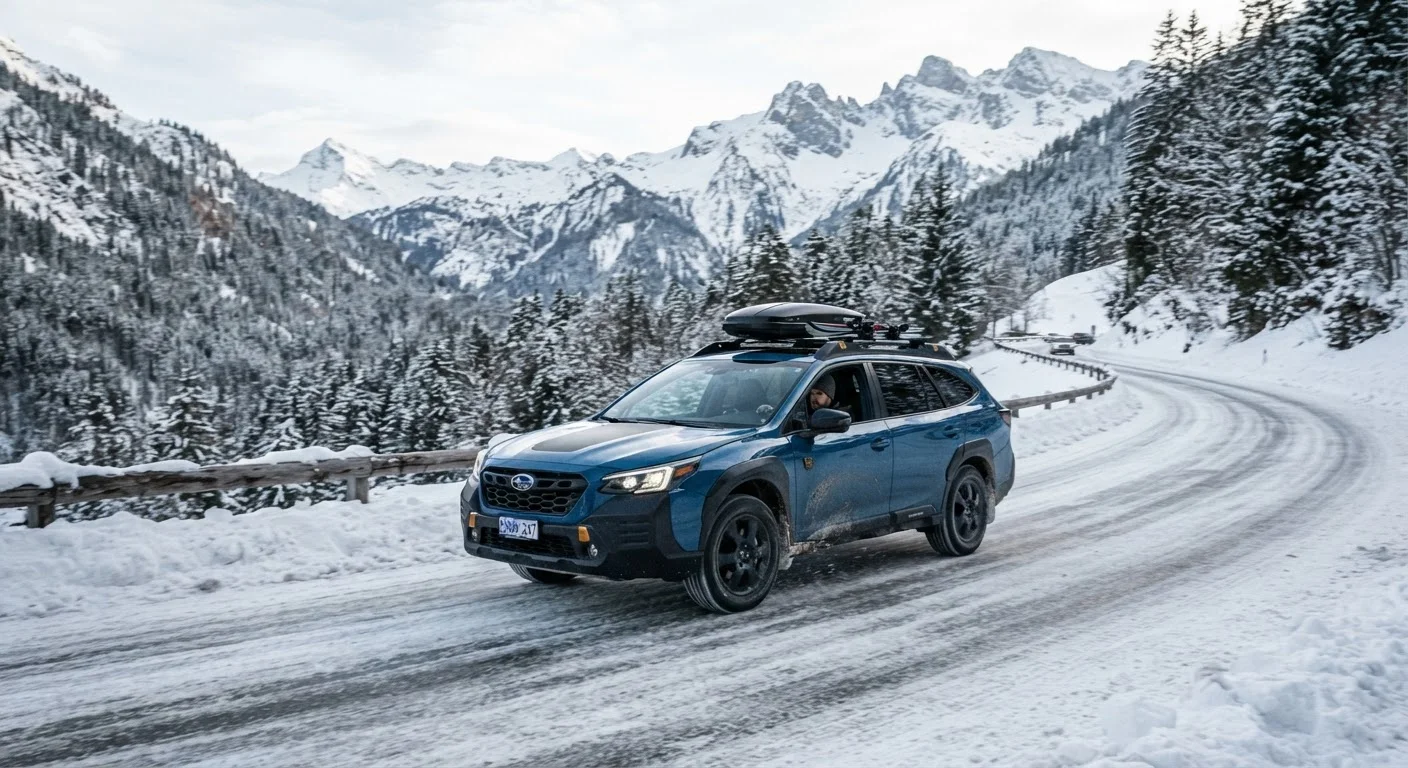
On rain-soaked roads, having power distributed to all four wheels reduces the likelihood of wheelspin when accelerating from a stop or merging onto a highway. In light snow, AWD can be the difference between confidently pulling away from an intersection and spinning in place. Drivers in the Northeast, Pacific Northwest, and Mountain West - where winter conditions are routine - tend to report the most tangible benefit.
~70%
Subaru US sales with AWD standard
Subaru has long reported that a large majority of its US vehicles are sold with AWD as a standard feature rather than an option, reflecting the brand's core identity around the system.
3-5%
Typical AWD fuel economy penalty
According to the U.S. Department of Energy's fueleconomy.gov, AWD drivetrains typically reduce fuel efficiency by roughly 1-2 mpg compared to equivalent front-wheel-drive models, though exact figures vary by vehicle.
However, AWD has clear limitations that are frequently misunderstood. It does not help a vehicle stop faster. Braking is governed by tire-to-road friction and the anti-lock braking system (ABS), not by how many wheels are driven. A Subaru Outback on all-season tires will still take longer to stop on ice than a front-wheel-drive car equipped with dedicated winter tires. AWD also offers no meaningful advantage on dry, flat pavement - the conditions most US drivers experience most of the time.
Winter Tires Multiply AWD Benefits
If you drive a Subaru in a region with genuine winter weather, fitting winter-rated tires dramatically improves the system's effectiveness. Winter tires use a softer rubber compound and specialized tread patterns that grip snow and ice far better than all-season tires - giving the AWD system better traction to work with at each wheel.
Tires: The Part Most Drivers Overlook
Tire choice has an outsized effect on how well any AWD system performs. An AWD vehicle on worn or mismatched tires will underperform a front-wheel-drive vehicle on quality winter tires in snowy conditions. This is not a theoretical distinction - tire testing data consistently shows that tread pattern, rubber compound, and tread depth are the primary determinants of grip.
Subaru's owner documentation is explicit about one tire-related requirement: all four tires should be the same brand, model, and tread depth. Because AWD systems work by sensing rotational speed differences between axles, a significantly worn tire on one corner can cause the system to misread the situation and place unnecessary stress on the transfer components. Rotating tires on schedule - typically every 5,000 to 7,500 miles - helps keep all four tires wearing evenly.
For drivers who live where winters are genuinely harsh, fitting a set of dedicated winter tires on a separate wheel set is often the most effective safety upgrade possible, regardless of whether the vehicle has AWD. See our guide to how vehicle body styles affect daily driving for more context on how drivetrain choices interact with the type of vehicle you choose.
Is Subaru AWD Worth It for Your Situation?
For drivers in regions with meaningful precipitation, seasonal snow, or unpaved roads, Subaru's Symmetrical AWD is a genuinely useful feature rather than a marketing footnote. It provides real traction advantages during acceleration and cornering on slippery surfaces, and the full-time engagement means it requires no driver input to activate.
For drivers in consistently dry, mild climates - parts of the Southwest, for instance - the system's benefits may be minimal in day-to-day use. AWD adds mechanical complexity, which can translate to higher repair costs if components fail after the warranty period. It also contributes to a slight fuel economy penalty compared to front-wheel-drive alternatives.
Understanding what the system does and does not do is more valuable than the system itself. Drivers who combine Subaru's AWD with appropriate tires, adjusted speeds in poor conditions, and realistic expectations will get the most from it. Those who assume AWD makes any road condition manageable at any speed are likely to be disappointed - or worse, caught off guard.
This article provides general information about vehicle drivetrain systems for educational purposes. Always consult your vehicle's owner's manual and a qualified mechanic for guidance specific to your car. Safe driving practices, including appropriate speeds and tire maintenance, remain the driver's responsibility regardless of the drivetrain system equipped.