

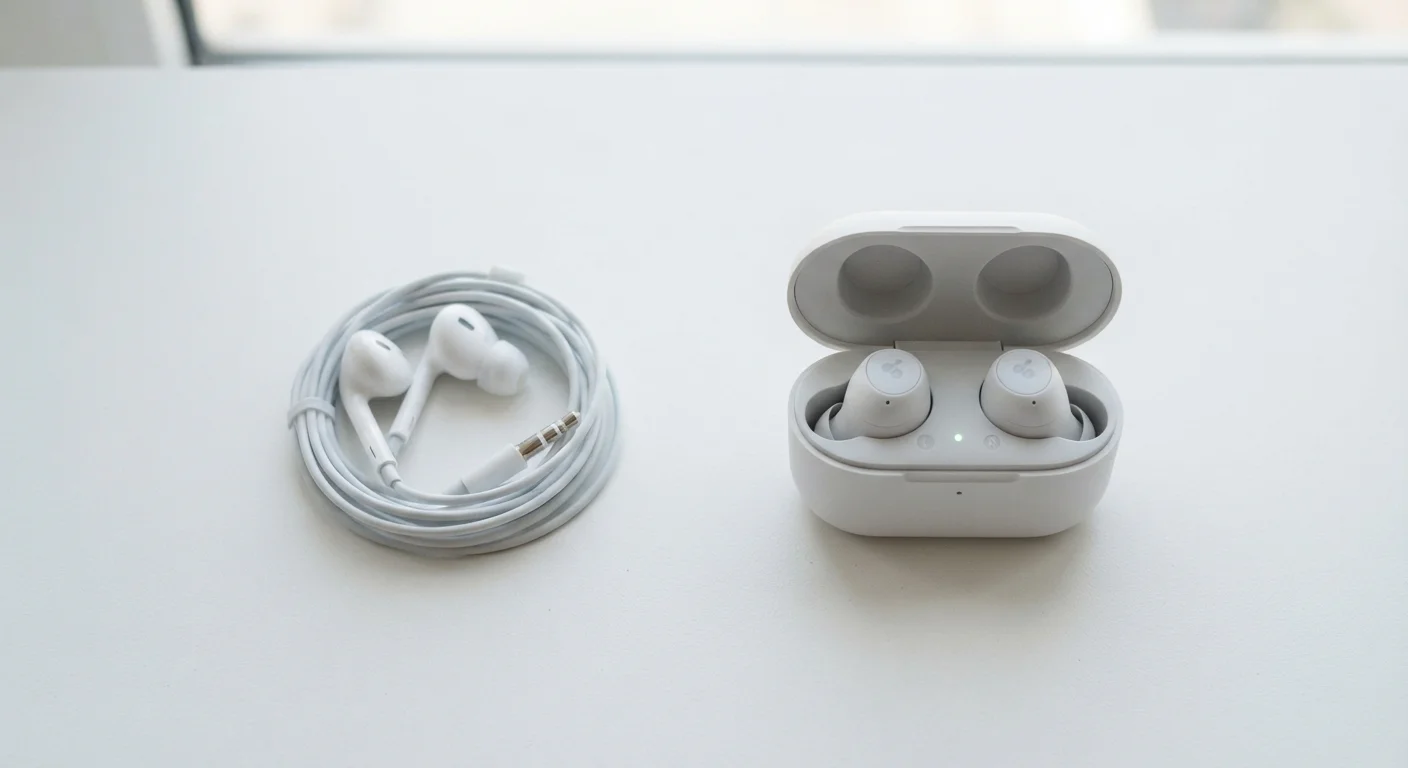
Key Takeaways
Option A
Wired Earbuds
The reliable, no-compromise audio classic.
Best for: Listeners who prioritize consistent audio quality, zero latency, and freedom from battery anxiety.
Option B
Wireless Earbuds
The cable-free, feature-rich modern standard.
Best for: Active users and commuters who value convenience, portability, and smart features over absolute simplicity.
If you listen critically to music or monitor audio professionally
Wired Earbuds
Wired connections eliminate Bluetooth compression and latency, delivering the most unaltered audio signal possible.
If you exercise, commute, or move around frequently
Wireless Earbuds
No cable means no snagging or tangling during movement, and compact charging cases keep battery top-ups effortless.
If you frequently watch videos or play games on mobile
Wired Earbuds
Wired audio stays perfectly in sync with video, whereas Bluetooth latency can cause noticeable audio-visual mismatches.
If you want smart features like noise cancellation or voice assistant access
Wireless Earbuds
Most modern wireless earbuds bundle active noise cancellation, ambient sound modes, and hands-free voice assistant integration.
If you own a newer smartphone without a headphone jack
Wireless Earbuds
Wireless earbuds connect over Bluetooth and bypass the need for a 3.5mm jack or a separate dongle adapter entirely.
The Core Difference: How Audio Gets From Source to Ear
The fundamental split between wired and wireless earbuds is the transmission method. Wired earbuds carry an analog or digital audio signal directly through a cable, typically via a 3.5mm headphone jack or, on some devices, a USB-C connector. The signal path is straightforward and continuous — there is no encoding, broadcasting, or decoding step involved.
Wireless earbuds rely on Bluetooth, a short-range radio standard, to transmit audio from your device. The audio is compressed into a supported codec — common ones include SBC, AAC, and aptX — broadcast wirelessly, then decoded in the earbud itself. This process introduces a small processing delay, known as latency, and involves a degree of audio compression that varies by codec quality.
For casual music listening, most people cannot consciously detect the difference in audio fidelity between a well-implemented Bluetooth codec and a direct wired connection. However, when watching video or playing games, even a latency gap of 100–200 milliseconds can make speech feel visibly out of sync with lip movements.
| Criterion | Wired Earbuds | Wireless Earbuds |
|---|---|---|
| Audio latency | Effectively zero | 20–200ms depending on codec |
| Battery requirement | None (passive power) | 5–10 hrs per charge |
| Headphone jack needed | Yes (or USB-C adapter) | No |
| Active Noise Cancellation | Rarely available | Common on modern models |
| Multi-device pairing | Not supported | Supported on most models |
| Risk of losing earbuds | Low (tethered by cable) | Higher (fully independent) |
| Audio compression | None | Varies by Bluetooth codec |
| Setup required | Plug in and play | One-time Bluetooth pairing |
Battery Life, Connectivity, and Everyday Practicality
Wired earbuds draw power passively from the device they are plugged into, so there is nothing to charge and nothing that can run flat mid-commute. This reliability is a genuine advantage in long-haul travel scenarios or whenever power access is limited.
Wireless earbuds carry their own batteries, typically lasting between 5 and 10 hours on a single charge, with charging cases extending total use to 20–30 hours before a wall outlet is needed. Battery capacity has improved substantially, but it remains a variable that wired earbuds simply do not have.
5–10 hrs
Typical wireless earbud battery life per charge
Most mainstream wireless earbuds offer this range, with charging cases extending total use to roughly 20–30 hours.
~200ms
Maximum Bluetooth audio latency (standard SBC codec)
Lower-latency codecs such as aptX Low Latency can reduce this to under 40ms, though device support varies.
3.5mm
Headphone jack absent from most flagship phones
Apple removed the headphone jack from iPhone in 2016; many Android flagship makers followed, affecting wired earbud compatibility.
On connectivity, wireless earbuds can pair with multiple devices and often reconnect automatically when taken out of their case. This seamless switching between a phone and a laptop, for instance, is a quality-of-life feature that wired earbuds cannot replicate. On the other hand, Bluetooth connections can occasionally drop or experience interference in crowded RF environments — something worth considering if you frequently use earbuds in dense urban settings, airports, or anywhere with heavy wireless traffic. For context on wireless interference more broadly, see our guide to public Wi-Fi risks.
Features, Fit, and the Headphone Jack Problem
Wireless earbuds have become a platform for additional technology. Active Noise Cancellation (ANC), transparency modes that pipe in ambient sound, touch or gesture controls, and on-device voice assistants are now common on mid-range and higher wireless models. These features are almost entirely absent on wired earbuds, which are by design passive and simple.
There is also a compatibility issue specific to wired earbuds. Many current smartphones — particularly flagship Android devices and all recent iPhones — no longer include a 3.5mm headphone jack. Wired earbuds that terminate in a 3.5mm plug require either a separate USB-C or Lightning adapter or a device that still has a jack. This is a real friction point that wireless earbuds avoid entirely.
Fit and form factor differ too. Wired earbuds typically weigh almost nothing individually, while wireless earbuds carry onboard electronics and a battery, making them marginally heavier. True wireless designs (no wire between buds) offer maximum freedom of movement but also increase the risk of losing a single earbud — a loss that is far more costly than misplacing a wired pair.
Ultimately, neither format is objectively superior. Wired earbuds reward simplicity and audio fidelity; wireless earbuds reward convenience and capability. Matching the format to your actual listening habits — rather than following a trend — will consistently yield the better outcome.