

| Typical closing cost range | 2%–5% of the purchase price (Consumer Financial Protection Bureau (CFPB)) |
| Federal disclosure deadline | 3 business days before closing (TRID rule, CFPB) |
| Lender's title insurance | Required on virtually all financed purchases (Industry standard) |
| Owner's title insurance | Optional but strongly recommended (CFPB guidance) |
| Loan origination fee range | 0.5%–1% of loan amount (General industry range) |
| Negotiable vs. fixed fees | Many lender fees are negotiable; government taxes are not |
What Closing Costs Are — and Why They Exist
Closing costs are the collection of fees and prepaid expenses a buyer settles on the day ownership legally transfers. They are separate from your down payment and cover a range of services — lender processing, third-party professionals, government recording, and prepaid homeownership expenses — all required to safely transfer a home and fund a mortgage.
The CFPB estimates closing costs typically run 2%–5% of the purchase price, meaning a $350,000 home could carry $7,000–$17,500 in settlement fees. The exact total depends on your loan type, location, lender, and which services you shop for independently.
For a full picture of the homebuying journey, see our walkthrough of the US homebuying process. If any terms below are unfamiliar, our homebuyer glossary covers them in plain language.
| Typical closing cost range | 2%–5% of the purchase price (Consumer Financial Protection Bureau (CFPB)) |
| Federal disclosure deadline | 3 business days before closing (TRID rule, CFPB) |
| Lender's title insurance | Required on virtually all financed purchases (Industry standard) |
| Owner's title insurance | Optional but strongly recommended (CFPB guidance) |
| Loan origination fee range | 0.5%–1% of loan amount (General industry range) |
| Negotiable vs. fixed fees | Many lender fees are negotiable; government taxes are not |
Lender Fees: What You Pay to Get the Loan
These fees appear in Section A of your Closing Disclosure and are charged by your mortgage lender to originate and process your loan.
- Origination fee: Covers underwriting and administrative processing. Typically 0.5%–1% of the loan amount, though some lenders charge a flat fee. This is one of the most negotiable line items — compare Loan Estimates across lenders.
- Discount points: Optional prepaid interest that lowers your mortgage rate. One point equals 1% of the loan amount. Whether buying points makes sense depends on how long you plan to hold the loan.
- Application and processing fees: Some lenders bundle these into the origination fee; others list them separately. Always ask what each line item covers.
- Rate lock fee: Charged by some lenders to lock your interest rate for a defined period during underwriting. Many lenders include this in the origination fee.
Loan Estimate vs. Closing Disclosure
When you apply for a mortgage, your lender provides a Loan Estimate within three business days — an early snapshot of expected costs. The Closing Disclosure arrives at least three business days before settlement and reflects final, binding figures. Always compare the two documents side by side to spot any meaningful changes. Under TRID rules, certain fees cannot increase between the Loan Estimate and the CD without a valid changed-circumstance reason.
Third-Party Service Fees
These fees pay professionals whose work is required to close safely. Some are lender-mandated; others you can shop for independently — your Closing Disclosure will indicate which.
2%–5%
Of purchase price goes to closing costs
According to the CFPB, buyers on a $300,000 home could pay $6,000–$15,000 at closing.
3 days
Minimum notice before closing
Under federal TRID rules, lenders must deliver the Closing Disclosure at least three business days before settlement.
~$6,000
Average closing costs paid by US buyers
CoreLogic data indicates average closing costs (excluding taxes) have hovered near $6,000, though they vary widely by state and loan size.
- Appraisal fee: Pays a licensed appraiser to confirm the home's market value for the lender. Typically $300–$600 for a standard single-family home, though complex properties cost more.
- Title search and exam: A title company or attorney reviews public records to confirm the seller's right to convey the property free of undisclosed claims.
- Lender's title insurance: Required on nearly all financed purchases, this one-time premium protects the lender if a title defect surfaces after closing. The owner's title insurance policy — which protects you — is optional but widely recommended.
- Settlement or closing fee: Paid to the escrow officer, title company, or closing attorney who coordinates the transaction. Ranges from roughly $500–$1,500 depending on the state and service provider.
- Survey fee: Required in some states and loan programs, a survey confirms the property's boundaries. Costs vary widely by property size and state.
- Home inspection fee: Typically paid before closing rather than at the table, but budgeted as part of transaction costs — generally $300–$500.
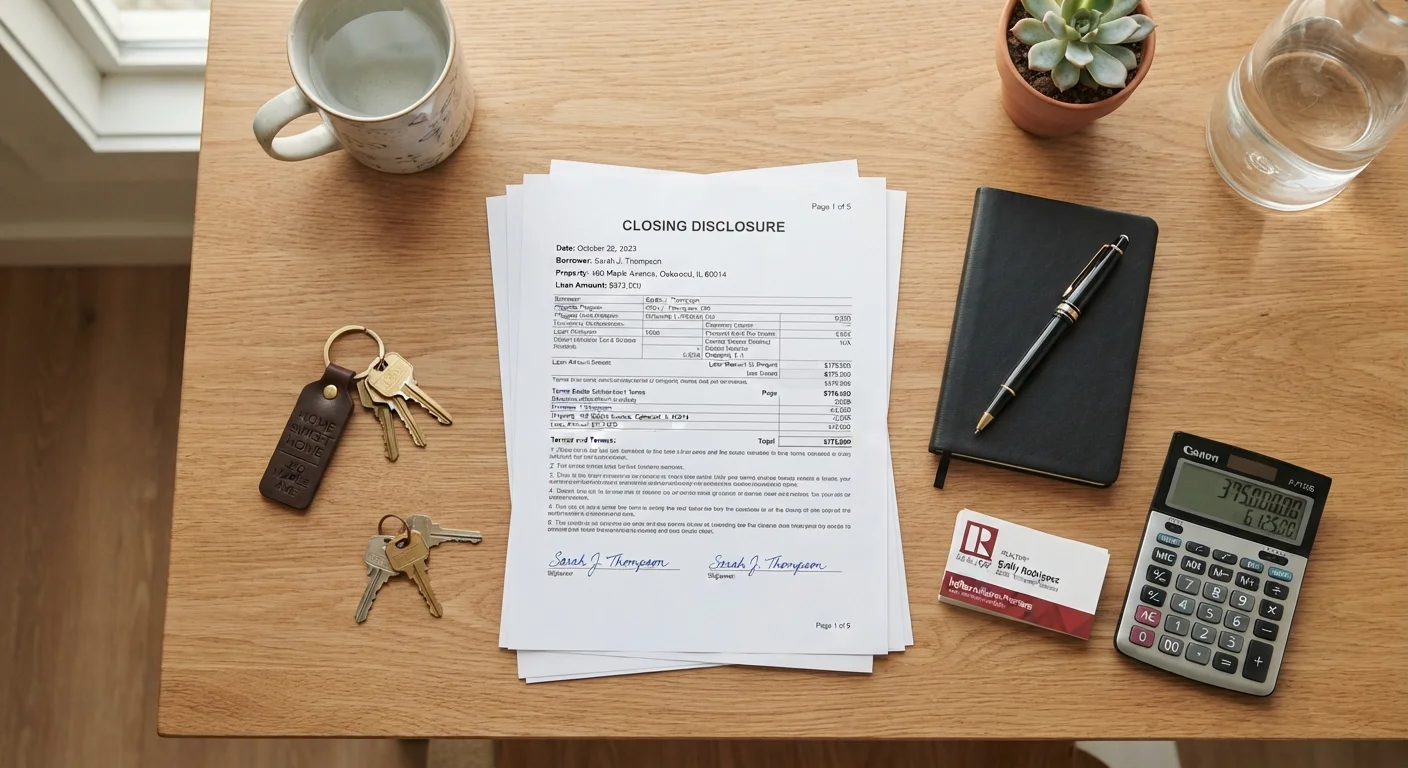
Closing Disclosure (CD)
A standardized five-page federal form lenders must provide at least three business days before closing. It itemizes all final loan terms, monthly payments, and closing costs.
Loan Origination Fee
A fee charged by the lender to process and underwrite your mortgage application, typically expressed as a percentage of the loan amount.
Title Insurance
A one-time premium that protects the buyer (owner's policy) and lender (lender's policy) against losses from defects in the property's title history, such as undisclosed liens or ownership disputes.
Escrow Impounds
Upfront deposits collected at closing to pre-fund the escrow account that pays future property taxes and homeowners insurance on your behalf.
Prepaid Interest
Per-diem mortgage interest collected at closing to cover the days between your closing date and the start of your first full payment period.
Transfer Tax
A state or local government tax levied when property ownership transfers from seller to buyer. Rates and who pays vary significantly by state and county.
Prepaid Items, Escrow Reserves, and Government Charges
Beyond service fees, buyers pre-fund several ongoing homeownership expenses at closing.
- Prepaid homeowners insurance: Most lenders require you to pay the first year's premium in full at or before closing.
- Prepaid mortgage interest: Per-diem interest from your closing date through the end of that month. Closing earlier in the month means more prepaid interest due.
- Escrow impounds: Initial deposits — typically two to three months of property taxes and insurance — to establish your escrow account. Amounts vary by tax rate, insurance premium, and lender requirements.
- Recording fees: Local government charges to officially record the deed and mortgage in public records. Usually modest — $50–$250 — but set by the jurisdiction.
- Transfer taxes: Some states and counties impose taxes when ownership transfers. Rates and who pays (buyer, seller, or both) vary considerably by state; in some jurisdictions these can represent a meaningful portion of total closing costs.
Once you close, ongoing costs continue beyond the mortgage. The real costs of owning a home beyond the mortgage covers what to budget for property taxes, insurance, maintenance, and HOA fees over time.
This article provides general educational information about closing costs in the United States and does not constitute personalized financial, legal, or mortgage advice. Fees, requirements, and regulations vary by state, loan type, and lender. Consult a licensed mortgage professional, real estate attorney, or HUD-approved housing counselor for guidance specific to your situation.