

Key Takeaways
Our Verdict
Hypothyroidism and hyperthyroidism are distinct conditions driven by opposite hormonal imbalances. While both involve a dysfunctional thyroid gland, they require different diagnostic evaluation and treatment strategies. Anyone experiencing persistent, unexplained symptoms — whether fatigue and weight gain or a racing heart and unintended weight loss — should consult a healthcare provider for proper evaluation.
| Best for | Recommended |
|---|---|
| Those experiencing fatigue, cold intolerance, or unexplained weight gain | Evaluation for Hypothyroidism |
| Those experiencing anxiety, rapid heartbeat, or unexpected weight loss | Evaluation for Hyperthyroidism |
What the Thyroid Does — and What Goes Wrong
The thyroid is a small, butterfly-shaped gland at the base of the neck. It produces two key hormones — thyroxine (T4) and triiodothyronine (T3) — that regulate metabolism, body temperature, heart rate, and energy use throughout the body. The brain's pituitary gland monitors thyroid output and releases thyroid-stimulating hormone (TSH) to keep production in balance.
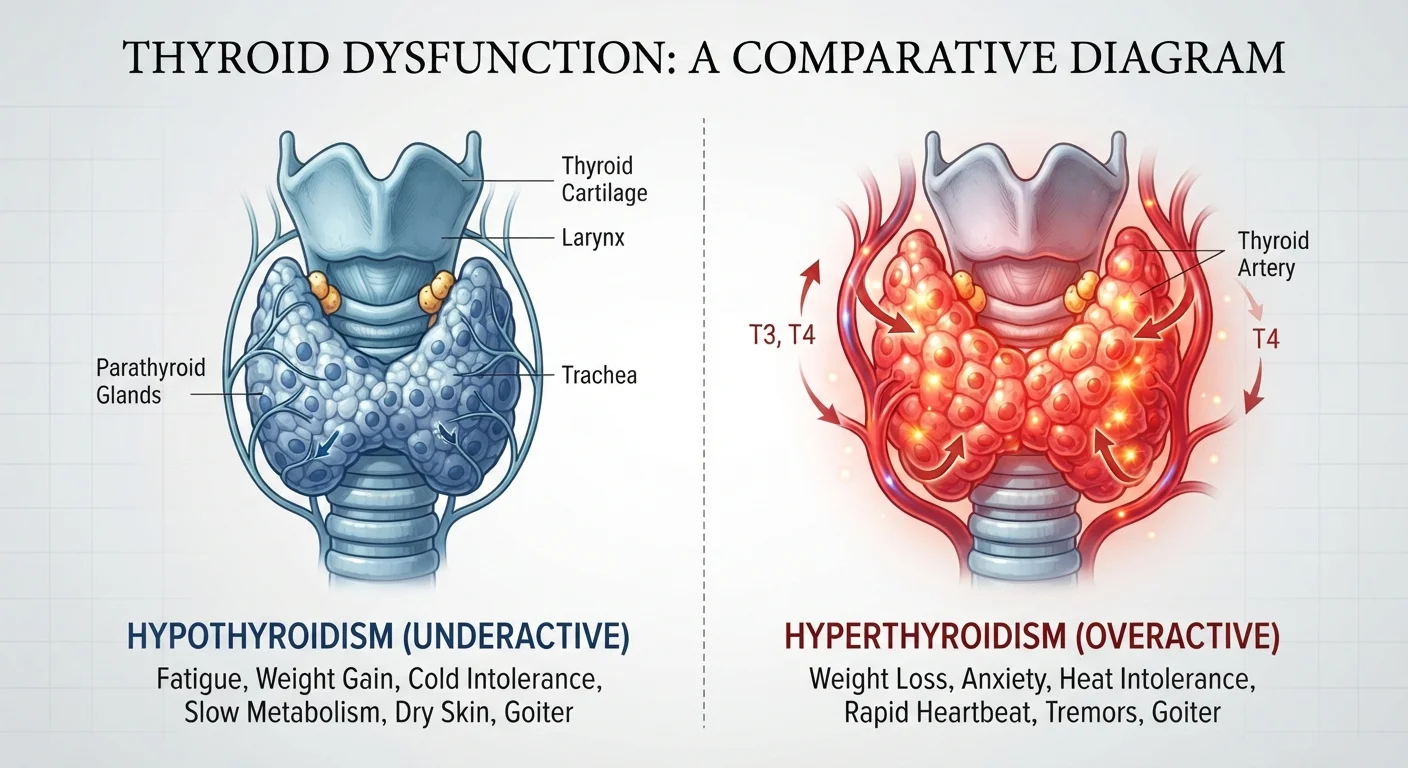
When this system breaks down, it falls into one of two broad categories. Hypothyroidism occurs when the thyroid is underactive and produces insufficient hormone. Hyperthyroidism occurs when the gland is overactive and floods the body with excess hormone. Both disrupt normal physiological function — but in sharply contrasting ways. Just as two seemingly similar medical terms can describe meaningfully different conditions, hypothyroidism and hyperthyroidism are not interchangeable despite both involving the same gland.
Symptoms: Opposite Ends of the Spectrum
Because thyroid hormones regulate so many body systems, an imbalance produces wide-ranging symptoms. Crucially, the symptoms of the two conditions tend to be mirror images of each other.
Hypothyroidism Symptoms
- Persistent fatigue and sluggishness
- Unexplained weight gain
- Sensitivity to cold
- Constipation
- Dry skin and hair thinning or loss
- Slowed heart rate (bradycardia)
- Depression or low mood
- Brain fog and difficulty concentrating
Hyperthyroidism Symptoms
- Unexplained weight loss despite normal or increased appetite
- Rapid or irregular heartbeat (palpitations)
- Anxiety, nervousness, or irritability
- Heat intolerance and increased sweating
- Frequent bowel movements or diarrhea
- Tremors in the hands
- Difficulty sleeping
- Bulging eyes (in Graves' disease specifically)
Don't Self-Diagnose from Symptoms Alone
Many symptoms of thyroid disorders overlap with those of other common conditions such as depression, anxiety, perimenopause, and chronic fatigue. The only reliable way to confirm a thyroid disorder is through blood tests ordered by a healthcare provider. If you suspect a problem, seek a professional evaluation rather than adjusting diet or supplements on your own.
Symptom overlap with other common conditions — such as depression, menopause, or anxiety disorders — means thyroid dysfunction is sometimes missed or misattributed. A simple blood test is the definitive way to assess thyroid function.
Causes and Risk Factors
The root causes of each condition differ, though some risk factors — particularly being female and being over 60 — apply to both.
Common Causes of Hypothyroidism
The most common cause in the United States is Hashimoto's thyroiditis, an autoimmune condition in which the immune system mistakenly attacks thyroid tissue. Other causes include prior thyroid surgery, radiation therapy to the neck or head, certain medications (such as lithium or amiodarone), and iodine deficiency — though the latter is rare in the US due to iodized salt.
Common Causes of Hyperthyroidism
Graves' disease, another autoimmune disorder, is the leading cause of hyperthyroidism. Other causes include toxic multinodular goiter (multiple overactive nodules on the gland), a single hyperactive nodule (toxic adenoma), thyroiditis (inflammation that temporarily releases stored hormone), and excessive iodine intake.
| Feature | Hypothyroidism | Hyperthyroidism | |
|---|---|---|---|
| Hormone level | Feature | Too little T3/T4 | Too much T3/T4 |
| TSH level | TSH level | Elevated | Suppressed |
| Weight change | Weight change | Weight gain | Weight loss |
| Energy level | Energy level | Fatigue, sluggishness | Restlessness, insomnia |
| Heart rate | Heart rate | Slowed (bradycardia) | Rapid (tachycardia/palpitations) |
| Temperature sensitivity | Temperature sensitivity | Cold intolerance | Heat intolerance |
| Most common cause | Most common cause | Hashimoto's thyroiditis | Graves' disease |
| Primary treatment | Primary treatment | Levothyroxine (daily hormone replacement) | Anti-thyroid drugs, radioactive iodine, or surgery |
Diagnosis and General Treatment Approaches
Both conditions are diagnosed through blood tests. A TSH test is typically the first step: elevated TSH suggests hypothyroidism (the pituitary is working harder to stimulate an underperforming gland), while suppressed TSH suggests hyperthyroidism. Levels of free T4 and T3 are measured to confirm and characterize the imbalance. Imaging, such as a thyroid ultrasound or radioactive iodine uptake scan, may follow to identify structural abnormalities.
~20 million
Americans with some form of thyroid disease
According to the American Thyroid Association, approximately 20 million Americans have a thyroid condition, and up to 60% are unaware of it.
5–8x
Higher thyroid disorder risk in women vs. men
The American Thyroid Association notes that women are significantly more likely than men to develop thyroid disorders across their lifetime.
Treating Hypothyroidism
The standard treatment is a synthetic thyroid hormone called levothyroxine, taken orally as a daily pill. Most people require long-term or lifelong therapy. Dose is individualized through regular blood monitoring and should only be adjusted under a physician's guidance.
Treating Hyperthyroidism
Treatment options include anti-thyroid medications (such as methimazole) that reduce hormone production, radioactive iodine therapy that gradually shrinks or disables overactive thyroid tissue, and in some cases surgery to remove part or all of the gland. Beta-blockers may be prescribed short-term to manage heart-rate symptoms. The choice of treatment depends on the cause, severity, patient age, and other health factors — decisions made collaboratively with an endocrinologist or other specialist.
This article is for general informational purposes only and does not constitute medical advice. If you have concerns about thyroid function or any health symptoms, please consult a qualified healthcare professional for evaluation and personalized guidance.