
Key Takeaways
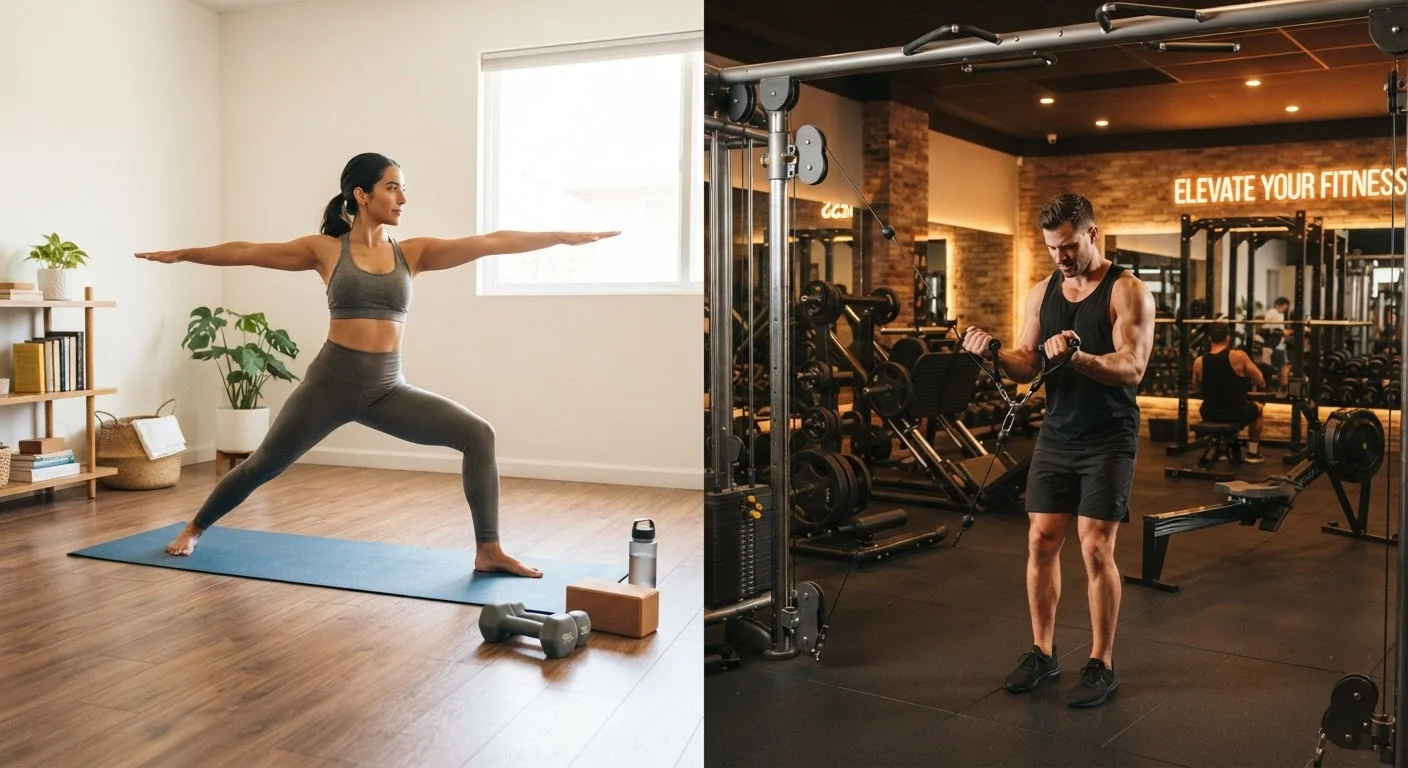
Option A
Home Workouts
The convenient, low-cost training environment.
Best for: Adults who prioritize flexibility, privacy, and minimal commute time.
Option B
Gym Training
The structured, equipment-rich fitness setting.
Best for: People who benefit from dedicated equipment, variety, and a motivating social environment.
If you have a tight schedule or irregular hours
Home Workouts
No commute and no operating hours mean you can train at any time, removing common scheduling barriers to consistency.
If you want access to progressive strength equipment
Gym Training
Barbells, cable machines, and adjustable weight stacks make it far easier to systematically increase resistance over time.
If budget is a primary concern
Home Workouts
After a modest initial investment in basic equipment, ongoing costs are essentially zero compared to monthly membership fees.
If you struggle with self-motivation when exercising alone
Gym Training
The social environment, group classes, and the act of physically going to a dedicated space can significantly boost adherence.
If you want a hybrid approach that adapts to travel or life changes
Home Workouts
Bodyweight and minimal-equipment routines transfer seamlessly to hotel rooms, backyards, or any space without access to a facility.
The Core Trade-Offs at a Glance
Choosing between home workouts and gym training is rarely a question of which is objectively superior. Both environments can support cardiovascular health, muscular strength, and general fitness — the research does not clearly favor one over the other when effort and consistency are equal. What differs is the practical experience: the cost, available tools, accountability structures, and day-to-day friction each setting creates.
Before committing, it helps to map out the concrete differences. If you're newer to exercise altogether, our beginner's guide to starting a fitness routine walks through how to build sustainable habits regardless of setting.
| Criterion | Home Workouts | Gym Training |
|---|---|---|
| Upfront cost | Low to moderate (basic equipment) | Low (membership fee, no equipment purchase) |
| Ongoing cost | Minimal after initial setup | $30–$80+ per month (typical US range) |
| Equipment variety | Limited unless heavily invested | Extensive — machines, free weights, cardio |
| Scheduling flexibility | Any time, no commute | Bound by operating hours and travel time |
| Progressive overload support | Moderate (bodyweight progressions, bands) | High (incremental weight increases readily available) |
| Motivation environment | Self-directed; potential for distraction | Social cues, classes, dedicated space |
| Privacy | Complete | Shared, public setting |
| Expert access | Limited (online resources only) | On-site trainers and staff available |
Equipment and Exercise Variety
At home, your options depend almost entirely on what you purchase and how much space you have. Bodyweight training — push-ups, squats, lunges, planks — covers a broad range of movement patterns and requires nothing but floor space. Adding a set of resistance bands or a pair of adjustable dumbbells meaningfully expands variety. However, exercises that depend on heavy barbells, cable pulleys, or dedicated machines are difficult to replicate without significant investment and space.
Gyms solve the equipment problem immediately. A standard commercial gym provides access to free weights across a wide load range, cable systems, cardio machines, and often specialty equipment like rowing ergometers or leg press stations. This makes progressive overload — gradually increasing the demand placed on muscles over time — more straightforward to manage. If understanding how different training styles affect your body interests you, see our comparison of cardio versus strength training.
~$58/mo
Average US gym membership cost
Estimates from fitness industry surveys suggest the average American gym member pays approximately $40–$70 per month, with premium facilities exceeding that range.
50%+
Members who rarely use their gym
Multiple industry analyses have estimated that a significant portion of gym members visit infrequently, underscoring that membership alone does not guarantee consistent exercise.
23%
US adults meeting aerobic activity guidelines
According to CDC physical activity data, fewer than one in four American adults meets both aerobic and muscle-strengthening activity guidelines — regardless of training setting.
Cost, Convenience, and Consistency
Home training has a lower long-term financial cost. A modest set of dumbbells and a mat typically represents a one-time outlay, while an average gym membership in the US ranges from roughly $30 to over $80 per month depending on the facility. Over several years, the savings are substantial — though premium home equipment (power racks, cable machines) can rival or exceed gym costs upfront.
Convenience cuts both ways. Eliminating commute time removes a common barrier to exercising, but a home environment also introduces distractions — family, household tasks, and the absence of a dedicated space. A gym creates a physical and psychological boundary: you are there specifically to train. Research on exercise adherence consistently points to habit formation and environmental cues as critical factors, and for many people, the ritual of going to a gym strengthens both.
Adherence Matters More Than Setting
Exercise science consistently shows that the most effective workout is the one a person will actually do regularly. Factors like enjoyment, convenience, and social support predict long-term adherence more reliably than the specific environment or equipment used. Before optimizing your setup, consider what has kept you consistent — or inconsistent — in the past.
For a structured way to assess which environment fits your current life situation, review our personal exercise readiness checklist before committing to either approach.
Which Setting Is Right for You?
There is no universal answer — the right setting is the one you will actually use. If your primary challenge is finding time, home training removes logistical friction. If your primary challenge is motivation or access to equipment for a specific goal (such as building maximal strength), a gym is likely more supportive. Many adults find that a hybrid model — training at home most days with occasional gym sessions — offers practical flexibility.
It is also worth separating myths from evidence before deciding. Our article on common fitness myths addresses several beliefs — such as the idea that results require expensive equipment — that may be influencing your thinking without a solid factual basis.
This article is for general informational purposes only and does not constitute medical or professional fitness advice. Consult a qualified healthcare provider or certified fitness professional before beginning any new exercise program, particularly if you have existing health conditions or have been inactive for an extended period.