

Key Takeaways
Our Verdict
No single plan type suits everyone. HMOs and EPOs work well for healthy individuals who prefer coordinated, lower-cost care within a network. PPOs offer the broadest access for those with ongoing specialist needs. HDHPs make the most sense for people who are generally healthy, budget-conscious on premiums, and want to build tax-advantaged savings. Consult a licensed insurance professional before enrolling to match your specific situation.
| Best for | Recommended |
|---|---|
| Budget-conscious individuals with predictable, routine care needs | HMO |
| Those who see multiple specialists or travel frequently | PPO |
| People wanting no referrals but are comfortable staying in-network | EPO |
| Healthy individuals seeking lower premiums and HSA savings potential | HDHP |
Why Plan Type Matters Before You Enroll
Choosing a health insurance plan isn't just about the monthly premium. The plan type determines which doctors you can see, whether you need a referral to visit a specialist, and how much you'll pay when something unexpected happens. Before diving into cost comparisons, it helps to understand the structural rules each plan follows.
If you're new to insurance terminology, our guide on deductibles, premiums, and copays explains the key cost-sharing concepts you'll encounter across all plan types. This article focuses specifically on the four plan structures most commonly offered in the US employer and marketplace markets: HMO, PPO, EPO, and HDHP.
Check Network Before Enrolling
Plan type alone doesn't tell you which specific doctors or hospitals are covered. Always use the insurer's online provider directory to confirm your current physicians are in-network before selecting a plan. Network changes can also occur mid-year, so it's worth re-checking at each open enrollment period.
HMO: Coordinated Care, Lower Costs
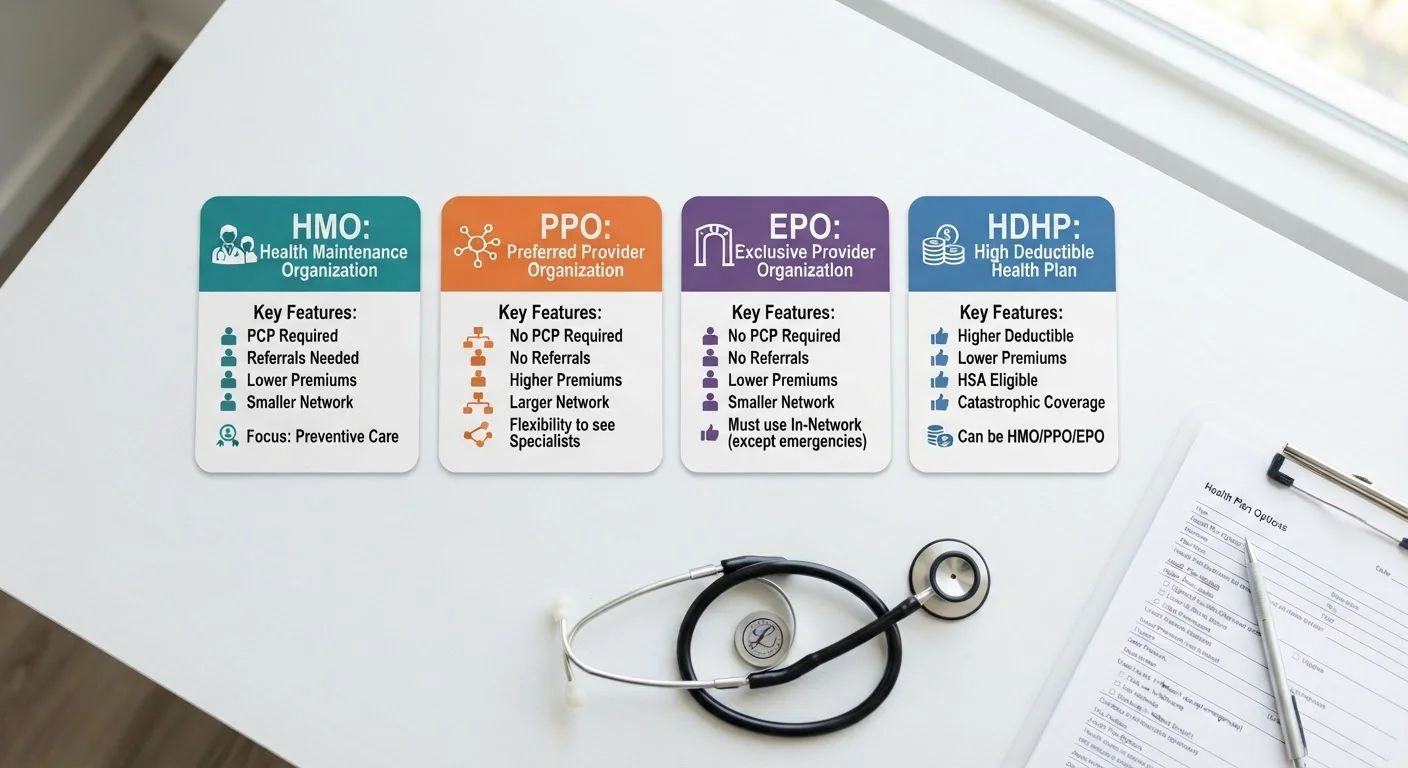
A Health Maintenance Organization (HMO) requires members to choose a primary care physician (PCP) who acts as a gatekeeper for all non-emergency care. To see a specialist, you generally need a referral from your PCP. Care is limited to providers within the plan's network, with very limited or no coverage for out-of-network visits except in emergencies.
Trade-off: The structure adds an administrative step but typically results in lower monthly premiums and predictable copays. HMOs suit people who have an established relationship with a primary care provider and don't anticipate needing frequent specialist access. They are among the most common plan types offered through Medicaid and employer-sponsored coverage.
PPO: Flexibility at a Premium
A Preferred Provider Organization (PPO) gives members the most flexibility. You can see any licensed provider — no referral required — and the plan covers both in-network and out-of-network care, though out-of-network visits cost more. There is no mandatory PCP relationship.
Trade-off: That freedom comes with higher monthly premiums and often higher deductibles than HMOs. PPOs tend to be a strong fit for people managing chronic conditions, those who travel frequently and need care in multiple states, or anyone who already has a preferred out-of-network specialist. For guidance on what your plan actually covers once you've enrolled, see our article on reading your policy's coverage and exclusions.
| HMO | PPO | EPO | HDHP | |
|---|---|---|---|---|
| Requires PCP | Yes | No | No | Varies by structure |
| Referrals needed | Yes | No | No | Varies by structure |
| Out-of-network coverage | Emergency only | Yes, at higher cost | Emergency only | Varies by structure |
| Typical premium level | Lower | Higher | Moderate | Lower |
| Deductible level | Low to moderate | Moderate | Moderate | High (IRS-defined) |
| HSA eligible | No | No | No | Yes |
| Best network flexibility | Low | High | Moderate | Varies |
EPO: Network-Only, No Referrals
An Exclusive Provider Organization (EPO) sits between an HMO and a PPO. Like a PPO, EPOs do not require referrals to see specialists. Like an HMO, care is almost entirely restricted to the plan's network — out-of-network services are typically not covered at all, except in genuine emergencies.
Trade-off: EPOs can offer lower premiums than PPOs while removing the referral friction of HMOs. The key risk is network adequacy — if your preferred provider is outside the network, you'll pay full cost out of pocket. Before enrolling in an EPO, verify that your current physicians and any specialists you anticipate needing are in-network.
Out-of-Network Gaps Can Be Costly
With EPO and HMO plans, receiving non-emergency care from an out-of-network provider can result in the full bill being your responsibility — insurers may deny the claim entirely. If you're mid-treatment with a specialist who is outside your new plan's network, discuss continuity-of-care options with both your insurer and provider before your coverage starts.
HDHP: Lower Premiums, Higher Deductibles, and HSA Eligibility
A High-Deductible Health Plan (HDHP) is defined by IRS thresholds — as of recent years, a minimum annual deductible of $1,600 for individuals and $3,200 for families (thresholds adjust periodically; verify current figures with irs.gov). HDHPs can be structured as HMOs, PPOs, or EPOs underneath, but their defining feature is the high deductible paired with lower premiums.
The significant benefit: HDHPs are the only plan type that qualifies members to open and contribute to a Health Savings Account (HSA). An HSA allows pre-tax contributions that can be used for qualified medical expenses, and unused balances roll over year to year. This makes HDHPs a tax-efficient option for those who are generally healthy and can afford to pay out of pocket for routine care while building long-term medical savings.
Trade-off: If you have ongoing prescriptions, frequent doctor visits, or a planned procedure, you may reach your deductible quickly — and the higher upfront cost can be a financial strain. To ensure you're not over-insuring or under-insuring based on your actual risk, explore strategies outlined in our guide on matching your coverage to your risk profile.
47%
Workers enrolled in HDHP/HRA plans
According to KFF's 2023 Employer Health Benefits Survey, nearly half of covered workers were enrolled in an HDHP or HRA-based plan.
36%
Workers enrolled in PPO plans
KFF's 2023 survey found PPO enrollment has declined over time as HDHP adoption has grown among employer-sponsored plans.
This article is for general informational purposes only and does not constitute personalized insurance, financial, or medical advice. Coverage terms, networks, and costs vary by plan and provider. Consult a licensed insurance professional before making enrollment decisions.