

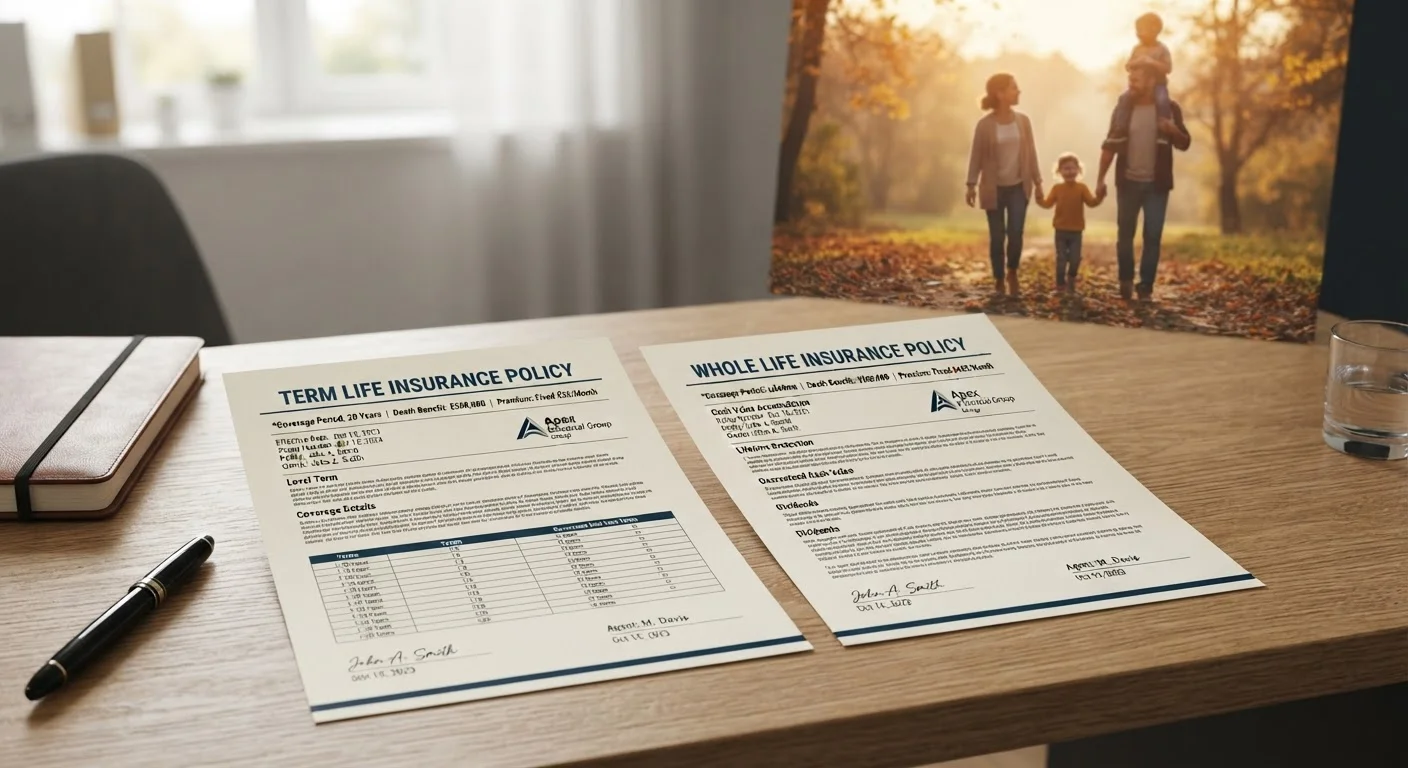
Key Takeaways
Option A
Term Life Insurance
Straightforward, affordable protection for a defined period.
Best for: People seeking maximum death benefit coverage at the lowest premium cost during peak earning or family-raising years.
Option B
Whole Life Insurance
Permanent coverage with a built-in savings component.
Best for: People who want lifelong coverage and are comfortable paying higher premiums in exchange for guaranteed cash value accumulation.
If you need affordable coverage while raising children or paying off a mortgage
Term Life Insurance
Term policies deliver a large death benefit at a low premium cost, making them well-suited for protecting dependents during the years they need it most.
If you want lifelong coverage with no risk of outliving your policy
Whole Life Insurance
Whole life never expires as long as premiums are paid, ensuring a death benefit is available regardless of when you pass away.
If building tax-deferred cash value alongside coverage is a priority
Whole Life Insurance
The guaranteed cash value component grows over time and can be accessed via policy loans, providing a financial resource beyond the death benefit.
If you are on a tight budget but still need meaningful financial protection for your family
Term Life Insurance
Term life maximizes the death benefit per dollar of premium, making substantial coverage accessible even for those with limited monthly budgets.
If you have a long-term estate planning or final expense coverage need
Whole Life Insurance
Permanent coverage ensures beneficiaries receive a payout at any age, which can be useful for estate planning, business succession, or guaranteed final expense funding.
How Each Policy Type Is Structured
Life insurance exists to replace lost income and protect the people who depend on you financially. But not all life insurance works the same way. The two most common types — term life and whole life — differ fundamentally in how long they last, how premiums are calculated, and what happens to your money over time.
Term life insurance is a contract that pays a death benefit only if the insured person dies within a specified period, called the term. Common terms run 10, 20, or 30 years. If you outlive the policy, coverage ends and no benefit is paid. Premiums are fixed for the duration of the term and are determined primarily by your age, health, and the coverage amount at the time of purchase.
Whole life insurance is a form of permanent insurance, meaning it does not expire. As long as premiums are paid, the policy remains in force for the insured's entire life. Part of each premium payment goes toward the death benefit, and part builds a cash value — a savings-like component that grows at a guaranteed rate set by the insurer. This cash value belongs to the policyholder and can be borrowed against or, in some cases, withdrawn.
Before diving deeper, it helps to understand how premium and cost terminology works across insurance products. Our guide to insurance premiums and deductibles explains the foundational terms you'll encounter when shopping for any coverage.
| Criterion | Term Life | Whole Life |
|---|---|---|
| Coverage duration | Fixed term (10–30 years) | Lifetime (permanent) |
| Premium cost | Lower | Significantly higher |
| Cash value component | None | Yes, guaranteed growth |
| Death benefit guarantee | Only if death occurs in term | Guaranteed at any age |
| Policy loan option | No | Yes, against cash value |
| Premium flexibility | Fixed during term | Fixed, non-negotiable |
| Best use case | Temporary income replacement | Permanent protection or estate planning |
| Complexity | Simple, easy to understand | More complex, more variables |
Cost, Cash Value, and Long-Term Trade-offs
The most immediate difference most applicants notice is cost. For an equivalent death benefit — say, $500,000 — a healthy 35-year-old will typically pay substantially less per month for a 20-year term policy than for a whole life policy. Industry data consistently shows whole life premiums running five to fifteen times higher than comparable term premiums, though exact figures vary by insurer, health classification, and policy design.
5–15x
Higher cost of whole life vs. term premiums
Industry data generally shows whole life premiums running five to fifteen times higher than term premiums for an equivalent death benefit amount.
~$26/mo
Approximate term life premium for a healthy 35-year-old
LIMRA and insurer rate data suggest a healthy 35-year-old may pay roughly $25–$30 per month for a $500,000, 20-year term policy, though individual rates vary.
54%
US adults with some form of life insurance
According to LIMRA's 2023 Insurance Barometer Study, roughly 54% of American adults reported owning some form of life insurance.
That premium gap reflects what you receive in return. With whole life, the insurer guarantees the death benefit will be paid at some point — whether you die at 45 or 95 — and guarantees the cash value will grow. These guarantees have a cost. With term, the insurer bears less risk because most policyholders outlive the term period and no benefit is ever paid out, which is why premiums are lower.
The cash value in a whole life policy grows on a tax-deferred basis, meaning you owe no income tax on the growth as long as it stays inside the policy. You can borrow against it without credit checks, though unpaid loans reduce the death benefit. However, surrendering the policy early — especially in the first several years — typically yields less than the total premiums paid, making whole life a poor short-term choice.
Term insurance, by contrast, builds no financial asset. If the goal is purely income replacement for a defined window of time — the years when children are young or a mortgage is outstanding — term achieves that goal at a fraction of the cost.
What About Universal and Variable Life?
Beyond term and whole life, permanent insurance also includes universal life and variable life policies. Universal life offers more premium flexibility than whole life, while variable life ties cash value growth to investment sub-accounts with market risk. These products are more complex and carry additional trade-offs. If you are evaluating permanent insurance options, it is worth discussing all types with a licensed professional before committing.
This article is for general informational purposes only and does not constitute personalized insurance, financial, or legal advice. Coverage terms, premiums, and eligibility vary by insurer and individual circumstances. Consult a licensed insurance professional before purchasing any life insurance policy.