

Key Takeaways
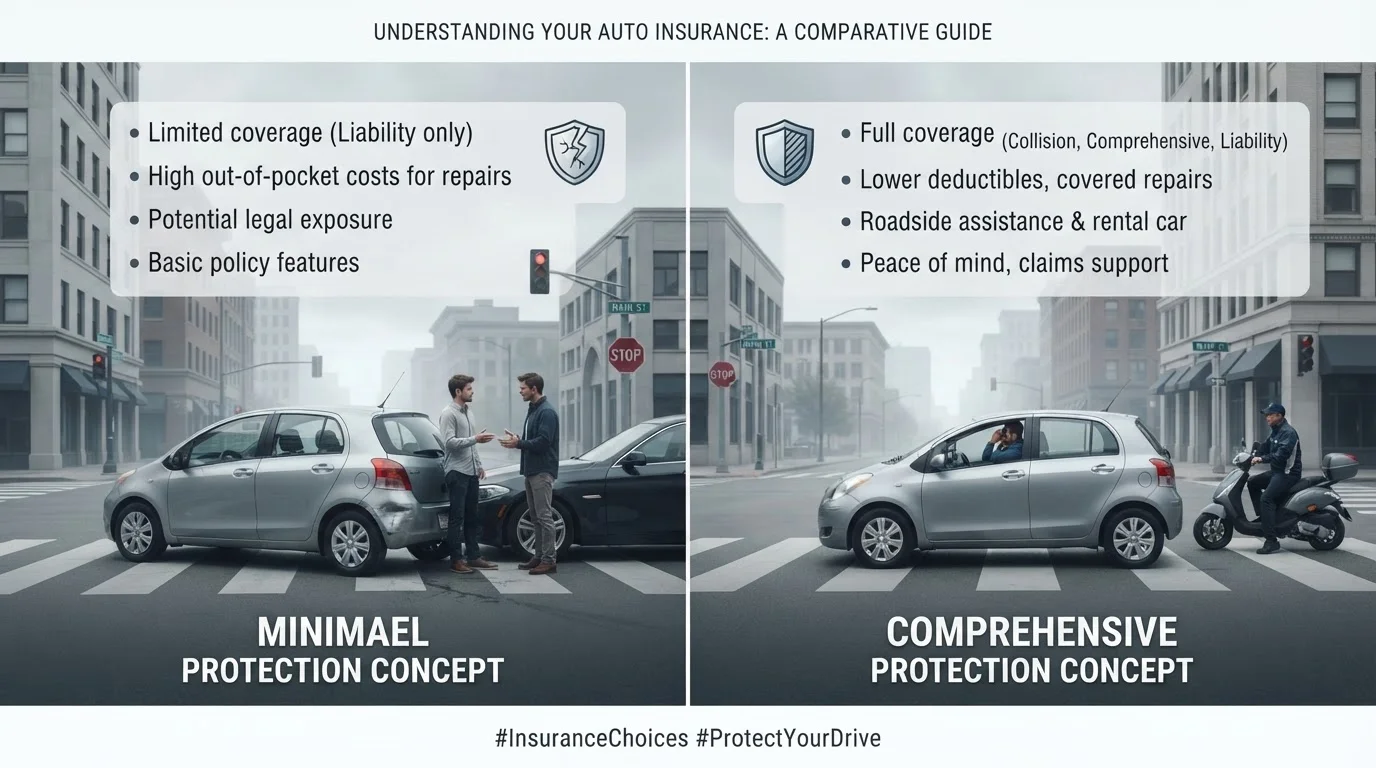
Option A
Liability Coverage
The legally required minimum in most U.S. states.
Best for: Drivers of older, lower-value vehicles who want to meet state minimums at lower premium cost.
Option B
Full Coverage
A broader protection bundle including damage to your own vehicle.
Best for: Owners of newer or financed vehicles who need protection against a wider range of loss scenarios.
If you own an older vehicle outright with low market value
Liability Coverage
When a car's value is low, the cost of adding collision and comprehensive coverage may exceed what you'd receive in a claim payout. Liability-only can be a more cost-efficient choice in this scenario.
If you are financing or leasing your vehicle
Full Coverage
Lenders and lessors almost universally require collision and comprehensive coverage to protect their financial interest in the vehicle. Dropping below full coverage could violate your loan or lease agreement.
If you drive a newer or high-value vehicle you own outright
Full Coverage
A significant repair or total-loss event on a valuable vehicle could represent a major financial setback. Full coverage limits your out-of-pocket exposure in those situations.
If budget is severely constrained and you need to meet state legal minimums
Liability Coverage
Liability coverage satisfies the legal requirement to drive in most states. However, consider whether the minimum limits are adequate for your asset-protection needs.
What Liability Coverage Actually Does
Liability auto insurance is the foundation of virtually every U.S. auto policy — and the law in most states mandates carrying at least a minimum amount. What it covers, though, is narrowly defined: the costs you cause to other people when you are at fault in an accident.
A standard liability policy breaks into two components. Bodily injury liability pays for medical expenses, lost wages, and legal costs if you injure another driver, passenger, or pedestrian. Property damage liability covers repair or replacement of another person's vehicle or property — a fence, a storefront, another car.
What liability coverage does not do is equally important: it provides no payment for your own vehicle's repair, your own medical bills, or any damage to your property. If you cause a collision and your car is totaled, you bear that cost entirely unless you carry additional coverage.
State-mandated minimums vary widely. Some states require as little as $10,000 in property damage coverage, an amount that can be exhausted quickly in a serious accident. Carrying only the minimum may satisfy the law while still exposing you to significant personal financial liability if damages exceed your policy limits. For a broader look at how policy terms and exclusions work, see what an insurance policy actually covers.
| Criterion | Liability Coverage | Full Coverage |
|---|---|---|
| Covers damage to others | Yes | Yes |
| Covers your vehicle (collision) | No | Yes |
| Covers non-collision losses (theft, weather) | No | Yes (comprehensive) |
| Typically required by law | Yes, at minimums | No (lenders may require) |
| Required for financed vehicles | No | Usually yes |
| Average annual premium | Lower | Higher |
| Best suited for vehicle age | Older, low-value cars | Newer or high-value cars |
What Full Coverage Adds to the Picture
"Full coverage" is an industry shorthand rather than a single, standardized product. It generally refers to a policy that bundles liability insurance with two additional components: collision and comprehensive coverage.
Collision coverage pays to repair or replace your vehicle after an accident, regardless of who is at fault. Whether you back into a post or are struck by another driver, collision coverage addresses damage to your own car, subject to your chosen deductible.
Comprehensive coverage handles losses unrelated to collisions — theft, vandalism, hail, flooding, fire, or hitting an animal. Together, these two coverages significantly expand the range of situations in which your insurer contributes to repairing or replacing your vehicle.
Full coverage policies may also include optional add-ons such as uninsured/underinsured motorist protection, roadside assistance, or rental reimbursement, though these vary by insurer and state. The premium for full coverage is higher than liability-only, with the difference depending on the vehicle's value, your driving history, your deductible choice, and your location.
~80%
U.S. drivers carrying more than liability-only
According to the Insurance Research Council, the majority of U.S. drivers carry collision or comprehensive coverage beyond the state-mandated liability minimum.
$13,000+
Average property damage claim cost
The Insurance Information Institute has reported average auto property damage liability claim costs consistently exceeding $13,000, illustrating why minimum limits can fall short.
Drivers who are currently financing or leasing a vehicle should note that most lenders contractually require full coverage. Failing to maintain it could trigger lender-placed insurance — typically more expensive and less favorable — or even loan default. For practical guidance on managing all aspects of vehicle ownership costs, the auto ownership hub covers related topics in depth.
How to Decide Which Level of Coverage Fits Your Situation
The decision between liability-only and full coverage hinges on a few concrete factors rather than personal preference alone.
Vehicle Value
A widely used guideline suggests that if a vehicle's current market value is low enough that annual collision and comprehensive premiums — plus your deductible — approach or exceed the vehicle's worth, dropping to liability-only may be financially reasonable. A licensed agent or an independent appraisal can help you assess this accurately.
Loan or Lease Status
If you do not own your vehicle outright, the decision may already be made for you. Review your financing agreement to confirm what coverage levels are required.
Your Financial Safety Net
Consider how you would absorb a significant unexpected loss. If replacing or repairing your car out-of-pocket would cause meaningful financial hardship, the premium cost of full coverage may be worthwhile. On the other hand, if you have substantial liquid savings dedicated to self-insuring vehicle losses, carrying higher deductibles or stepping down to liability-only on an older car is a defensible approach.
Driving Environment and Habits
High-crime areas increase theft and vandalism risk — scenarios comprehensive coverage addresses. Frequent highway driving or long commutes elevate collision exposure. These factors reasonably tilt toward broader coverage.
Liability Limits: More Than Meeting the Minimum
Even when full coverage is not warranted, carrying only your state's minimum liability limits carries its own risk. If damages from an at-fault accident exceed your policy limits, you may be personally responsible for the difference. Many financial advisers suggest evaluating higher liability limits — or an umbrella policy — as a cost-effective way to protect personal assets. A licensed insurance professional can help you determine what limits align with your net worth and risk exposure.
Whatever level of coverage you choose, periodically revisiting the decision matters. A car that justified full coverage when new may reach an age or mileage where the calculus shifts. This review also applies broadly to how you think about coverage across policy types — the principles explored in avoiding over- and under-insuring can help frame the exercise.
This article is for general informational purposes only and does not constitute personalized insurance, financial, or legal advice. Coverage options, requirements, and costs vary by state and insurer. Consult a licensed insurance agent or adviser for guidance tailored to your specific circumstances.