

Key Takeaways
The 50/30/20 Rule
The 50/30/20 rule is a budgeting framework that divides your after-tax income into three categories: 50% for needs, 30% for wants, and 20% for savings and debt repayment. It offers a simple starting point for households who want to organize their spending without tracking every individual purchase. The goal is balance - covering essentials, enjoying discretionary spending, and building financial security simultaneously.
The framework was popularized by Senator Elizabeth Warren and her daughter Amelia Warren Tyagi in their 2005 book 'All Your Worth.' It applies to net (after-tax) income, not gross income.
How the Three Categories Break Down
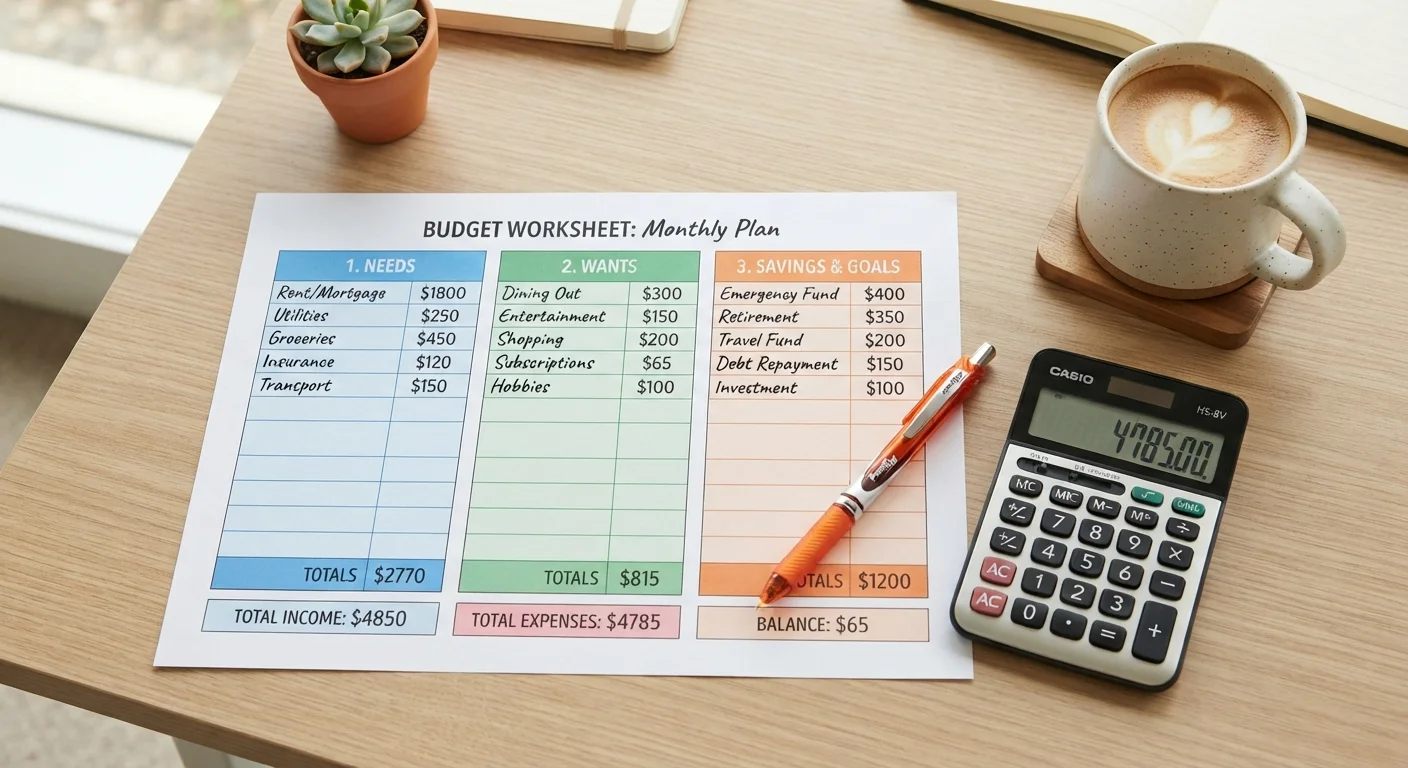
The 50/30/20 rule starts with one number: your monthly after-tax income. From that figure, every dollar is assigned to one of three buckets. Understanding what belongs in each category is the foundation for using this framework effectively.
50% - Needs
This portion covers the essential expenses required to maintain a basic standard of living. Common examples include:
- Rent or mortgage payments
- Utilities (electricity, water, gas, internet)
- Groceries and household supplies
- Health insurance premiums and required medications
- Minimum required payments on debts (credit cards, student loans, auto loans)
- Basic transportation costs (car payment, insurance, transit pass)
A helpful test: if you stopped paying this expense, would there be immediate financial or physical consequences? If yes, it is likely a need. If you want to understand these categories more precisely, our guide to common budgeting terms explains the distinction between discretionary and non-discretionary spending in plain language.
30% - Wants
Wants are discretionary expenses - spending that improves your quality of life but is not strictly necessary. This includes dining out, streaming subscriptions, gym memberships, hobbies, travel, and clothing beyond the basics. Many people underestimate how much of their budget falls into this category, which is why tracking actual spending (rather than estimating) often produces surprising results.
20% - Savings and Debt Repayment
This bucket has two purposes: building financial reserves and eliminating debt beyond the minimum required payments. Within this 20%, a common approach is to prioritize an emergency fund (typically three to six months of essential expenses), then contribute to retirement accounts, then pay down high-interest debt faster. The exact order depends on your individual circumstances - consulting a qualified financial adviser can help clarify the right sequence for your situation.
Start With One Month of Real Data
Before assigning percentages, pull together one full month of bank and credit card statements to see where your money is actually going. Most households discover their needs or wants are higher than expected. Real data makes your first 50/30/20 allocation far more accurate than estimates alone.
Applying the Rule to a Real Household Budget
To see how the framework functions in practice, consider a household with a combined monthly after-tax income of $5,000. Applying the 50/30/20 split produces these target amounts:
| Category | Percentage | Monthly Target |
|---|---|---|
| Needs | 50% | $2,500 |
| Wants | 30% | $1,500 |
| Savings / Debt Repayment | 20% | $1,000 |
These figures serve as targets, not guarantees. A household in a major metro area may find that rent alone consumes more than $2,500, pushing the needs category well above 50%. In that case, the rule is best treated as a directional guide rather than a fixed formula. Adjusting the percentages to reflect reality - while keeping savings as a non-negotiable line item - preserves the spirit of the framework.
For a more hands-on approach to setting up these categories in a workable plan, the step-by-step guide to building a monthly household budget walks through the full setup process from income listing to category assignment.
~34%
Average share of income spent on housing by US renters
According to the U.S. Census Bureau's American Community Survey, median gross rent represents approximately 34% of renter household income nationally, which can strain the 50% needs ceiling.
$1,000
Median emergency savings many households lack
Federal Reserve surveys on household economic well-being have consistently found that a significant share of US adults could not cover a $400-$1,000 unexpected expense from savings alone, underscoring why a dedicated savings bucket matters.
15%
Recommended retirement savings rate (general guideline)
Many financial planning resources, including guidance from Fidelity and Vanguard, suggest saving roughly 15% of gross income for retirement - a figure that can overlap with or exceed the 20% bucket depending on household needs.
Limitations and When to Adjust the Framework
The 50/30/20 rule works best as an entry point - a way to impose structure when there is currently none. It has real limitations that are worth acknowledging before relying on it exclusively.
“The goal of a budget is not to make you feel guilty about spending money on things you enjoy - it's to make sure you're paying yourself first and covering what truly matters.”
— Elizabeth Warren, U.S. Senator and co-author of 'All Your Worth'
Income level matters. At lower income levels, basic needs may consume 60-70% of take-home pay simply due to fixed costs like housing. Forcing a 50% ceiling on needs can create unrealistic pressure. At higher income levels, 30% allocated to wants may result in more discretionary spending than is necessary or desirable.
Life stage affects priorities. A recent graduate managing student debt has different savings objectives than a household approaching retirement. The 20% savings target may need to flex upward significantly in later career stages.
Partner dynamics add complexity. Households combining two incomes must agree on how to calculate the shared after-tax base and how to assign joint versus individual spending. Our article on navigating shared finances with a partner covers contribution models and communication strategies in detail.
Households that find the 50/30/20 rule too rigid might explore other structures. Our balanced look at the case for and against a strict monthly budget outlines when structured budgets help and when they create friction - particularly for variable-income households.
Whichever approach you use, reviewing your allocations regularly is essential. A monthly budget reset checklist can help you compare targets against actual spending each month and recalibrate before habits drift.
The 20% Bucket Covers Multiple Goals
Savings and debt repayment share the same 20% allocation, which means you may need to prioritize within this bucket. A common approach is to fund a starter emergency fund first, then maximize any employer retirement match, then tackle high-interest debt. The right order depends on interest rates, your employer's benefits, and your personal risk tolerance - a licensed financial adviser can help you sequence these decisions.
This article is for general informational and educational purposes only. It does not constitute personalized financial, investment, or tax advice. Please consult a qualified financial professional for guidance specific to your situation.