

Key Takeaways
Tailgating
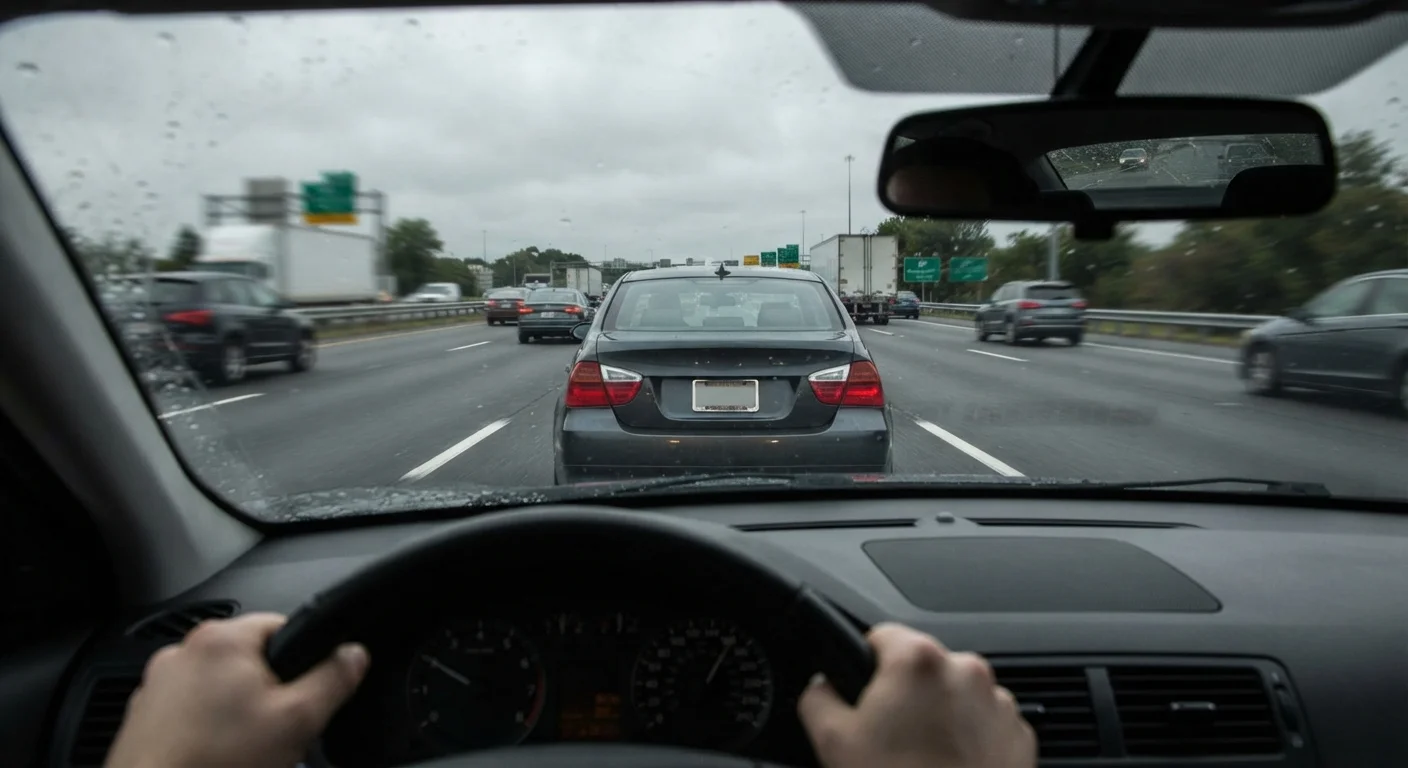
Tailgating means following another vehicle more closely than is safe given your speed, road conditions, and reaction time. It reduces the time and space you have to brake if the car ahead slows or stops suddenly. Most rear-end collisions involve at least one driver who was following too closely.
Stopping distance is the sum of reaction distance (the distance traveled before braking begins) and braking distance (the distance needed to bring the vehicle to a full stop). Both increase with speed, making adequate following distance a physics requirement, not just a courtesy.
The Physics Behind the Risk
Most drivers underestimate how much road they actually need to stop a moving vehicle. At 60 mph, a car is covering 88 feet every single second. A typical reaction time of 1.5 seconds means the vehicle travels more than 130 feet before braking even begins. Add braking distance on top of that, and a complete stop from 60 mph under ideal conditions can require well over 240 feet.
Tailgating erases that buffer. When a driver follows one or two car lengths behind at highway speed, there is simply no physical space for the sequence - perceive, decide, react, brake - to play out safely. This is not a matter of skill. It is a matter of physics that applies to every driver regardless of experience.
~29%
Of all US crashes are rear-end collisions
According to the National Highway Traffic Safety Administration (NHTSA), rear-end collisions consistently represent the largest share of police-reported crashes in the United States.
240+ ft
Stopping distance from 60 mph under ideal conditions
This figure accounts for average human reaction time plus braking distance on dry pavement; adverse conditions push the number substantially higher.
1.5 sec
Average driver perception-reaction time
Research on driver reaction times consistently places the average between 1.5 and 2.5 seconds, depending on alertness, distraction level, and visibility.
Road and weather conditions compound the problem further. Wet pavement can increase stopping distance by 50% or more. Worn brake pads, underinflated tires, or cargo loads all push that number higher. The same gap that feels adequate on a dry summer day can be dangerously short in autumn rain.
Why Drivers Tailgate - and Why It Rarely Helps
Tailgating is often less about aggression and more about impatience or inattention. A driver distracted by a phone, conversation, or fatigue may drift closer to the vehicle ahead without consciously deciding to. Others tailgate as a form of pressure - an attempt to get the car ahead to move faster or change lanes.
Neither motive produces meaningful benefit. Studies on traffic flow consistently show that aggressively closing gaps does not significantly improve travel time on congested roads. On a 30-minute commute, cutting following distance may save seconds while increasing crash risk substantially. The real safety trade-offs of driving faster apply just as clearly to following distance as they do to speed itself.
Use a Fixed Landmark to Check Your Gap
When the vehicle ahead of you passes a road sign, overpass, or shadow line, start counting: one-one-thousand, two-one-thousand. If you reach the same point before finishing the count, close the gap mentally - then physically. Make this a habit every time you drive at speed.
Tailgating can also escalate into dangerous confrontations. Drivers who feel pressured or harassed may brake-check, make erratic lane changes, or respond with aggression. Understanding how road rage develops and escalates helps explain why maintaining a calm, generous following distance benefits everyone on the road.
The Two-Second Rule - and When to Extend It
The two-second rule is the most widely taught following-distance guideline in the US. Pick a fixed object on the roadside - a sign or overpass - and count two seconds from when the vehicle ahead passes it to when yours does. If you reach that marker before two seconds are up, you are too close.
Two seconds is a minimum for ideal conditions: dry roads, good visibility, a fully alert driver in a well-maintained vehicle. Safety experts and many state driver's manuals recommend three to four seconds as a more practical baseline for everyday driving. In rain, fog, snow, or when towing, four to six seconds is more appropriate.
Following Distance Changes With Vehicle Type
Larger, heavier vehicles such as SUVs, pickups, and vehicles towing trailers require significantly more stopping distance than a standard sedan. If you drive a heavier vehicle or carry regular loads, treat the two-second rule as an absolute minimum and default to three or four seconds under normal conditions.
Building consistent following distance is one of the foundational habits of defensive driving on US roads. It gives you time to react not just to the car directly ahead, but to hazards several vehicles up the road that an alert driver can often anticipate before they become emergencies.
What to Do When You Are the One Being Tailgated
Being followed too closely creates genuine danger even when you are doing everything right. Resist the urge to brake-check or retaliate - sudden deceleration when a vehicle is close behind can cause the exact crash you are trying to avoid, and it may also create legal liability for you.
The most effective response is calm and deliberate. Gradually ease off the accelerator to widen the gap ahead of you, which gives you more room to slow gently if needed. If a lane change is safe, take it and let the tailgater pass. On a two-lane road, pulling slightly to the right and reducing speed can invite the driver behind to pass when it is legal to do so.
Tailgating, distracted driving, and other high-risk behaviors often cluster together. Staying alert to the full picture around your vehicle - not just what is immediately ahead - is what separates reactive driving from genuinely safe driving.
This article is for general informational purposes only. Always consult your state's driver's manual and follow local traffic laws for guidance specific to your situation.